which components are most vulnerable to ESD?? (switch mode power supply ics?)

Thread Starter

tsmspace

Joined Mar 16, 2026
126
I have built a large number of kits recently, probably dozens, often containing some kind of ic, often 555's for the early kits, but also little opamps, rdm5087 variants, lcd drivers, etc. over time I have also handled a number of logic ics, and always build my own computer.


I believe I have damaged a few very used ram boards with esd (an audible spark during installation followed by no longer working being my clue, and after was working before audible spark) , but never before have I damaged any component in any kit, and cpu, or any other component I've purchased.

The first time I try to build a switch mode power supply kit, I appear to have determined that two of the ic's responsible for switching to their corresponding voltages are not working. This kit is the pemenol breadboard kit: DIY Breadboard Power Supply Soldering Kit, PEMENOL Multi-Output LM2596 Power Module with 3.3V / 5V / 12V and Adjustable Output, Built-in Display and Switch for Electronics Projects, Labs and Makers - Amazon.com

12v and 5v never worked, I reflowed and reflowed to ensure good soldering, and no part is incorrectly installed. Following the voltages while on, I can trace 3.3v and var in a way that shows consistency, and on 12v I just get nothing from it ic output pin, and the same goes for the 5v (which I have also noticed gets so hot that there appears to be smoke, although it also seems a bit like an illusion. It is nevertheless very hot to the touch.)

Are these components particularly vulnerable to esd? I ate loads of pizza beforehand, which is always a bad idea if esd is a concern, you sort of don't want to be fully juiced with free carbs. I feel pretty confident at this point that the bad components are the controller ics. I am not confident that i damaged them, although I am open to the idea, I am also open to them having been damaged before, and arrived to me in the state they are in, and honestly think this is more likely.

I know that cpu's should be more fragile, but a lot of engineering has been done to protect them. In this case I am talking about lm2596-t-12 and tps5430 (esop-8) being doa (suspect) or perhaps damaged by me while soldering it all on. I did have to spend some time on the tps5430 to put those tiny pins on without bridging, although the lm2596-t-12 is a beast with huge long pins going through hole, so I did NOT heat this chip at all.

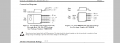
edit:::: funny .. it says right in the datasheet they have limited esd protection. hardly a smoking gun but still funnyScreenshot 2026-05-25 125624.png
 
Last edited:

MrChips

Joined Oct 2, 2009
34,882
All semiconductor devices are vulnerable to ESD.
Hence, there are standard handling procedures when manufacturing, storing, transporting, handling, assembling, all semiconductor components and assembled products.
 

Thread Starter

tsmspace

Joined Mar 16, 2026
126
All semiconductor devices are vulnerable to ESD.
Hence, there are standard handling procedures when manufacturing, storing, transporting, handling, assembling, all semiconductor components and assembled products.
right but some will be more than others. I have been extremely not careful often with lots and lots of components to no ill effect.
 

MrChips

Joined Oct 2, 2009
34,882
right but some will be more than others. I have been extremely not careful often with lots and lots of components to no ill effect.
That is a huge and dangerous misconception. Semiconductor structures can be compromised by ESD and still function properly. It could just be the origin of a catastrophic failure that results in millions of dollars in damage when the device fails out in the field.
 

WBahn

Joined Mar 31, 2012
32,930
I have built a large number of kits recently, probably dozens, often containing some kind of ic, often 555's for the early kits, but also little opamps, rdm5087 variants, lcd drivers, etc. over time I have also handled a number of logic ics, and always build my own computer.


I believe I have damaged a few very used ram boards with esd (an audible spark during installation followed by no longer working being my clue, and after was working before audible spark) , but never before have I damaged any component in any kit, and cpu, or any other component I've purchased.

The first time I try to build a switch mode power supply kit, I appear to have determined that two of the ic's responsible for switching to their corresponding voltages are not working. This kit is the pemenol breadboard kit: DIY Breadboard Power Supply Soldering Kit, PEMENOL Multi-Output LM2596 Power Module with 3.3V / 5V / 12V and Adjustable Output, Built-in Display and Switch for Electronics Projects, Labs and Makers - Amazon.com

12v and 5v never worked, I reflowed and reflowed to ensure good soldering, and no part is incorrectly installed. Following the voltages while on, I can trace 3.3v and var in a way that shows consistency, and on 12v I just get nothing from it ic output pin, and the same goes for the 5v (which I have also noticed gets so hot that there appears to be smoke, although it also seems a bit like an illusion. It is nevertheless very hot to the touch.)

Are these components particularly vulnerable to esd? I ate loads of pizza beforehand, which is always a bad idea if esd is a concern, you sort of don't want to be fully juiced with free carbs. I feel pretty confident at this point that the bad components are the controller ics. I am not confident that i damaged them, although I am open to the idea, I am also open to them having been damaged before, and arrived to me in the state they are in, and honestly think this is more likely.

I know that cpu's should be more fragile, but a lot of engineering has been done to protect them. In this case I am talking about lm2596-t-12 and tps5430 (esop-8) being doa (suspect) or perhaps damaged by me while soldering it all on. I did have to spend some time on the tps5430 to put those tiny pins on without bridging, although the lm2596-t-12 is a beast with huge long pins going through hole, so I did NOT heat this chip at all.

edit:::: funny .. it says right in the datasheet they have limited esd protection. hardly a smoking gun but still funnyView attachment 367663
First thing to keep in mind is that the answer really depends on what the intended use is. If this is for a hobby project that will be put in a draw after playing with it for a few days, then most modern ICs have sufficiently robust internal ESD protection structures that you can handle them with little care and they will stiff function adequately for that purpose. The same is largely true for doing prototype work, particularly early proof-of-concept builds. You still run the risk, however, of damaging a part so that it's characteristics change and then basing your design in part or in whole on a demo that had a non-spec'ed part in it. But if you want it to work reliably for years, then not taking proper precautions is like playing Russian roulette. It may seem like nothing bad happened, but you've taken a good portion of the life off of it and when it does fail it might fail all at once, or in a slow, degradation slide.

To get a bit more to your question, not all ESD structures are the same. Not only are there the inevitable differences from manufacturer to manufacturer -- or design team with an manufacturer, or countless other variables -- but the presence of these structures has an impact on I/O characteristics. In many cases, it doesn't matter much and so designers slap down a standard cell layout for the pad and move on. But sometimes it very much matters and the protection structure has to be very carefully designed so as to keep the negative impact of its presence within tolerable limits. This usually comes at the cost of reduced protections. Sometimes, a tolerable level of impact is only achieved with no protection structure at all, in which case breathing in to deeply or quickly when you are in the same room with the part can cause enough motion of the air to result in sufficient static charge build up to blow the chip (or at least is sure seems that way).

I would expect that the I/O pins on high-density, high-speed things like RAM chips might well involve some of these compromises, but I don't know that that's the case.
 

ThePanMan

Joined Mar 13, 2020
932
Are these components particularly vulnerable to esd? I ate loads of pizza beforehand, which is always a bad idea if esd is a concern, you sort of don't want to be fully juiced with free carbs.
What you eat has nothing to do with ESD.
some will be more (sensitive to ESD) than others. I have been extremely not careful often with lots and lots of components to no ill effect.
As @MrChips said - that's not true. One component of ESD is EOS - or - Electrical Over Stress which can damage a part but not into full failure. Having worked in the industry for decades, EOS is more of a concern than ESD. With ESD the result is a failed component which will precipitate repair of the product before it makes it out into the field. Whereas EOS can mean a component has been weakened to some degree, possibly to NEAR failure; but still pass all tests. Then one day some pilot pushes the button to launch countermeasures and that over stressed component just can no longer handle the load and fail. The pilot is about to have the worst day of his life. Just because you have not observed any ESD related failures does not mean there has been no issues. There is no way to detect EOS unless you test that component to its max rated operating parameters.

As to which components are more susceptible to ESD, the answer is more of "What voltage can damage a component?" Satellites that have to operate on extremely low current often have devices that are static sensitive down to as little as 50 volts static. Whereas your car radio, full of micro-components, may be sensitive to static voltages starting in the kilo-volt range. Where one diode can withstand 10 amps; something you'll never see in static charges, another diode can be damaged or destroyed at currents as low as 250mA of current. So it's not "Which components are more susceptible to ESD?" it's more of what practices can be employed to prevent ESD and EOS?!
 

B-JoJo-S

Joined Jan 3, 2026
350
ALL things are susceptible to ESD if the event is large enough. Remember - Lightning is an ESD event. I've seen trees blown apart from a strike. ESD events on the workbench aren't likely going to blow out a 6V capacitor, nor will it blow most resistors. But some metal film resistors can be damaged. Not necessarily blown out but compromised like @ThePanMan said. EOS.

Best practice is to work at a grounded station, one that is grounded properly. And the operator should be grounded through an approved wrist grounding strap as well. Just because you haven't observed any problems from ESD doesn't mean there haven't been any events that can weaken a component.
 
I believe I have damaged a few very used ram boards with esd (an audible spark during installation followed by no longer working being my clue, and after was working before audible spark) , but never before have I damaged any component in any kit, and cpu, or any other component I've purchased.
It is true that these ICs do not have maximum ESD protection but your design may have a fault too.
 

B-JoJo-S

Joined Jan 3, 2026
350
"transport/storge"
A good point not to be overlooked. Some people like using conductive foam for IC's and other sensitive parts for storage and transport. But the foam can cause oxidation on the leads making them difficult to solder. Some like aluminum or tin foil. Not bad. But the leads can poke through the foil and become an exposure point to static energy.

MY preferred storage and transport choice is to use a Velostat (product name) bag which is a metalized bag that can conduct static energy around a sensitive component or board without allowing any energy to pass through the part. When taking the part out of the bag working at a static safe work station the chances of an ESD event are very low. And if properly grounded, any ESD events that do occur are forced to pass through a very high resistance thus limiting the current to a very low point. As long as the bag, part, work mat and operator are kept at the same level there will be no ESD. Another way of expressing this is to say that if YOU were at 50KVs, your WORK STATION, PCB and COMPONENT are all at 50KVs then there will be no ESD event. Not until you take the board elsewhere. Then that static charge has to go somewhere. ESD is the movement of charge. Static means it's just sitting there. When it finds a path to something that is at a much lower charge (or even a negative charge) the two different levels of charge will seek to equalize. That's when damage occurs if the charge transfer is great enough. That's why you can grab a door knob on a wooden door and get that nasty snap. The door isn't grounded. The knob isn't either. But their charge level is much lower than the charge you're carrying on your body. And the human body can carry as much as 50KVs (Kilo Volts static) charge. Wearing a grounded wrist strap will drain that static to zero. Placing your part in a Velostat bag on a conductive mat will drain away any charges that may have accumulated. Taking your part out of the bag while wearing the wrist strap and on a static mat will ensure that the component is safe.
 
Top