Suggestion for an alternative operational amplifier

Kjeldgaard

Joined Apr 7, 2016
476
There are some things I can not get fit.

The LTC2203 is a relatively fast 25 Msps ADC.

In the data sheet I can not find any filter capacitors on the analogue inputs above 100 pF, most sketches have capacitors down in the 5 to 12 pF range.
 

Thread Starter

somaye2022

Joined Mar 23, 2022
100
There are some things I can not get fit.

The LTC2203 is a relatively fast 25 Msps ADC.

In the data sheet I can not find any filter capacitors on the analogue inputs above 100 pF, most sketches have capacitors down in the 5 to 12 pF range.
Thank you for your reply,
my Boss told me in between that Bandwidth is not the problem here, but I don't know the input current of the OP, even if it should be "zero".
the time constant of the protective resistor and 100nF must not be too large and the voltage drop across the R must not disturb.
 

Thread Starter

somaye2022

Joined Mar 23, 2022
100
1651244927739.png
Hello everyone,
I think I did not explain my concern well, maybe because my English is not so good.

then once again!

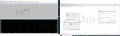
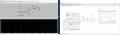
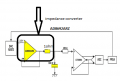
There is a block diagram as attached. and I should decide if an alternative pin to pin compatible OP (as impedance converter in the circuit )with this part number TLV342AIDR can be replaced instead of this OP with part number AD8692ARZon a big board,
that is, I must not replace the whole board if possible.

Now, my question is how could I compare these two opamp to understand that if the alternative one could do the same job with 100nF load? Because the old board has the ability to tolerate 100nF without additional way.


P.S: On the data sheet I could not find a proper comparison

best regards,
Somayeh
 
Last edited:

crutschow

Joined Mar 14, 2008
38,533
how could I compare these two opamp to understand that if the alternative one could do the same job with 100nF load?
You generally can't do that from a data sheet.
You either can check the phase-margin with a Spice simulator using a good model for the op amp. or generate a Bode plot to check the real circuit for gain and phase margin.
 

Thread Starter

somaye2022

Joined Mar 23, 2022
100
You generally can't do that from a data sheet.
You either can check the phase-margin with a Spice simulator using a good model for the op amp. or generate a Bode plot to check the real circuit for gain and phase margin.
Thank you,

but there isbt any spice model for the new One!
 

Thread Starter

somaye2022

Joined Mar 23, 2022
100
I believe there is one in Tina Spice from TI.
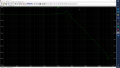
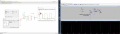
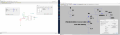
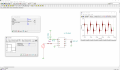
Thank you for your helpful reply. I found that OP in TINA. Now I should compare 2 OPs in two different simulators (LTspice and TINA). I simulated the TLV342 in TINA, with our requirment( step response of 100mV and offset voltage of 2.4 V ,see screenshot in uploded) and the AD8692ARZ in LTspice . how does it look? Is my simulation and comparison correct?
 

Attachments

Last edited:

crutschow

Joined Mar 14, 2008
38,533
Is my simulation and comparison correct?
Looks ok.
There is a slight peak in the both responses, just before the roll-off, which could indicate instability.
In your LTspice simulation you should use 1k for the number of Bode point, not 1m.

You should also do a transient test with a low level square-wave (e.g. 1kHz) to look at the overshoot and ringing.
 

crutschow

Joined Mar 14, 2008
38,533
Saw a possible problem.
Since you are using a single supply, you need to bias the input at about 2V when you do the AC Bode plot.
Just add 2Vdc to the source DC value.

You should also use a 1V to 2V square-wave for the transient test.

In my simulations, changing the resistor from 1Ω to 5Ω eliminated the peaking and ringing.
Unless you really need the bandwidth, the resistor should be changed, as the original was a marginal design.
Because of ringing, the op amp actually settles to the correct value faster with the 5Ω resistor, for a pulse input.
 
Last edited:

Thread Starter

somaye2022

Joined Mar 23, 2022
100
Saw a possible problem.
Since you are using a single supply, you need to bias the input at about 2V when you do the AC Bode plot.
Just add 2Vdc to the source DC value.

You should also use a 1V to 2V square-wave for the transient test.

In my simulations, changing the resistor from 1Ω to 5Ω eliminated the peaking and ringing.
Unless you really need the bandwidth, the resistor should be changed, as the original was a marginal design.
Because of ringing, the op amp actually settles to the correct value faster with the 5Ω resistor, for a pulse input.
Thank you for your help.

I think, I already add a 2,4 V dc level, didnt I?

Best regards
Somayeh
 

Thread Starter

somaye2022

Joined Mar 23, 2022
100
Saw a possible problem.
Since you are using a single supply, you need to bias the input at about 2V when you do the AC Bode plot.
Just add 2Vdc to the source DC value.

You should also use a 1V to 2V square-wave for the transient test.

In my simulations, changing the resistor from 1Ω to 5Ω eliminated the peaking and ringing.
Unless you really need the bandwidth, the resistor should be changed, as the original was a marginal design.
Because of ringing, the op amp actually settles to the correct value faster with the 5Ω resistor, for a pulse input.
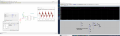
I have already done a tranisnte analysis with 200m amplitude. The alternative analysis had a big reining, I'm not sure if I did something wrong?

and even if I give 2.4V pulse amplitude it looks even more bad. And when I changed the resistor to 5 ohms, there was no such compensation. How could you do that?
By the way, what do you mean by "as the original was a marginal design"?

Could you please help me more in this regard?

thank you very much with best regards
 

Attachments

Last edited:

Thread Starter

somaye2022

Joined Mar 23, 2022
100
Hi everyone,
I was asked to find an alternative pin-to-pin compatible OP for the AD8692ARZ as an impedance converter in the circuit that has a load capacitance of 100 nF with only a 1 ohm support resistor). One suggestion for this was the TLV342AIDR.

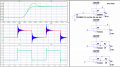
I compared these two op-amps (see screenshot) to see if the alternative amplifier could do the same job with a load of 100 nF! Because the old opamp has the ability to handle 100nF without any additional way with a pulse input of 100mV and an offset voltage of 2.4V.

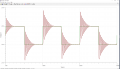
I already did a AC analyse and tranisnte analysis. The alternative analysis had a large ringing, I am not sure if I did something wrong?
and even if I give 2.4V pulse amplitude, it looks worse.

If everything is proper, could you please advise me if there is an alternative OP that can do the same job as the AD8692ARZ?


Thanks in advance


P.S: one OP is simulated in LTspice and another in Tina simulator because I didn't find both in one simulator, but i tried to set them in the same situation.


best regards,
Somayeh
 

Attachments

crutschow

Joined Mar 14, 2008
38,533
By the way, what do you mean by "as the original was a marginal design"
1 ohm is not large enough to isolate the op amp output from the capacitance, so you get the ringing you observed.

That's why you need to go to a larger resistor to eliminate the ringing and insure stability.

I don't know of any op amp that guarantees stability with that capacitive load.

You need to tell your boss that the original design was marginal (even thought it apparently worked) and the resistor value needs to be increased for stability.
I see no reason that a small increase in that resistor value will have any significant affect on the circuit operation otherwise.
The alternative analysis had a large ringing,
What's the "alternate analysis"?
 

Thread Starter

somaye2022

Joined Mar 23, 2022
100
1 ohm is not large enough to isolate the op amp output from the capacitance, so you get the ringing you observed.

That's why you need to go to a larger resistor to eliminate the ringing and insure stability.

I don't know of any op amp that guarantees stability with that capacitive load.

You need to tell your boss that the original design was marginal (even thought it apparently worked) and the resistor value needs to be increased for stability.
I see no reason that a small increase in that resistor value will have any significant affect on the circuit operation otherwise.
What's the "alternate analysis"?
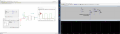
I mean OP TL342 als altenative OP, and besid that i couldnt see in my simulation a significant change in stability on the circuit with 5 Ohm Resistor(in Attachment), what is wrong with my simulation?
 

Attachments

Thread Starter

somaye2022

Joined Mar 23, 2022
100
Saw a possible problem.
Since you are using a single supply, you need to bias the input at about 2V when you do the AC Bode plot.
Just add 2Vdc to the source DC value.

You should also use a 1V to 2V square-wave for the transient test.

In my simulations, changing the resistor from 1Ω to 5Ω eliminated the peaking and ringing.
Unless you really need the bandwidth, the resistor should be changed, as the original was a marginal design.
Because of ringing, the op amp actually settles to the correct value faster with the 5Ω resistor, for a pulse input.
Could you please make me a screenshot of your simulation with and without 5Ohm?
 

crutschow

Joined Mar 14, 2008
38,533
Could you please make me a screenshot of your simulation with and without 5Ohm?
I did the Tina simulation with the TL432 and it does seem to be very sensitive to capacitive loading.
You may have to look for a different alternate that rings less in the simulation.
 
Top