Stepper motor Peak vs RMS current and choosing the correct one

Thread Starter

kiltro

Joined Oct 24, 2011
63
Hello everyone,
I read all sort of different things about setting the correct current to drive a stepper motor, so now I'm a bit confusioed.

1. The value for current that is usually given in specs is RMS?
2. To calucate the current to drive the motor we start from the RMS current? And what percentage we take, 70,%, 80% or...?

Thanks
 

meth

Joined May 21, 2016
302
I dont think you can just "set" current to the motor. I mean you can but it will not do the mechanical work as it should since the current depends of the load the motor moves.
Also, during startup the motor can draw x10 than the nominal current for a very short time, because the electrical energy has to battle the motor's physical inertia but also the opposing magnetic field.

So (if this is for a particular project and not a general question) maybe if you explain to us your setup, what motor you use and what you intend to drive maybe it would be easier to help you.
 

Thread Starter

kiltro

Joined Oct 24, 2011
63
Hi, thanks for your input!
I get that the actual current drawn by the motor varies with load and that startup transients can be much higher. However, my question is specifically about setting the current limit on stepper drivers—more precisely, on TMC2209 drivers in UART mode.

From what I understand:

  1. The current rating in motor specs is usually RMS, unless otherwise stated (e.g., "peak current"). Can you confirm this is generally the case?
  2. When configuring the driver, we start from this RMS value and apply a percentage (e.g., 70–80%) to set a safe operating current. This is common advice online, but I'm wondering if there's a more precise way to determine the ideal percentage.

Since my drivers allow me to set the current via firmware (instead of adjusting Vref manually), I just want to make sure I’m applying the correct logic when configuring my stepper motors.
 

MaxHeadRoom

Joined Jul 18, 2013
30,605
There are all kind of IC's and illustrations where a stepper motor is driven with a constant rateded current from zero RPM to it max rated RPM value.
IOW , it is up to a method used by the interface in order to maintain the motor plate rated current at all times.
e.g. In a L297 simple controller, it is easy to see how it is done.
 

MisterBill2

Joined Jan 23, 2018
27,362
A stepper motor is powered with switched DC, and usually RMS is reserved for AC circuits. And in every application where I have used steppers the current is specified, so not much math involved.
 

MaxHeadRoom

Joined Jul 18, 2013
30,605
Fortunately around the time I started using Stepper motors, there were several of the major companies that offered Printed information and means of control for their products in the form of txt book-like formats! :cool:
Nidec.
SloSyn
Oriental Motor
ElecroCraft
CMC

The previously common pair of IC's that perform the necessary signals and constant current control, were the L297/L298 pair.
Handy pair for interface directly to a micro controller PGM etc.
 

Attachments

Last edited:

Danko

Joined Nov 22, 2017
2,154
Stepper Motor Drivers
(Full text see here: https://www.orientalmotor.com/stepper-motors/technology/stepper-motor-overview.html)
There are two common systems of driving a stepper motor: constant current drive and constant voltage drive. The circuitry for the constant voltage drive is simpler, but it’s relatively more difficult to achieve torque performance at high speeds.
The constant current drive, on the other hand, is now the most commonly used drive method, since it offers excellent torque performance at high speeds. All Oriental Motor’s drivers use the constant current drive system.

Overview of the Constant Current Drive System

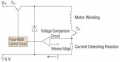
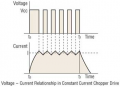
The stepper motor rotates through the sequential switching of current flowing through the windings. When the speed increases, the switching rate also becomes faster and the current rise falls behind, resulting in lost torque. The chopping of a DC voltage that is far higher than the motor’s rated voltage will ensure the rated current reaches the motor, even at higher speeds.
1740882915323.png
The current flowing to the motor windings, detected as a voltage through a current detecting resistor, is compared to the reference voltage. Current control is accomplished by holding the switching transistor Tr2 ON when the voltage across the detecting resistor is lower than the reference voltage (when it hasn’t reached the rated current), or turning Tr2 OFF when the value is higher than the reference voltage (when it exceeds the rated current), thereby providing a constant flow of rated current.
1740883040060.png
 

MaxHeadRoom

Joined Jul 18, 2013
30,605
The constant current drive, on the other hand, is now the most commonly used drive method, since it offers excellent torque performance at high speeds. All Oriental Motor’s drivers use the constant current drive system.
This is the method I described, the higher supply voltage is used in order to maintain the constant rated current as RPM and motor inductive reactance increases with switching frequency
 

MisterBill2

Joined Jan 23, 2018
27,362
The switching scheme is certainly a lot more efficient than the resistor method used back in the 1970's era. Whie it did allow higher speed torque, it was terribly inefficient.
 
Top