Step rate

Thread Starter

ronv

Joined Nov 12, 2008
3,770
I'm working with shortbus on his EDM machine which uses a stepper motor to control the ram.
The circuit I have designed could give a maximum step rate of 2500 steps per second. This would only happen continuously as the ram was moving into position but during normal operation 2 or three steps might happen at this rate. The motor will be in micro step 1/10.
The big question is can it work for 2 or 3 steps at that rate and what would happen if it can't? Will it still take 1 step or will it go bananas. I can easily change the rate but faster is better.
 

DNA Robotics

Joined Jun 13, 2014
670
If you try to step too fast, it will just sit there buzzing. I would start by testing it with 100 steps, back and forth at a slow speed and increase the speed until it stops being accurate.
 
Last edited:

cmartinez

Joined Jan 17, 2007
8,759
I'm working with shortbus on his EDM machine which uses a stepper motor to control the ram.
The circuit I have designed could give a maximum step rate of 2500 steps per second. This would only happen continuously as the ram was moving into position but during normal operation 2 or three steps might happen at this rate. The motor will be in micro step 1/10.
The big question is can it work for 2 or 3 steps at that rate and what would happen if it can't? Will it still take 1 step or will it go bananas. I can easily change the rate but faster is better.
That actually depends on the inertial load at the motor. I think you're at the very limits of a harsh start at the motor, risking a stall. Normally, with any motor, you need to ramp it up so as to avoid it from stalling. But making an acceleration curve without using an MCU ain't easy at all.
And btw, if the motor does stall... nothing will happen, it won't explode or burn up in flames or cause a major catastrophe... it will just refuse to move and sit there humming and buzzing.
 

Thread Starter

ronv

Joined Nov 12, 2008
3,770
That actually depends on the inertial load at the motor. I think you're at the very limits of a harsh start at the motor, risking a stall. Normally, with any motor, you need to ramp it up so as to avoid it from stalling. But making an acceleration curve without using an MCU ain't easy at all.
And btw, if the motor does stall... nothing will happen, it won't explode or burn up in flames or cause a major catastrophe... it will just refuse to move and sit there humming and buzzing.
I'm not so worried about it blowing up, but rather having it not move and the EDM saying move move move and nothing happening. Then it would just "hang" there. I think we could make an easy fix for it to move into the starting position by slowing it down. Most steps in actual operation would be single steps, but I'm pretty sure that at 2500 arcs per second there will be some that need 2 or 3 steps. So I guess the real problem is asking it to go from zero to about 1 rpm without a ramp? Seems like the motor spec should tell us what the maximum rate is but I guess it depends on the load and "stuff". I'm going to Google up the motor again and look some more. Care to hazard a guess on how fast it might be able to go open loop????? Surely it must be a few hundred micro steps per second??
 

cmartinez

Joined Jan 17, 2007
8,759
I'm not so worried about it blowing up, but rather having it not move and the EDM saying move move move and nothing happening. Then it would just "hang" there. I think we could make an easy fix for it to move into the starting position by slowing it down. Most steps in actual operation would be single steps, but I'm pretty sure that at 2500 arcs per second there will be some that need 2 or 3 steps. So I guess the real problem is asking it to go from zero to about 1 rpm without a ramp? Seems like the motor spec should tell us what the maximum rate is but I guess it depends on the load and "stuff". I'm going to Google up the motor again and look some more. Care to hazard a guess on how fast it might be able to go open loop????? Surely it must be a few hundred micro steps per second??
Yes, you can easily go from zero to a few hundred micro steps per second, I'd place my bets on more than 400 but not more than 1,000. Either way, I'm sure that's pretty easy for you to adjust in your design. I'd just make a small table based on changing the value of a single component. Or, maybe you could install a trimpot that could let you adjust step rate from, say, 200 steps/sec to 2,000 steps/sec. That would make things a lot easier for the user.
 

Thread Starter

ronv

Joined Nov 12, 2008
3,770
Yes, you can easily go from zero to a few hundred micro steps per second, I'd place my bets on more than 400 but not more than 1,000. Either way, I'm sure that's pretty easy for you to adjust in your design. I'd just make a small table based on changing the value of a single component. Or, maybe you could install a trimpot that could let you adjust step rate from, say, 200 steps/sec to 2,000 steps/sec. That would make things a lot easier for the user.
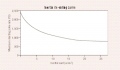
Ha, That fits with this.:D:D:D:D

Thanks C!

The maximum pulse rate for


starting a step motor depends on

the load. As more inertia is introduced

in the system, the starting

pulse rate must decrease to ensure

that the motor will not miss steps

starting and stopping. This can be

seen graphically for a typical stepper

in Figure 3 and in the following

equation

f = fs/(1 + Jl/Jo)0.5
upload_2015-6-6_19-34-19.png
 
Top