Steady DC current to Pulsating DC current

MisterBill2

Joined Jan 23, 2018
27,639
OK, with two adjustable VRs it should be possible to add current control quite simply. It will be needed to be able to add a parallel resistance to set the second current level, that might be as simple as tacking on a photo-resistor with an LED to control it.Then even a 555 timer could control the operation.
 

Thread Starter

sab201

Joined Nov 18, 2023
297
You can try inputting a signal from a signal generator to the wiper pin of the voltage control pot through a large capacitor (e.g. ≥100uµF).
The upper frequency limit will be determined by the response time of the converter.

Edit: You may have to add a resistor (start with 1kΩ) in series with the capacitor so the output doesn't oscillate.
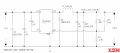
Will this 555 timer Square Wave Signal Generator be suitable.

https://www.electronicscomp.com/ne5...WFPf_6t4GoE2xeoO0ZxReyF1yl4jkx50aAs0YEALw_wcB

Max output current would be 35 mA.

So I could connect this to the wiper pin of a voltage control potentiometer. Could you please suggest the rating of the voltage control potentiometer. Provided the buck converter output should produce a square wave of max 3.5 Amps and min 1.5 Amps.

So my understanding is that I should connect the output of this voltage potentiometer to the input of the buck converter after adding the capacitor and the resistor at the places you mentioned. Please correct me if my understanding is wrong.

Thanks a lot!
 

crutschow

Joined Mar 14, 2008
38,537
So I could connect this to the wiper pin of a voltage control potentiometer. Could you please suggest the rating of the voltage control potentiometer
You would connect the 555 output to the top of the pot, the bottom of the pot to ground, and the pot wiper pin through the resistor in series with the capacitor to the wiper pin on the converter.
Try a 10kΩ pot.
 

ApacheKid

Joined Jan 12, 2015
1,762
Well, that would run too expensive!

I was looking for a cheaper alternative possible.

Besides the waveform need not be an exact sinewave, it could also be rectangular. The idea is to send pulsed current continuously through the inductor to increase the magnetic field capacity or to see how it affects the magnetic field as compared with a normal steady dc current through the inductor.

Ofcourse a programmable power supply would be perfect but that is too inefficient for this application.

Thanks all for your responses.
As BobTPH said, square, rectangular, sharp, box like signal shapes require more than you might think at first, even infinite voltages. A "perfect" square signal is not actually a single signal at all. Mathematicians long ago found that square signals are what you get when you add lots of sine signals together.

Read this, it will give you some important insights.
 

Thread Starter

sab201

Joined Nov 18, 2023
297
You would connect the 555 output to the top of the pot, the bottom of the pot to ground, and the pot wiper pin through the resistor in series with the capacitor to the wiper pin on the converter.
Try a 10kΩ pot.
Thanks. So now - should the voltage control potentiometer on the buck converter has to be soldered out completely and the wire from the capacitor soldered in to the wiper pin of buck converter voltage adjustment potentiometer on the board. Or it can be done without soldering it out from the board.

I presume the current output adjustment from buck converter is to be left untouched as with the previous current output setting of 3.5 A to the electromagnets.
 

MisterBill2

Joined Jan 23, 2018
27,639
I suggest that before hacking into an adjustment pot, that you first observe what it does, and then investigate what the voltages across the pot are as it changes either the regulated current or the regulated voltage.
OR, if not, then buy a few of those supplies for when you burn them up just hacking away.
 

Thread Starter

sab201

Joined Nov 18, 2023
297
You don't change the voltage or current pot already on the board.
Crutschow,

It has been a while and I have tried the method you suggested. I notice changes in magnetic field once the pulsed current is passed this method is a genius one considering its low cost and effectiveness. Thanks for making this possible.

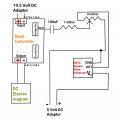
However, I connected the signal generator output to a 10 KOhm pot. Its wiper pin output to the buck converter's voltage pot through a 1 kohm resistor and 100uF capacitor as you mentioned. It worked just fine. But the problem I encountered is - damaging the signal generators. I damaged 3 of them. I suppose the most likely cause is when I accidentally switch power off to the signal generator there is a voltage at the buck converter pot which sends a reverse current through the signal generator causing damage to it.

So is it possible that I can use a diode in series with the capacitor to avoid this backflow of current? Will it work out and where would the diode be placed in the circuit. Or adding it would affect the waveform/pulsed current. Could you please suggest any possible method to protect the signal generator.

Thanks.
 

LowQCab

Joined Nov 6, 2012
5,101
What is it that You are trying to demonstrate ?
This makes no sense at all.

Apparently, You want close to a Square-Wave, for some unknown reason.
A Buck-Regulator is probably not the best way to go about this.
What You need is a high-Current-Switch, operated by an adjustable Oscillator,
and a Current-Limiter-Circuit to set the maximum Current desired.
The Voltage should remain as high as possible,
to enable producing as square a waveform as possible,
( if that's even necessary for some unknown reason ).

With the 2 Coils opposed to each other,
and in close proximity to each other, or even wound on the same Core,
it's dubious as to what will actually happen, if anything.

You have basically designed your own special kind of "Common-Mode-Choke",
it's probably not going to function as a useful "Electromagnet".

An actual picture of the "Electromagnet",
and an explanation of how it is supposed to provide useful-work,
would go a long way towards clearing-up this whole post,
and possibly producing some more useful solutions.
.
.
.
 
Last edited:

MisterBill2

Joined Jan 23, 2018
27,639
Really, That varying waveform shown in post #6 will be simple to produce at any reasonable power level, up to a few hundred watts and several hundred volts of DC.
It is the same waveform that has been used for many years to modulate AM transmitters, ranging from toys to large broadcast radio stations.
The one specially selected item will be a transformer able to handle the power required, and with adequate frequency handling capacity.

Given that we have not been given any real hint as to the desired frequency of the variation other than "what is possible", I suggest using an ordinary audio amplifier, either a borrowed PA amp or one channel of an adequately rated stereo amp, and a transformer wit an adequate power handling ability.
Given that the power supply is isolated from everything, the transformer could be replaced with a suitable single inductor, and driven in parallel with the single winding. This will be much simpler that any of the other suggested schemes, and should not damage any of the equipment utilized.
AND, damaging three signal generators is really a big deal. What sort of organization aside from a college lab has that sort of resources available??? Given that we have NO INFORMATION about the TS, I wonder.
 
Last edited:

Tonyr1084

Joined Sep 24, 2015
9,744
Voltage and current are not the same thing. You can have a high voltage and low current or a low voltage and a high current. You can have both voltage and current at either a very high value or at a very low value. From what I'm picking up it looks to me like you want a coil energized at all times. Only you want to vary the current going through it. In other words you want a strong magnetic field then a weaker magnetic field. That can be done two ways: Varying the voltage or varying the current.

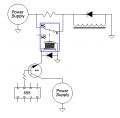
Here's what I'm thinking: A power supply powering a coil through a resistor of sufficient value and wattage to give you the 1.5 amps you want. With a relay switching ON and OFF you can bypass that resistor providing full current to the magnet. Give me 24 min's and I'll bang out a drawing.
 
Last edited:

Thread Starter

sab201

Joined Nov 18, 2023
297
AND, damaging three signal generators is really a big deal. What sort of organization aside from a college lab has that sort of resources available??? Given that we have NO INFORMATION about the TS, I wonder.
The signal generator is an N555 timer square wave generator mentioned in post #22. It costs around $ 0.5 each.
 

Tonyr1084

Joined Sep 24, 2015
9,744
Here, you will always have voltage present at the coil (magnet). The resistor will provide a voltage drop which results in a drop in current. I've not taken the time to draw out a 555 circuit, there are plenty out there to be had. This circuit will toggle the high current / low current through the coil. But you WILL be limited by how fast the relay can switch. I've not seen anything suggesting you want a high frequency, but rather PROBABLY something switching on the order of Change Of State every second or longer.

Screenshot 2024-04-16 at 8.28.44 AM.png
Output on pin 3 goes high switching the transistor on, providing current to the relay coil, pulling the C - NC contacts open, thus dropping the current the magnet sees. When pin 3 goes low the transistor shuts off and the coil drops back into its Normal Closed configuration, bypassing the resistor and allowing full current to reach the magnet.

Coils don't like change. Once a magnetic field is created the coil wants to maintain that state. When the magnetic field breaks down the coil induces a high voltage spike, which is what the diodes are used to suppress. Leaving the diodes out of the circuit means the relay contacts will see a huge spike when they open, causing arcing and burning the contacts. On the relay, the high inductive spike will likely blow the transistor out. So the diodes are necessary.

Coils are good at suppressing voltage [edit] current [end edit] spikes and dips. They take time to increase and take time to decrease their voltage levels. Thus they tend to hold a voltage and block such spikes and dips. They are similar in function to a capacitor, taking time to increase and time to decrease their voltage levels.
 
Last edited:

Tonyr1084

Joined Sep 24, 2015
9,744
Depends on the frequency you want.
This device is capable of
{quote from the link} The general use of module generates pulses from approximately 4Hz to 1.3Khz.{end quote}
Four changes of state every second. That's pretty fast for a relay. If you want to switch your magnet that fast or faster then my circuit likely won't work.
 

Thread Starter

sab201

Joined Nov 18, 2023
297
Four changes of state every second. That's pretty fast for a relay. If you want to switch your magnet that fast or faster then my circuit likely won't work.
Tonyr1084,

That's amazing, thanks a lot for taking your time to draw the circuit and all the useful technical information. I will put it into use in further course. Like you said, I like to vary the frequencies and waveforms and try to test the electromagnet under varying conditions. On that case the method suggested by Crutschow seems to work just fine.

I could use a DDS signal generator like this one which is available for around $18 and use it to "tweak" the buck conveter.

https://zbotic.in/product/dds-signa...usoidal-square-sawtooth-wave-kit-1hz-65534hz/

However your method is a straight forward one and I will also try it along the run. Also you have a complete understanding of my project. Once again, thanks for all your time and information to enlighten me and other members for responding. I am learning a lot from this forum.
 

Thread Starter

sab201

Joined Nov 18, 2023
297
The ground for the 555 generator should be connected to the buck converter ground.
Is it?
If not, that could cause the failures you observed, as large static voltages can occur between two isolated grounds.
No the ground terminal of the 555 generator is connected to the 5 Volts supply adaptor's negative terminal. I will now connect it to the buck converter supply's negative terminal. Thanks for correcting it.

So - should I use a diode inbetween the buck converter and 555 generator to prevent current flowing into the 555 generator when it goes off and voltage is present at the buck converter voltage pot wiper terminal. I am not sure about this. Please advice.
 

crutschow

Joined Mar 14, 2008
38,537
should I use a diode inbetween the buck converter and 555 generator to prevent current flowing into the 555 generator when it goes off and voltage is present at the buck converter voltage pot wiper terminal.
Not necessary.
The capacitor blocks any DC voltage from the converter.
 
Top