Steady DC current to Pulsating DC current

Thread Starter

sab201

Joined Nov 18, 2023
297
Not necessary.
The capacitor blocks any DC voltage from the converter.
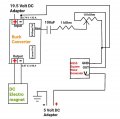
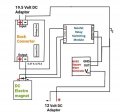
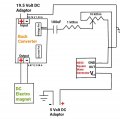
Ok Thanks for the clarification. I made the corrected circuit here. The 10 kOhm pot bottom pin and GND of the 555 generator are shorted and connected to the negative terminal of the buck converter supply adaptor.

sketch-1713290568029.jpgNext I am planning to use a DDS signal generator (instead of 555 generator) that produces sine, square, triangle waves with variable frequency range to test the electromagnet. It is more expensive so I have to be careful not to damage it.
 

Thread Starter

sab201

Joined Nov 18, 2023
297
As long as you connect all the grounds together, including the DDS generator ground, you should be okay.
The DDS signal output has two wires as opposed to a GND, Vcc and OUT pins from the 555 generator. Like you said I will connect the signal output GND wire to one common ground.
 

Thread Starter

sab201

Joined Nov 18, 2023
297
Good Day,

It has been a while and I have been using this circuit for producing pulsating current to feed it into the electromagnet.
sketch-1716530093690.jpg
But as few members pointed out, this could not be used as a standard method due to its limitations.

So now what I am proposing to do after doing some research is that I am going to give the output of the buck converter which is around 3.75 Amperes at 6.37 Volts DC to a MOSFET relay switching module.

https://robu.in/product/lr7843-mosfet-control-module-replacement-relay/

It has a trigger voltage of 3 to 5 Volts. I connect the output of the 555 timer astable mode wave generator circuit with peak value of 5 Volts OUT voltage going to the PWM pin of this Mosfet relay switching module. This Mosfet module could be used for PWM control of motors and light intensity control. So this would directly send pulsating current through the electromagnet. And ofcourse I have to use the diode for free wheeling.

sketch-1716532646354.jpg

Could this work. Because I am using a buck converter as a supply source to the Mosfet Module. The Voltage and current pots of the buck converter are set and they would provide constant current.
 
Last edited:

Thread Starter

sab201

Joined Nov 18, 2023
297
I tried the above method with the mosfet relay module. As I suspected the buck converter messed up and was showing a higher output voltage than the output voltage before it was working with. There was no output from mosfet module though the pwm signal was blinking indicating that the mosfet relay is closed. Then I decided to try with a higher rated mosfet module. It worked like a charm. At low frequency signal of 0.1 Hz, I saw the current was actually going up and down. But the current it was lower than before and at a higher output voltage of 10 Volts, before it was around 6 Volts. So I adjusted the current to 3.75 Amperes from the voltage pot of the buck converter. The electromagnet started to heat up and after a while the buck converter got damaged and it wasn't producing any output at all. May be I should try a buck converter with a higher wattage rating but still that would consume more power.

So for now I reverted back to the original method suggested by Crutschow.

Thanks.
 

Papabravo

Joined Feb 24, 2006
22,084
SMPS do not generally like load transients, and when they were first developed their transient performance was, charitably speaking, quite poor. More modern designs are better in this regard, but with a mechanical relay in the mix I have to believe that results will be sub optimal.
 

MisterBill2

Joined Jan 23, 2018
27,639
OK, I just read thru the whole thread and still I see NO HINT as to what the ultimate purpose of creating some varying magnetic field is intended to achieve. Nor really just how intense a magnetic field it needs to be to achieve whatever that undisclosed purpose may be. For producing a really solid magnetic field without needing to be conceerned about power supplies, I suggest a series string of automotive sized 12 volt batteries. The string can be slowly charged in series when not in use, and certainly it can deliver pulses of several hundred amps with no problem. The voltage can be varied in 12 volt increments by changing the tap points in the string. And a changing field intensity is simply a matter of selecting different tap points alternately. For the much higher currents at the lower pulsed rates an electro-mechanical relay will be simplest to implement. For higher rates of change high current mosfet devices may be employed.
 

Thread Starter

sab201

Joined Nov 18, 2023
297
OK, I just read thru the whole thread and still I see NO HINT as to what the ultimate purpose of creating some varying magnetic field is intended to achieve. Nor really just how intense a magnetic field it needs to be to achieve whatever that undisclosed purpose may be.
I already mentioned to you that I am building a special electromagnet/electromagnets which are long and flexible and vary their shapes to study how magnetic field behaves at various shapes. Further more I am testing the effect of this field on organic matter like plants and tissues to see its positive effects. This is the reason I want to vary the current intermittently as pulsed current at different frequencies and see its impact.

Thanks, your batterries method looks like a good idea but I am not sure if it would offer the flexibility of varying the frequency precisely.

I also understand that at higher frequencies mosfets can be employed and at lower frequencies relays can be used.
 

Thread Starter

sab201

Joined Nov 18, 2023
297
SMPS do not generally like load transients, and when they were first developed their transient performance was, charitably speaking, quite poor. More modern designs are better in this regard, but with a mechanical relay in the mix I have to believe that results will be sub optimal.
I too had the same doubts about the performance of the buck converter with an operating relay driving the output load. The buck converter uses an inductor and steps down the voltage and it does it with frequency. The transient load would definitely impact the performance of the buck converter since the load current is switched on and off at a frequency. But what I observed was performance wise it was working normal at lower current of 2.5 Amp for a few minutes at a low frequency of 0.1 Hz and I am not sure but I suppose after increasing the current value it messed up since the power went up.

Anyway I want to test it with a higher power rated buck converter or I do not know maybe someone can suggest if the right power supply module for this application is available. Only thing is I do not want to spend on a higher power buck converter and blowing it up so I am in a dilemma of keeping the usual method.

Thanks.
 

MisterBill2

Joined Jan 23, 2018
27,639
To use a buck converter with a pulsing load you will need to add a bit of capacitance across the output of the supply so that the load variations to the supply can be smoothed out. The added capacitance needs to be low "ESR" capacitors.
 

Thread Starter

sab201

Joined Nov 18, 2023
297
To use a buck converter with a pulsing load you will need to add a bit of capacitance across the output of the supply so that the load variations to the supply can be smoothed out. The added capacitance needs to be low "ESR" capacitors.
The buck converter already has two 470 uF capacitors on the input and output side of it.

Now as you suggest I could incorporate an interference suppression board with capacitors like this one:

https://roboticsdna.in/product/0-50...wer-amplifier-interference-suppression-board/
 

Thread Starter

sab201

Joined Nov 18, 2023
297
Note that significant added capacitance at the output of a switching regulator, can significantly degrade the feedback loop stability.
Yes right. Could you advice a possible optimal value of capacitance for this application. Buck converter already has 470uF capacitor.
 

MisterBill2

Joined Jan 23, 2018
27,639
OK, so add a series diode to provide isolation. And put the capacitors downstream, at the pulsing switch device . And by all means us a power suppply with adequate capacity.
 
Top