Facebook
 Google
 GitHub
 Linkedin
Hi everyone,
this is my 1st post, I hope you can help me.
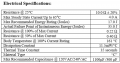
I placed a NTC thermistor for inrush current suppression in my PCB. The stady state current that flows through the themistor is about 0.4A.
The inrush current is limited as expected by my calculations and this is OK. The max load capacitance constraint is also met.
Also, according to the datasheet, the thermistor has a temperature operating range of -50 +200 °C. In my case, operating at an ambient temperature of 25 °C, it reaches 70 °C. The possible problem is that the value of the thermistor (in ohm) at steady state seems not to be costant. I guess it could be due to the fact that it exhibits a max steady state current of 2.5A that is much higher than the current flowing in my case. So, the current could not be enough to bring the thermistor value low enough -> it dissipates more power, dissipating more power the temperature rises, rising the temperature the value of the thermistor lowers -> it cools and its value rises and so on...
I would know if my supposition is right and if this behavior could damage the thermistor, even operating at higher ambient temperatures. Consider that I already took into account the decrease of the inrush current limiting effect up to an ambient temperature of 75 °C and it is enough even in this case.
Many thanks in advance.
this is my 1st post, I hope you can help me.
I placed a NTC thermistor for inrush current suppression in my PCB. The stady state current that flows through the themistor is about 0.4A.
The inrush current is limited as expected by my calculations and this is OK. The max load capacitance constraint is also met.
Also, according to the datasheet, the thermistor has a temperature operating range of -50 +200 °C. In my case, operating at an ambient temperature of 25 °C, it reaches 70 °C. The possible problem is that the value of the thermistor (in ohm) at steady state seems not to be costant. I guess it could be due to the fact that it exhibits a max steady state current of 2.5A that is much higher than the current flowing in my case. So, the current could not be enough to bring the thermistor value low enough -> it dissipates more power, dissipating more power the temperature rises, rising the temperature the value of the thermistor lowers -> it cools and its value rises and so on...
I would know if my supposition is right and if this behavior could damage the thermistor, even operating at higher ambient temperatures. Consider that I already took into account the decrease of the inrush current limiting effect up to an ambient temperature of 75 °C and it is enough even in this case.
Many thanks in advance.