Facebook
 Google
 GitHub
 Linkedin
See schematic below
This circuit is basically a coin gun (except for a different application). It uses a booster module to generate 300V DC which is used to charge up a capacitor. When a button is pressed on a remote control unit, it generates a output on a receiver module (not shown in the schematic), which is used to trigger a thyristor which dumps the charge through a coil. The capacitor then charges up again.
A problem with an earlier iteration (discussed in a previous thread) was that when the current flowed through the coil, the currents and/or voltages were so high that they destroyed the booster module. So to deal with this I put a NC relay on the input line. Now, when the button is pressed, instead of directly triggering the SCR, the signal goes to a ATTINY85, which first puts out a pulse that turns on the relay (isolating the booster module from the rest of the circuit), then another pulse to trigger the SCR.
Which works. However, because I need the operation to be near-silent, I have used a small reed relay (which can be driven directly from the ATTINY). However the relay contacts have a low current rating, and when the capacitor is charging the current inrush can be briefly 4A (possibly higher, momentarily) and this fuses the contacts together. Using a more rugged relay is not an option (because of the noise), so it seems to me I have two options:
1) Limit the inrush current with a thermistor. But I'm not quite sure how these work. From my reading it looks as though if I want to limit the current to 1A, at 300V, I need a 300 ohm thermistor, but most seem to be lower than that. Also I don't know how long they would take to reset (I need mine to reset within a few seconds). Is this a sensible way to go?
2) Use a non-physical switch instead of a relay. I would think a P channel mosfet would do the trick, but do I need one with a D-S rating of 4A and 300V? These seem rare
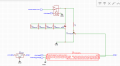
This circuit is basically a coin gun (except for a different application). It uses a booster module to generate 300V DC which is used to charge up a capacitor. When a button is pressed on a remote control unit, it generates a output on a receiver module (not shown in the schematic), which is used to trigger a thyristor which dumps the charge through a coil. The capacitor then charges up again.
A problem with an earlier iteration (discussed in a previous thread) was that when the current flowed through the coil, the currents and/or voltages were so high that they destroyed the booster module. So to deal with this I put a NC relay on the input line. Now, when the button is pressed, instead of directly triggering the SCR, the signal goes to a ATTINY85, which first puts out a pulse that turns on the relay (isolating the booster module from the rest of the circuit), then another pulse to trigger the SCR.
Which works. However, because I need the operation to be near-silent, I have used a small reed relay (which can be driven directly from the ATTINY). However the relay contacts have a low current rating, and when the capacitor is charging the current inrush can be briefly 4A (possibly higher, momentarily) and this fuses the contacts together. Using a more rugged relay is not an option (because of the noise), so it seems to me I have two options:
1) Limit the inrush current with a thermistor. But I'm not quite sure how these work. From my reading it looks as though if I want to limit the current to 1A, at 300V, I need a 300 ohm thermistor, but most seem to be lower than that. Also I don't know how long they would take to reset (I need mine to reset within a few seconds). Is this a sensible way to go?
2) Use a non-physical switch instead of a relay. I would think a P channel mosfet would do the trick, but do I need one with a D-S rating of 4A and 300V? These seem rare