State of the art mobo took a hit, how to repair such damage?

Thread Starter

highrankingofficial

Joined Nov 30, 2024
2
1000020613.jpg
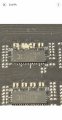
This is a threadripper Pro motherboard, about as expensive as these get, and at first glance, "I'll twist the focus on my digital microscope, and polish my favorite tweezers, and plop the smd resistors, oh crap!" What can we do here?! Run pigtails to where? That's like a dozen layers of PCB... Please let me know what to consider, or is it a lovely aluminum sculpture ready for the gold scavengers with chain mills and whatnot. My skill level is barely passable, I can confidently remove motherboard components, like the (sic) bios chip for removing locks on it, and also upgrading RAM and storage on recent Macbooks, which has me reballing like a champ, 2 tries and it worked! That is my most technical electronics repair to date. Can I handle this?
 

MisterBill2

Joined Jan 23, 2018
27,370
Certainly Tweezers and a lot of patience and very careful removal of what looks like damaged LEDs may be able to clear away the destroyed items so that a repair can be attempted.
But the serious question ids what else is damaged?? What I see is damaged LEDs, (I guess),and if the solder pads are not ripped of the PCB then a repair will be possible, for somebody with good enough soldering skill, and a fine point soldering pen. OR is there likely more damage that we do not see???
WHAT HAPPENED HERE?????
 

Thread Starter

highrankingofficial

Joined Nov 30, 2024
2
Thank you for your time and expertise. The story is indirect. I had a threadripper 3960x and Gigabyte trx40 master mobo which were both stolen.

[My custom CPU thermal management should have been a deterrent akin to sweat-stained trucker hats and missing teeth at a casting call for CNN news anchors, but my unorthodox vapor chamber and copper foam heatsinks Festooned with wind-corralling vanes and sensors had it running 18°C cooler than a $2,400 custom water cooling system, but "prototype aesthetic" was the kindest way to describe my fugly computer.]

I recently bought a threadripper pro 3995wx 64 core dream CPU for $1,200 USD. The stolen computer left me with only my phone for nearly a year. I am broke. I only need RAM and mobo to complete my personal supercomputer, since the thief(ves) spared my GPU. [I use the high throughput for molecular modelling research and deep learning AI].

I found this motherboard on EBay, at ~15% of retail, so I took a chance on it. It looked like the damaged SMD components were either resistors or capacitors, not LEDs.

My thinking was that I would learn by attempting repair, and the upside was compelling. I could win a WRX80 ASUS motherboard and be back to hunting lead compounds to sell to Big pharma. Not a bad gig, and maybe I'll have a hand in a cure for something that kills people and is presently untreatable.
 

Ya’akov

Joined Jan 27, 2019
10,226
Welcome to AAC.

Those appear to be decoupling capacitors and the carnage seems to be the result of a botched repair.

You need solder wick, tacky flux, solder, and a very fine point soldering iron. Of course you also need replacement caps—desoldering one of them will allow you to get a value.


1733645742257.png

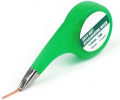
Solder Wick—here—it will absorb the blobbed solder, cleaning up the pads. The link is to a type sold in a very nice dispenser that allows you to avoid burnt fingers but raw spools are cheaper. Using some tacky flux can make it easier.

1733645793889.png

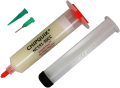
Tacky flux—here—plenty of YouTube videos on applying it. This will make replacing the caps a lot easier. The link is to a no clean flux that is very good. It is no clean, but you will want to have some IPA* on hand to clean up most of the mess. The residue will not hard the board or components, hence "no clean" but the sloppy mess will harm your sensibilities. (*Isopropanol, not beer—keep that away until you're done.)

1733645919639.png

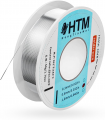
Solder—here—you want to use 63Sn/37Pb allow solder. Not lead free, which will cause you all sorts of problems. The 63Sn/37Pb alloy is eutectic which means it will have the lowest melting point of all the Sn/Pb alloys, and no plastic state. The transition from liquid to solid happens at a very specific temperature, not a range. This means it is nearly impossible to make a cold solder joint by moving the work.

1733646737140.png

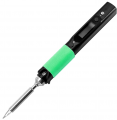
Soldering iron—here—the Pinecil is an open source iron that runs from a USB PD power supply and it a good deal. It is temperature controlled and uses readily available integral heater type tips which are far more efficient than tip-over-heater types.

There are many, many videos on PCB rework on YouTube. What you want to do is probably very basic. There doesn't appear to be any issue with the traces but but it is hard to tell from the photo. Good luck, ask any questions you encounter on the way.
 

MisterBill2

Joined Jan 23, 2018
27,370
The serious challenge is that aside from what has been explained, it is a multi layer board wit fragile plated thru holes connecting the layers. Which means pulling out those device leads may tend to remove that plated thru connection if you are not super gentle. IF you were able to solder the replacement capacitors surface mount style that could be better if you made no short circuits. AND STILL the question I see is "what else??"
 

DC_Kid

Joined Feb 25, 2008
1,242
Need a handheld reflow heater for that work. Lots of online vids on how that works. Can be repaired rather easily. You might need to practice on some old recycled stuff before working on the mobo.
 
Last edited:

Externet

Joined Nov 29, 2005
2,628
Before applying any hot iron, confirm if by the left of label 39 there is signs of beheaded components that once were present. Same by the right of label 22 and those at the top and bottom rows, and by label 18. You need to know which were/were-not populated.
Try to find a picture of a healthy equal. If obvious signs of all broke solder on pads, well, consider all to be replaced as some may not visually show damage. Typically are vulgar 0.1μF/50V decoupling capacitors. Be patiently s l o w .
 
Top