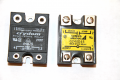
SSR TEST

Thread Starter

MattBuzzBurbank

Joined Nov 14, 2019
21
Hello, I repair espresso machines and many of them have static relays and they can go bad. I need more information on how to test them, beyond the green light indicator. So far, all the testing scenarios involve hooking it up to a lightbulb load to see if it switches. Well what GOOD does that do me in the bowels of an espresso machine? I am not about to rip out wiring and components to get to an SSR to remove it to put it up on a wooden board and do a correct Mr. Wizard test. How can I test it without REMOVING IT? Arrrghhh! Can't I use a multimeter ALONE to test the damn thing? I did try to do a voltage test across the load terminals when I activated the input terminals but there's voltage to the load terminal whether or not there's input / activating voltage. Also when I apply activating voltage, there is STILL showing no continuity across the load terminals? WHY is this? Very strange.
 
Last edited:

crutschow

Joined Mar 14, 2008
38,389
You can measure the voltage across the two output terminals.
It should be near zero volts when the SSR is ON, and equal to the supply voltage when the SSR is OFF.
Are the loads AC or DC?
 

Thread Starter

MattBuzzBurbank

Joined Nov 14, 2019
21
120V AC and so is the INPUT voltage. OK but can I test it with NO supply voltage, just activating INPUT voltage? **OK I tested it with the way you suggested and this is correct. But that assumes there is a functioning load on the SSR! That is a whole OTHER test!
 
Last edited:

Thread Starter

MattBuzzBurbank

Joined Nov 14, 2019
21
These SSR's generally switch a very high amperage load, like a heating element. And heating elements in espresso machines often fail. They can be tricky to test also because they can fail completely, partially fail and anywhere inbetween! Is there no way to test an SSR JUST using a meter by itself with no load?
 

crutschow

Joined Mar 14, 2008
38,389
Is there no way to test an SSR JUST using a meter by itself with no load?
Not with most AC type SSRs, since they use SCR's or a TRIAC to control the output AC current and need an AC voltage to be properly tested.

If you measure the AC voltage across the SSR terminal and it's near zero then, if the element is not heating, it would appear the element is faulty.

So you should be able to determine whether it's the SSR or the heater element that's bad just by measuring the voltage across the SSR output when it is commanded ON and when commanded OFF.
 

Ian0

Joined Aug 7, 2020
13,112
A SSR is a triac. When triacs fail they almost always fail short. For a quick test, remove the connections to one terminal and check for a short circuit across the two terminals. If it IS short it had definitely failed. If it's not short it's probably OK. There can be other types of failure, but they are considerably less common.

The failure will have probably been caused by an overload, and the overload caused by the breakdown of the heating element insulation.

Whilst you've got the wire off, you can check if the heating element has gone open-circuit.
 

Reloadron

Joined Jan 15, 2015
7,867
A SSR (Solid State Relay) can come along in a variety of case designs. Below are a few cube type examples.
SSR1.png
The terminals on the top are the switched terminals in series with a load. The lower terminals are the control lines where a voltage is applied to turn the SSR on and off. Some SSRs use AC control (left) and some use DC low voltage control (right). As mentioned a quick check is when the SSR is on and driving a load there should be a very little voltage drop across terminals 1 & 2. This assumes a good load (heater element). On a 120 VAC system the SSR is switching the high side of the heating element. The low side of the heating element should be connected to common of AC line mains power. Enter a potential problem. If the SCR has no control voltage it should be off but if the load is open circuit (open heater element) it's not unusual to measure 120 VAC on the load side. This is what is known as leakage. If you know the part numbers of the SSRs used in your espresso machines the data sheets will give you minimum and maximum loads and min loads are what needs to be the load for the SSR to function.

With the unit powered down and disconnected from Mains Power you should be able to test the heating element(s) with a simple resistance check. If you have a schematic of the espresso machine it should be easy to build a simple troubleshooting tree. While many parts may be buried in the bowels of the machine hopefully wires going to and from are available on accessible terminals for test purposes.

Ron
 

Reloadron

Joined Jan 15, 2015
7,867
But I bet the ones you might find in a coffee machine are triacs!
I took a look at some of today's espresso makers. Like so many of today's appliances there is the infamous "control board" which is home to of course a uC (micro-controller). Gone are a simple thermal switch for heating water or making steam. Lookiong at schematics out there it appears some use triacs and some SSRs. Doesn't matter much as when a unit calls for heat and element should make heat. This is the highly sophisticated espresso coffee maker I remember so well from my grandmother's house. I have one and it works just fine. OK, point being sans a schematic we have no clue what is used to switch the element on and off or exactly what the thread starter is looking at. :)

Ron
 

Ian0

Joined Aug 7, 2020
13,112
I took a look at some of today's espresso makers. Like so many of today's appliances there is the infamous "control board" which is home to of course a uC (micro-controller). Gone are a simple thermal switch for heating water or making steam. Lookiong at schematics out there it appears some use triacs and some SSRs. Doesn't matter much as when a unit calls for heat and element should make heat. This is the highly sophisticated espresso coffee maker I remember so well from my grandmother's house. I have one and it works just fine. OK, point being sans a schematic we have no clue what is used to switch the element on and off or exactly what the thread starter is looking at. :)

Ron
I wasn't too clear there - was I? I meant that the SSRs in coffee machines were triac-based because they were switching AC mains. Although there are DC types as @MaxHeadRoom mentioned, I doubted that they would be in coffee machines.
I have a Gaggia Cadorna which I have not had to dismantle yet despite its being over a year old. It replaced a Gaggia Classic which was all thermal-switch based with no logic beyond a mechanical switch interlock. I live in an exceptionally hard-water area so water-heating appliances don't tend to last too long without maintenance!
 

Reloadron

Joined Jan 15, 2015
7,867
I wasn't too clear there - was I? I meant that the SSRs in coffee machines were triac-based because they were switching AC mains. Although there are DC types as @MaxHeadRoom mentioned, I doubted that they would be in coffee machines.
I have a Gaggia Cadorna which I have not had to dismantle yet despite its being over a year old. It replaced a Gaggia Classic which was all thermal-switch based with no logic beyond a mechanical switch interlock. I live in an exceptionally hard-water area so water-heating appliances don't tend to last too long without maintenance!
I agree, I also assume whatever switching is used likely has a triac at the heart of it.

Ron
 

MaxHeadRoom

Joined Jul 18, 2013
30,589
I assume that 'Static' relay indicates a SSR?
Considering that they evidentially are compactly made machines and physically demanding to service, The most efficient way to improve the situation would be if they were manuf. using DC circuitry and switched devices, DC solenoids etc.
The only thing is, the OP may be out of a job!!? :oops:
 
Last edited:

Ya’akov

Joined Jan 27, 2019
10,226
Hello, I repair espresso machines and many of them have static relays and they can go bad. I need more information on how to test them, beyond the green light indicator. So far, all the testing scenarios involve hooking it up to a lightbulb load to see if it switches. Well what GOOD does that do me in the bowels of an espresso machine? I am not about to rip out wiring and components to get to an SSR to remove it to put it up on a wooden board and do a correct Mr. Wizard test. How can I test it without REMOVING IT? Arrrghhh! Can't I use a multimeter ALONE to test the damn thing? I did try to do a voltage test across the load terminals when I activated the input terminals but there's voltage to the load terminal whether or not there's input / activating voltage. Also when I apply activating voltage, there is STILL showing no continuity across the load terminals? WHY is this? Very strange.
It might be worthwhile for you to make various measurements of voltage and resistance on a few working machines in both the unpowered and normal working states. This will give you a baseline for a normal machine.

Things like the input voltage to the SSR, the output of the SSR off and on, and the resistance at the output terminals of the SSR without power applied to the machine.

Then start recording the same information when you encounter a faulty machine. Once you diagnose the problem, you should be able to correlate the measurements to certain problems.

For example, since the hearing element resistance in the off state is likely to be something on the order to 15Ω ±5Ω you should be able to tell if the SSR has failed in a dead short.

In any case, with the data you should find patterns that will give you strong indications about the failure mode.
 

Thread Starter

MattBuzzBurbank

Joined Nov 14, 2019
21
ALL good comments! Most if not all of these new home espresso machines especially the newer pricey dual boiler PROFITEC / ECM /ROCKET machines all have SSR'sas well as multiple control boxes in Italian and Arghhh are packed full of spaghetti wiring galore - just to remove an SSR or a power relay may involve tedious removal of many other components like an entire BOILER, this can be a huge hassle as many of you know, many appliances are made by mfg who don't give a damn about what's involved in the tech servicing it YOU FIGURE IT OUT PAL we're out of here with your money...
 
Top