Sound amplifier and speaker compatibility with other electronic components (Motor and LED's)

Thread Starter

Jacob1994

Joined May 11, 2021
152
Hi Guys,

I've finished all electrical aspects of my project, I'm now only down to painting and making what I hope to be a couple of improvements in the performance of the music box.

Noise
The main area I'm really hoping to improve on is the noise level of the motor, as you can hear in the videos from the link below the noise level of the motor is much louder than when I originally tested it.
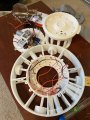
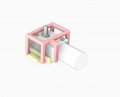
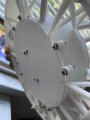
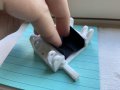
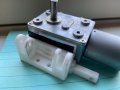
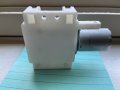
I've attached images of how the base containing the motor fixes to the underside of the box. I'm hoping the increase in noise is due to bolt and screw vibration as I've ordered rubber washers that I hope will help reduce this.
However, in the event this isn't the cause would anyone be able to suggest another possible reason for the increase in noise level and how I might address it? I have very limited options to contain the motor in anything due to wiring and height limitations.

Lighting
The final area I'm hoping will be easier to address is the flickering in the lighting when the motor is on. I'm hoping that this issue may be a case of the top piece not being perfectly level as this is something I could eventually fix. In the event it's something else I'd be unsure how to proceed and would appreciate any insights.

https://www.dropbox.com/sh/j1960c43vtcp1tl/AABtYMso5_Br7X-pxcsZTBc3a?dl=0

Many Thanks,

Jacob
 

Ya’akov

Joined Jan 27, 2019
10,356
The flickering may be the result of the slip rings not being uniform enough. Increased contact pressure and polishing the rings might help. The noise is because the motor is rigidly connected to the device which is acting as a sounding board. Shock mounting the motor should reduce it.
 

ElectricSpidey

Joined Dec 2, 2017
3,362
You might also try placing some capacitance on the receiving side of the slip rings, that may help if the flickering is not a result of interference from the motor...well it might help that as well.

It's worth a try.

And, I second what Yaakov said about the soundboard.
 

Thread Starter

Jacob1994

Joined May 11, 2021
152
The flickering may be the result of the slip rings not being uniform enough. Increased contact pressure and polishing the rings might help. The noise is because the motor is rigidly connected to the device which is acting as a sounding board. Shock mounting the motor should reduce it.
Thanks Yaakov,

Sorry for asking question upon question but how would I shock mount this?
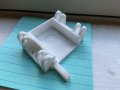
The below image is how I had to secure my motor as the mounting screws are only on the top and not bottom of the motor.
I was hoping I wouldn't have to disassemble the box as it was quite a challenge to get everything contained but if this is the only way to reduce the terribly loud noise then I am willing to give it a try. Capture34.JPG

Ok, I'll see if I can give the rings a polish. They are copper rings, I'm unsure if there is a certain material good for polishing them?
 

Thread Starter

Jacob1994

Joined May 11, 2021
152
You might also try placing some capacitance on the receiving side of the slip rings, that may help if the flickering is not a result of interference from the motor...well it might help that as well.

It's worth a try.

And, I second what Yaakov said about the soundboard.
Thanks Spidey. Sorry my technician know how is really bad here, when your saying on the receiving side of the slip rings are you meaning the side where the positive wire connects with the positively charged slip ring or am I misunderstanding?
 

Ya’akov

Joined Jan 27, 2019
10,356
You need to put something that is bad at transmitting vibrations, like foam or soft rubber between the motor and anything holding it. A closed cell foam like neoprene might work.

You can use a fine abrasive like Brasso, but be sure to clean them very thoroughly afterwards. The capacitor could help a great deal, it's an excellent idea.
 

Thread Starter

Jacob1994

Joined May 11, 2021
152
You need to put something that is bad at transmitting vibrations, like foam or soft rubber between the motor and anything holding it. A closed cell foam like neoprene might work.

You can use a fine abrasive like Brasso, but be sure to clean them very thoroughly afterwards. The capacitor could help a great deal, it's an excellent idea.
Ok, I’ll find something to use and give it a go, thanks for the guidance, I only wish I realized this problem sooner!
In the image below the motor fixing is attached to the underside of the base like so. Would adding rubber washers to these also help reduce noise in your opinion?

I’ll try and get that and will also look at using a capacitor too.Is there a particular capacitance amountI should be looking for?
 

Attachments

Thread Starter

Jacob1994

Joined May 11, 2021
152

Thread Starter

Jacob1994

Joined May 11, 2021
152
You might also try placing some capacitance on the receiving side of the slip rings, that may help if the flickering is not a result of interference from the motor...well it might help that as well.

It's worth a try.

And, I second what Yaakov said about the soundboard.
Also Spidey, just wondered is there a particular size/type of capacitor I should use?
 

ElectricSpidey

Joined Dec 2, 2017
3,362
I'm not really sure what size you would need, but I wouldn't go too big because you might risk pitting the rings. You might also want to place a small resistor in series with the cap...say 5 ohms.

Maybe start with 220uf then try larger if needed. (electrolytic)

Let me say this, a capacitor will only help with those short flickers those longer ones will definitely require a mechanical solution because a cap to eliminate those would be very large.

And, to clarify the receiving side is the side of the rings that receive the power from the supply. (the LEDs)

Good luck, I like what you have done so far. (lighted sculpture is kinda of my niche)
 

Thread Starter

Jacob1994

Joined May 11, 2021
152
I'm not really sure what size you would need, but I wouldn't go too big because you might risk pitting the rings. You might also want to place a small resistor in series with the cap...say 5 ohms.

Maybe start with 220uf then try larger if needed. (electrolytic)

Let me say this, a capacitor will only help with those short flickers those longer ones will definitely require a mechanical solution because a cap to eliminate those would be very large.

And, to clarify the receiving side is the side of the rings that receive the power from the supply. (the LEDs)

Good luck, I like what you have done so far. (lighted sculpture is kinda of my niche)
Ok, thanks so much. I’m going to try and buy a 220uf and get a couple other slightly larger Capacitors as well as a few 5ohm resistors too. I’m hoping to buy all of these together preferably from a store rather than buying in bulk from Amazon or waiting a week for pieces to arrive from digikey. (Nothing against Digikey, I just really want to get the final touches done ASAP) I don’t have access to a car right now so making a trip to a hardware store is a more difficult journey.

I see, well I’m hoping Yaakov’s suggestion of polishing the rings as well as making sure the carbon brushes are low enough to maintain enough pressure will resolve the large flickering. Hopefully your capacitor suggestion will remedy the more frequent smaller drops in light. It certainly is a good solution now I think about it!

Right, so the way I have my lighting setup at the top of the column ring doesn’t have enough space for me to have a capacitor/resistor connected directly to the LED’s, however if I understand you correctly (My apologies for my uncertainty with these topics) as long as I have the capacitor/resistor connected to my wiring above the rings where the rotation is occurring this will provide the intended function?

Thanks, it’s honestly my first time dealing with anything involving circuitry since high school, I’ve found the process to be really challenging at times but now seeing the project almost complete has really given me a sense of accomplishment. Not that I would‘ve been able to get this project to this level of functionality without your and everyone else’s incredible guidance! I can’t wait to see my wife’s reaction when I finally gift it to her as a first anniversary gift.
 

Thread Starter

Jacob1994

Joined May 11, 2021
152
I'm not really sure what size you would need, but I wouldn't go too big because you might risk pitting the rings. You might also want to place a small resistor in series with the cap...say 5 ohms.

Maybe start with 220uf then try larger if needed. (electrolytic)

Let me say this, a capacitor will only help with those short flickers those longer ones will definitely require a mechanical solution because a cap to eliminate those would be very large.

And, to clarify the receiving side is the side of the rings that receive the power from the supply. (the LEDs)

Good luck, I like what you have done so far. (lighted sculpture is kinda of my niche)
Ok I ended up ordering this from Amazon https://www.amazon.com/gp/aw/d/B07GCBSCM3?ref=ppx_pt2_mob_b_prod_image

I’ve attached a screenshot of the capacitors and resistors that come with the set if you think these will do the job?
 

Attachments

Last edited:

Thread Starter

Jacob1994

Joined May 11, 2021
152
You need to put something that is bad at transmitting vibrations, like foam or soft rubber between the motor and anything holding it. A closed cell foam like neoprene might work.

You can use a fine abrasive like Brasso, but be sure to clean them very thoroughly afterwards. The capacitor could help a great deal, it's an excellent idea.
I ended up ordering this https://www.amazon.com/gp/aw/d/B018H9CCPG?ref=ppx_pt2_mob_b_prod_image

I’m planning to cut it to shape so the motor is only touching the neoprene material. I’m also going to try cut a ring shape out of it as well so when I screw on the base to the underside there is some neoprene to hopefully further reduce any soundboard affect. Hopefully the rubber washers should also help for good measure too.

I must say I’m not looking forward to dismantling the underside but better now than later!
 

Thread Starter

Jacob1994

Joined May 11, 2021
152
Hey Yaakov / Spidey,

I was hoping for your opinions again if you don’t mind. I’ve removed the motor today to prep for the neoprene and capacitor/resistors arriving tomorrow.
After removing the motor and it’s housing I did anticipate coming into the issue, the empty space left from the motor by no means provides enough room to fit the neoprene sheets I ordered, even at 0.75mm it is too narrow a space. I did have an idea though and checked the material for shrink tube and discovered it can also be made from neoprene. Since this is much thinner I’ve been able to wrap 2 pieces of the larger shrink tube around the housing where the motor sits. Since this is much thinner I am wondering if you think it will still provide some noise absorption properties?
I do intend to try and fit the neoprene I ordered on the underside of the motor as the design allows it to be raised slightly, as well as adding a layer of neoprene sheet between the bottom of the base (see image) and the main board containing the rest of the electrical components. I’ll also wrap a ring of neoprene around the joining section where the base screws on to hopefully further reduce any vibration and soundboard affect.
sorry for the long winded description, I just mainly wondered if you guys think the shrink wrapis a good idea in the tight space of the motor housing or do you think it’s effects will be negligible?
P.S. before the shrink wrap was added the motor wasn’t a tight fix, but now it is tightly fixed.

Thanks,

Jacob
 

Attachments

Ya’akov

Joined Jan 27, 2019
10,356
Hey Yaakov / Spidey,

I was hoping for your opinions again if you don’t mind. I’ve removed the motor today to prep for the neoprene and capacitor/resistors arriving tomorrow.
After removing the motor and it’s housing I did anticipate coming into the issue, the empty space left from the motor by no means provides enough room to fit the neoprene sheets I ordered, even at 0.75mm it is too narrow a space. I did have an idea though and checked the material for shrink tube and discovered it can also be made from neoprene. Since this is much thinner I’ve been able to wrap 2 pieces of the larger shrink tube around the housing where the motor sits. Since this is much thinner I am wondering if you think it will still provide some noise absorption properties?
I do intend to try and fit the neoprene I ordered on the underside of the motor as the design allows it to be raised slightly, as well as adding a layer of neoprene sheet between the bottom of the base (see image) and the main board containing the rest of the electrical components. I’ll also wrap a ring of neoprene around the joining section where the base screws on to hopefully further reduce any vibration and soundboard affect.
sorry for the long winded description, I just mainly wondered if you guys think the shrink wrapis a good idea in the tight space of the motor housing or do you think it’s effects will be negligible?
P.S. before the shrink wrap was added the motor wasn’t a tight fix, but now it is tightly fixed.

Thanks,

Jacob
I don’t think that’s going to help. The idea is to avoid a high density connection to housing, compressed heat shrink isn‘t going to do that. Normally, vibration isolating mounts are metal studs connected with rubber.
 

Thread Starter

Jacob1994

Joined May 11, 2021
152
I don’t think that’s going to help. The idea is to avoid a high density connection to housing, compressed heat shrink isn‘t going to do that. Normally, vibration isolating mounts are metal studs connected with rubber.
Ok, do you think if the motor housing in the above images is separated by a good layer of 1.5mm neoprene with the main board it will make some difference?
If I add the shrink wrap to the inside of the motor housing so it is no longer a loose fit do you believe this would make the sound worse?
 
Top