[SOLVED] Counter IC does not count

Thread Starter

gelzky

Joined Dec 7, 2021
86
hi,
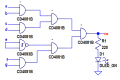
This is one method, you can work out how to make the same logic with your NAND gates.

As this is Homework, I cannot give you the final answer,
E
I actually doubted earlier if I should get the binary of 9 or just input them as is:>. Thank you so much for this, I'll make this work and I'll get back to you:>
 

djsfantasi

Joined Apr 11, 2010
9,237
If you look at the datasheet for the 4026 (particularly the timing diagrams) another solution may appear when the counter goes from 9 to 0. Or not, depending on whether the TS knows about edge detectors.
 

Thread Starter

gelzky

Joined Dec 7, 2021
86
hi,
OK.
If you can find an 8 input AND gate and use part of 7486 as an Inverter, that should get you close to the solution,
E
If you look at the datasheet for the 4026 (particularly the timing diagrams) another solution may appear when the counter goes from 9 to 0. Or not, depending on whether the TS knows about edge detectors.
Thank you sir for this information:>I'm still trying to figure out on how will I able to work this out:)
 

Thread Starter

gelzky

Joined Dec 7, 2021
86
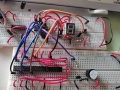
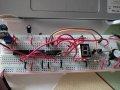
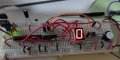
Hello. This is what I've done so far I used two input AND gates (2x), an inverter for the pin 11 (e) and connected the a-g pins on together with the vcc :> It's still not working yet, but I'm doing trials and errors:>. Maybe I'll try cascading the AND gates :>
Sorry for my messy circuit;<< I'm really having a hard time;<
 

djsfantasi

Joined Apr 11, 2010
9,237
Thank you sir for this information:>I'm still trying to figure out on how will I able to work this out:)
The 4026 has an output pin labeled Carry Out (CO). This pin will have a rising edge once the counter has cycled through 10 numbers.

This is what led me to comment on the edge detection. But it’s even easier. Use anything that is triggered on a rising edge and use its output to disable the counter and ring your buzzer. Like a toggle flip flop with reset or something that can be used to create a toggle flip flop with reset capability. Such as a D flip flop…
 

Thread Starter

gelzky

Joined Dec 7, 2021
86
Hello:> I cannot seem to find the new post but I am actually running out of time that is why I'm choosing other alternatives or options :).
 

ericgibbs

Joined Jan 29, 2010
21,442
hi g.
That's good progress.
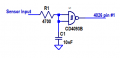
The random count could be due to the signal from the sensor being electrically noisy.
I would replace the 7486 with a CD4093 [ Schmitt input] and add a resistor /capacitor filter.

You are doing very well in your first project.:)
E
EG 1116.png
 

Thread Starter

gelzky

Joined Dec 7, 2021
86
hi g.
That's good progress.
The random count could be due to the signal from the sensor being electrically noisy.
I would replace the 7486 with a CD4093 [ Schmitt input] and add a resistor /capacitor filter.

You are doing very well in your first project.:)
E
View attachment 254851
hello:>>, thank you so much I really appreciate all your help:>. I replaced the xor gate with the schmitt and added a capacitor:) you're a genius!:)) it works fine now:>. Also, I'm still trying to figure out if I can be able to make it alarm when it reaches 9.:)
 

Attachments

Thread Starter

gelzky

Joined Dec 7, 2021
86
hi g,
Progress. !!!

See if you understand this option.

E
BTW: Using a 470 ohm and an LED can make a useful probe when checking out digital circuits.
thanks for replying :>> I'll try construct this first:) also I'm confused about the count out?
 

djsfantasi

Joined Apr 11, 2010
9,237
Thank you for all the information:> but I'm not really sure what to do on the count-out:)
The numbers from 0 to 9 take 4 bits to represent in binary. However, with 4 bits you can represent the numbers from 0 to 16. What?

The CD4026 is a special type of counter called a “decade counter”. It only counts the first 10 (decade) digits.

So what happens when it counts to 10? First, it starts over at 0. But if we want to represent the numbers from 0 to 99, we need two decade counters. And a way to count the number of “tens”. To do this, we connect two decade counters together. This connection is called “daisy chaining”.

CO, carry out or count out is used to count the numbers of tens. It is connected to the count or clock input of the second decade counter. Similarly, if we wanted to count hundreds, we’d add a third decade counter clocked by the CO of the second. And so on..,

So, in your circuit, CO indicates that the counter has counted ten numbers. 0-9.

Someone mentioned that you wanted to count to 9. I thought the original requirement was to stop after 10 pulses from the sensor. Stopping at 9 isn’t 10 pulses. It’s only 9.

If you have anymore questions, just ask.
 
Top