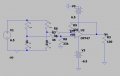
Will an OP747 source enough current to drive your 100 Ohm relay coil? Your OP747 is powered by batteries which look to be configured backwards? Have you actually run this as a simulation? Just do a Google of PT100 circuits.
Will an OP747 source enough current to drive your 100 Ohm relay coil? Your OP747 is powered by batteries which look to be configured backwards? Have you actually run this as a simulation? Just do a Google of PT100 circuits.
Will an OP747 source enough current to drive your 100 Ohm relay coil? Your OP747 is powered by batteries which look to be configured backwards? Have you actually run this as a simulation? Just do a Google of PT100 circuits.
My point was your circuit is not going to work well. You have your operational amplifier directly driving your relay coil. Your choice of using an operational amplifier is a poor choice Your circuit is designed around using a comparator which is much better suited for what you want. Your op-amp will not source enough current to drive a relay coil directly. You should use a comparator rather than an op-amp like for example an LM339. There is no need for a dual supply so no clue why that is in there. You should also have some feedback to your input + for hysteresis. The output should drive a transistor like for example a generic 2N2222 to drive the relay. All of this is why I suggested a simple Google of PT100 circuits. Even a Google of simple comparator circuits. OK, your circuit so if it does what you want then fine. I just don't see how it works? Possibly you could explain that?
My point was your circuit is not going to work well. You have your operational amplifier directly driving your relay coil. Your choice of using an operational amplifier is a poor choice Your circuit is designed around using a comparator which is much better suited for what you want. Your op-amp will not source enough current to drive a relay coil directly. You should use a comparator rather than an op-amp like for example an LM339. There is no need for a dual supply so no clue why that is in there. You should also have some feedback to your input + for hysteresis. The output should drive a transistor like for example a generic 2N2222 to drive the relay. All of this is why I suggested a simple Google of PT100 circuits. Even a Google of simple comparator circuits. OK, your circuit so if it does what you want then fine. I just don't see how it works? Possibly you could explain that?
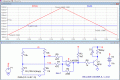
I'm sure you're absolutely right, because it shows that you know much more about the subject than I do, looking for PT100 circuits on google I haven't seen anything of the kind. I have assembled that circuit with what I have been able to see, the resistances of 60 and 20 are 2 pt100. When I submerge one of the two pt100 in nitrogen the relay turns off and when I take it out it turns on. That is why I have posted here that I had already solved it but I am 100% sure that it is not the best solution and that you must be absolutely right.
I have a video if you want.
My boss want that it need to have a button to refill analogic and a circuit to autorefill with the PT100, I have said that It shouldnt be dificult with a Arduino but she have asked me if I can do it with a own circuit.
Do u know how dificult can it be or easy solve for that or better I should do with a Arduino.
Back to the beginnings. Actually your initial thoughts and suggestions of using an Arduino or really any uC (Micro-Controller) based system was in my opinion the most sensible way to go. Today's engineering disciplines likely rely more on uC process control than designing circuits using discrete components. While for educational purposes and learning experience I can see where your supervisor may have wanted you using discrete components but for real work and commercial use I simply don't understand her request. Then too, not for me to question.
LN2 (Liquid Nitrogen has a temperature of about -196 C. (-320 F.). A PT 100 typically has a temperature range of -200 to 850 C. You don't even need that since when the PT100 probe is submerged it will be real cold and when in N2 gas above the liquid there will be a large change. All you care about is the change. A large change making it easily detected. Using discrete components a simple comparator circuit should work fine. When I mentioned PT100 circuits I seem to find dozens of circuits. Try the link. You don't really care about actual temperature. You care about sudden change. This gets tricky because if the LN2 level drops you add but less hysteresis in your design consider LN2 boils off fast and you don't want a solenoid turning On/Off chattering quickly. All I am saying is consider all the variables and believe me I worked quite a bit with LN2 during my career.
Anyway, if what you have works then that's all that matters.
Back to the beginnings. Actually your initial thoughts and suggestions of using an Arduino or really any uC (Micro-Controller) based system was in my opinion the most sensible way to go. Today's engineering disciplines likely rely more on uC process control than designing circuits using discrete components. While for educational purposes and learning experience I can see where your supervisor may have wanted you using discrete components but for real work and commercial use I simply don't understand her request. Then too, not for me to question.
LN2 (Liquid Nitrogen has a temperature of about -196 C. (-320 F.). A PT 100 typically has a temperature range of -200 to 850 C. You don't even need that since when the PT100 probe is submerged it will be real cold and when in N2 gas above the liquid there will be a large change. All you care about is the change. A large change making it easily detected. Using discrete components a simple comparator circuit should work fine. When I mentioned PT100 circuits I seem to find dozens of circuits. Try the link. You don't really care about actual temperature. You care about sudden change. This gets tricky because if the LN2 level drops you add but less hysteresis in your design consider LN2 boils off fast and you don't want a solenoid turning On/Off chattering quickly. All I am saying is consider all the variables and believe me I worked quite a bit with LN2 during my career.
Anyway, if what you have works then that's all that matters.
You have rason, first at all, I pref arduino because I can control with labview and fusion with the rest of the setup (We are going to do massive IV curves on nitrogen with labview, so I thought a pair of indicator with the arduino could be better).
Second the mayor problem is fast ON/OFF of the circuit when it is atempering.
I need the circuit fully preparated for september and I take holidays on august so, If I have time, I will buy some comparators (not bad idea to have some) and try your idea.
The problem with the circuits from google is that I see the schematic but I need testing all in ltspice.
Anyways, I dont want that you think I dont go to listen you, I will try what u said.
It isnt my only work... I need to prepare a server, prepare a machine to printer boards and all they will asking me.
Hi ericgibbs ! I have received all, just right now, I will try your circuit tomorrow. But I didnt go to have nitrogen before september because this center close in aaugust. But I will implement in a board to prepare it. Im seeing and I think I only have 1 diode xd I wait it will works . Tomorrow I post again, and thanks a lot.
Best regards!

 Facebook
 Google
 GitHub
 Linkedin