Smoker Circuit Design

Thread Starter

killivolt

Joined Jan 10, 2010
836
Grrr! I work so hard to use standard values and keep the price low, then you want to replace a 5% capacitor (44 cents) with something that's 25% off? OK. 0.5 uf will require a pot of 136k. Place 470k in parallel with the 190k pot.
Nah, I just wanted to let you know what and how close I was. Np, I'll be ordering today or just run to SLC if they have the parts.

Thanks, @#12 it's all good.

kv
 

cmartinez

Joined Jan 17, 2007
8,768
I just blew my top at a noob asking what else would fail every time anybody directed him to the right answer. I think it's time to sign off before I tell you to do the math.
:eek: ok, ok.... geeeezzzz...:oops: I'm grabbing pencil and paper even as I write this post... ... later! :D
 
Last edited:

cmartinez

Joined Jan 17, 2007
8,768
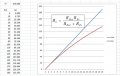
Ok... here's my math. The equivalent resistance of two resistors in parallel (ignoring their respective currents, for now) is given by Ro = (R1 x R2)/(R1 + R2)

So I graphed that equation with a 470k resistor in parallel with a 190k pot (in 10k increments) and this is what I got:

Capture.JPG

My conclusion is that although it does lose its linearity, it's not too dramatic... so it's a non-issue...
Besides, the OP has decided to get the proper parts instead of improvising, so this point has become moot.
 
Last edited:

Thread Starter

killivolt

Joined Jan 10, 2010
836
Ok... here's my math. The equivalent resistance of two resistors in parallel (ignoring their respective currents, for now) is given by Ro = (R1 x R2)/(R1 + R2)

So I graphed that equation with a 470k resistor in parallel with a 190k pot (in 10k increments) and this is what I got:


My conclusion is that although it does lose its linearity, it's not too dramatic... so it's a non-issue...
Besides, the OP has decided to get the proper parts instead of improvising, so this point has become moot.
Don't think I won't play around while I wait..........:D

Can't wait till I get home to throw some stuff on a breadboard.

kv
 

shortbus

Joined Sep 30, 2009
10,050
While the pellets seem an attractive alternative, the downside is that you practically end up marrying the pellet provider!
The pellet smoker was what was talked about earlier in the thread, so just used that as a reference to look for how they are made. That should get you guys a good idea of how the commercial one work. It seems like none of you really have a grasp on how they work. Sorry.

One of the reasons both smokers and stoves use pellets when automated is consistency. All of the pellets are of a set size, so the feeding is mostly trouble free. Using chips, unless you make them yourself they will very in size. and if you make them yourself, you might as well use chunks of wood(that's what I do). Six chunks of wood will make smoke in my cheap old Brinkman will smoke for ~5 hours, long enough to do a small turkey. The wood chunks are limb pieces around 2 inch diameter by 3 inch long.

Then comes an auger for feeding. As a metal worker/fabricator an auger is a hard thing to make. Getting one to fit in a tube and straight is a lot harder than you know. It would be easier to make a dump "bin", a piece of tube with a segment of the tube missing and a bent sheet metal divider welded in to make a bin that holds a set amount. The part of the tube that is still round keeps the chips from jamming the feeder as it dumps. Easier to draw then to explain.
 

#12

Joined Nov 30, 2010
18,224
@cmartinez
I suspect you were thinking about intentional distortion of pot curves (from linear to nearly logarithmic) accomplished by connecting a resistor of 1/10th the pot value between the wiper and one end. That's a rather strong curve. Today, we're using a resistor that is more like 1.2x the pot value, and it's not connected to the wiper.

If this was merely a pick-off point for a voltage at the wiper, the error would be zero. However, it is a current limiter, so the difference is real, and more than the guaranteed linearity of the pot. Therefore it is significant. The only saving grace is that this is a temporary mock-up of a hobby job made of scrap box parts. If you want 1% accuracy, you have to pay for the right parts.

In the end, I expect the time interval will be much better understood, the variable range will be much less, and the accuracy of the knob setting will very much resemble the expected results.

Right now, the worst error is at about 50% rotation and the ends are correct.
I get around this by measuring the performance and marking the panel to show where the real performance points are.
 

Thread Starter

killivolt

Joined Jan 10, 2010
836
I played a bit with the 555, put it on the scope with the output and obtained several different rates, the first was 33000pf cap and 470k resistor. So, I thought, I have a CD4013 not realizing all inputs run at -.5 to +.5 and burnt one out in an effort to slow the 555 down, I smoked the CD4013 with 6.71vcd to the data pin Vcc at around 9vdc. I forgot to order yesterday but, plan to order today or find out if I can get the parts locally.

University is in finals for fall and I need to get out this week and fix some stuff at the local High schools, I'll take a look at lunch today for parts hopefully.

kv
 

#12

Joined Nov 30, 2010
18,224
a CD4013 not realizing all inputs run at -.5 to +.5
Not true. The input voltage range for the CD series is equal to the power supply voltage.
They do have a power supply limit of 15 volts, so if you used the 12V transformer, you hit it with 17 volts DC.:(

We gonna have to add a voltage reducer to get that transformer down to CD4000 level, like 12V. LM7812, just a 5V zener to cut off 5 volts, a 13V zener and an NPN...something like that.
 

Thread Starter

killivolt

Joined Jan 10, 2010
836
I have a LM7812, they had all the parts, Film Capacitor .68uF, 100k pot with an external shaft, CD4020, the rest I have in spares.

I need to get the LTE and LTR from digikey or where ever. When I get back from lunch I'll have them looked up.

kv
 

Thread Starter

killivolt

Joined Jan 10, 2010
836
I did build the the one minute delay with a 100uF, and 10 minutes with the 1000uF cap. I didn't use the 1 meg wiper and it still performed.

kv
 

#12

Joined Nov 30, 2010
18,224
Remind me... is that timing equation for a whole cycle from zero to "flip" and back to "flop"?
And while we're at it, the first cycle won't be as calculated because the capacitor voltage has to rise from zero to 2/3 Vcc. After the first half cycle, the cap voltage is wandering back and forth between 1/3 Vcc and 2/3 Vcc so it takes less time.
At 10 minutes and 1000uf....545K
Congratulations on getting 10 minutes out of a 555 chip!
Now try for 25 minutes.:D 1.36 meg (calculated).
Ima 'fraid you're working on a razor's edge.

I would be dancing on the roof, but you have accomplished something that isn't reliable across time measured in years.
Cuz' that's how I roll.
A 0.68 metal film cap and a CD4020 will still clock the same 20 years from now.:cool:
 

Thread Starter

killivolt

Joined Jan 10, 2010
836
Remind me... is that timing equation for a whole cycle from zero to "flip" and back to "flop"?
Whole cycle from zero to "flip" and back to "flop"

Congratulations on getting 10 minutes out of a 555 chip!
I guess it didn't, based on my calculations it would and had someone watching it while I went to SLC to get the parts. Well, 18 minutes later and still didn't shut off, I think the leakage is to great like you said. Not reliable, but I should put a 1 meg on it to see what happens if anything while I'm waiting for parts.

I did do a 1 minute but, it drifted between 55sec and 1.06 Delay with a 23sec to 32sec OFF.

A 0.68 metal film cap and a CD4020 will still clock the same 20 years from now.:cool:
Yup, your still correct:D


I'll get to ordering the LTE and LTR tonight, I couldn't find my Hall Effect Switch either, they only had the Field Effect Sensors which are good for monitoring RPM.

kv
 

#12

Joined Nov 30, 2010
18,224
How about treating this chip loader like a windshield wiper? Auto-lock-out microswitch after 1 revolution and a short over-ride pulse to get it to start the next revolution.
 
Top