Single Feed Indicator Circuit

sghioto

Joined Dec 31, 2017
8,634
I think this will work.
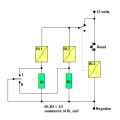
I see a problem. Lets say you operate the Right relay first. The current through the Left relay will hold the Right relay in agreed, but when the Left relay switch is actuated it shorts out the Right relay circuit and vise versa.
SG
 
Last edited:
How about two dual coil magnetic latching relays.

You can actually "steer" the pulse positive or negative to each relay to give you a pulse to continuous operation. "Steer" the positive pulse with a diode to one relay and the negative one to another.

Cancel's easy. the second coils in parallel, to whatever signal is used to cancel. +12 pulse or grounded pulse.

You won't get "auto-cancel" on power up. The signals would remain in the last state.

Magnetic latching relays are polarity sensitive. One coil is normally labeled SET and the other RESET with the polarities shown on the datasheet. A magnet is capable of holding the contacts in either position. It needs an electrical nudge "pulse" to move them.
You can flip the polarity on the SET coil and cause it to RESET.
 

sghioto

Joined Dec 31, 2017
8,634
You mean a zero ohm short?
Not in the schematic as shown but when you push the L/R switch to the "B" position to turn on the Left relay that will also short the anode of D2 to negative. If the Right relay is energized at this time it will drop out.
Same thing happens if the Left relay is energized first. Turning on the Right relay shorts the Left relay to 12volts.
SG
 

eetech00

Joined Jun 8, 2013
4,705
Not in the schematic as shown but when you push the L/R switch to the "B" position to turn on the Left relay that will also short the anode of D2 to negative. If the Right relay is energized at this time it will drop out.
Same thing happens if the Left relay is energized first. Turning on the Right relay shorts the Left relay to 12volts.
SG
I don’t see any path that “shorts” the battery.
If energizing one relay deenergizes the other by reducing current thru the coil..that’s not a problem. The path you show in post 23 actually passes thru the relay coils...

eT
 

cork_ie

Joined Oct 8, 2011
428
How do you actually intend to "Flash " these indicators? This must surely be a requirement for use on a public road. I also have serious doubts that you will get consistent holding on the relays in series as the system voltage is likely to be variable depending on RPM and other loads. Bikes rarely hold a steady 14.4 V like cars do.
I suggest you output from your switch to a very simple classB push-pull amplifier i.e a PNP and NPN transistor in series. It is literally a 5 minute job
Then use your common emmiter output to either directly switch your relays via isolating diodes or better still add a latching circuit to hold the selected relay on until you cancel.
After that it is a very simple matter to activate either the LH or RH relay and supply the B+ (30) contacts of both with a common + feed via a single conventional 49,49a flasher unit
Parts needed: 2 transistors,2 diodes 2 relays, 1 flasher unit, suitable resistors, a. few extra bits if latching
 
Last edited:

Thread Starter

themightyduc

Joined Aug 24, 2018
17
Not surprised, he's probably confused as hell right now. :D
SG
Yep. I didn't check for a while as on the back burner over Winter. I appreciate all the advice given, now not sure where to begin.

The diagrams in #16 and #17 are along the right lines. Although from what I can see they don't work for my purpose.

Arduino microcontrollers have been mentioned, would be a last resort but a sensible option. Post #28 offers some very interesting ideas about dual coil magnetic latching relays, something I think could offer the best solution. As they would allow cancellation of the opposite (R cancels L etc.).

I will attempt my own solution on the info given and report back.
 
Last edited:

Thread Starter

themightyduc

Joined Aug 24, 2018
17
Do you already have the relays?
SG
I have plenty of conventional automotive ones as above, my knowledge of what else is available is small so may hinder the simplification process. At present I am looking into twin coil latching (2 potentially achieving the same as the 6 in my diagram).
Finding appropriate versions of these is proving difficult.
 
Last edited:
Top