Single Feed Indicator Circuit

Thread Starter

themightyduc

Joined Aug 24, 2018
17
I am in a bind trying to wire some indicators. The input is singular and either +ve or -ve for L/R, it is also a momentary pulse (with a second input to cancel).There is a separate -ve feed to power the indicators. The control input cannot be altered so I have put some significant time in to figure out how to make this work with basic 12v circuitry.


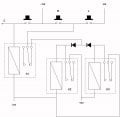
Below is my best effort so far, in theory allowing the input to activate either the top or bottom bank of relays depending on polarity and be self sustaining until cancelled by the second input (C). I was confident in the operation of this until I realised the final relays would short together (thus activating both lights), I hastily added in diodes but am not confident in this. Not sure where to go from here, I may have over complicated it, or it may be impossible. I would appreciate some advice! Alternately advice on a component / circuitry that could do the job instead, simplest / most reliable solution is best.


Ideally the L input would cancel R etc, but not essential.
 

KeithWalker

Joined Jul 10, 2017
3,604
I am in a bind trying to wire some indicators. The input is singular and either +ve or -ve for L/R, it is also a momentary pulse (with a second input to cancel).There is a separate -ve feed to power the indicators. The control input cannot be altered so I have put some significant time in to figure out how to make this work with basic 12v circuitry.


Below is my best effort so far, in theory allowing the input to activate either the top or bottom bank of relays depending on polarity and be self sustaining until cancelled by the second input (C). I was confident in the operation of this until I realised the final relays would short together (thus activating both lights), I hastily added in diodes but am not confident in this. Not sure where to go from here, I may have over complicated it, or it may be impossible. I would appreciate some advice! Alternately advice on a component / circuitry that could do the job instead, simplest / most reliable solution is best.


Ideally the L input would cancel R etc, but not essential.
I have read your question three times and do not understand what you are trying to do or exactly what you are asking. I do not understand your diagram. I assume the boxes are relays but there is nothing to indicate which are the coil and contact connections.
Can you please define the function of your circuit and identify the relay connections.
 

eetech00

Joined Jun 8, 2013
4,704
I am in a bind trying to wire some indicators. The input is singular and either +ve or -ve for L/R, it is also a momentary pulse (with a second input to cancel).There is a separate -ve feed to power the indicators. The control input cannot be altered so I have put some significant time in to figure out how to make this work with basic 12v circuitry.


Below is my best effort so far, in theory allowing the input to activate either the top or bottom bank of relays depending on polarity and be self sustaining until cancelled by the second input (C). I was confident in the operation of this until I realised the final relays would short together (thus activating both lights), I hastily added in diodes but am not confident in this. Not sure where to go from here, I may have over complicated it, or it may be impossible. I would appreciate some advice! Alternately advice on a component / circuitry that could do the job instead, simplest / most reliable solution is best.


Ideally the L input would cancel R etc, but not essential.
Hello,

It would be more helpful if you could describe the functionality your trying to obtain with the relays and indicators.
Then we could help find a solution.

Is the momentary switch a center-off switch?
Where are the indicator circuits? does each relay indicator represent the state of the relay? or are the indicators wire thru other relay contacts?
If this is automotive related, the wiring diagrams can be complex. But even showing a simplified version would help.

eT
 

Reloadron

Joined Jan 15, 2015
7,869
On the right side of your drawing the two upper and lower relays have their coils in series. I don't see how any of them can ever energize? When drawing components, using relays as an example, label them such as RY-1, RY-2 ... and the same as to the diodes D1, D2 so when people review your drawings they can comment with a reference to a component or components.

When using automotive relays keep in mind that some automotive relays have a diode across the coil. According to DIN 72552 the coil should be fed with +12V to terminal 86 and grounded via terminal 85, however in practice it makes no difference which way around they are wired, unless you are using a relay with an integrated diode (see more info on diodes below).

Finally I have no idea what you are asking? Describe in detail what it is you are trying to do? Just for example:
I am in a bind trying to wire some indicators. The input is singular and either +ve or -ve for L/R, it is also a momentary pulse (with a second input to cancel).There is a separate -ve feed to power the indicators. The control input cannot be altered so I have put some significant time in to figure out how to make this work with basic 12v circuitry.
What is the pulse duration? There are latching relays in a variety of designs which can latch and unlatch with a pulse, including those with a 12 VDC coil. Currently you have six relays and four of which will never do anything with their coils series wired.

Ron
 

Thread Starter

themightyduc

Joined Aug 24, 2018
17
I apologise if I made it confusing, I am confused myself! The diagram is a flawed example to show that I tried and failed (very much an amateur), and a request for help.

Basic principle, the indicator controls (motorcycle) are three momentary buttons , Left, Right and Cancel. The left and right buttons, share one output wire. For left it sends a positive pulse, for right it sends a negative pulse. Cancel is a separate wire. With this, I need to activate and cancel two separate indicator circuits (not shown as not relevant, they only need making or breaking).

I assume the boxes are relays but there is nothing to indicate which are the coil and contact connections.
Can you please define the function of your circuit and identify the relay connections.
Yes the boxes are automotive relays. This is standard formatting for these, thank you be80be for the detail. I hope this post will help to explain.

It would be more helpful if you could describe the functionality your trying to obtain with the relays and indicators.
Then we could help find a solution.
eT
Below is a wiring diagram with the relevant controls highlighted, wire 2 and 3 are the outputs we have to work with. The other relevant wires are 1 (negative feed) and 4 (positive feed). If we strip it to the basics, I need wire 2 to activate the L or R lighting circuit depending on pulse polarity, and to keep it activated until a pulse from wire 3.

Context: The operation I am trying to create is identical to the original factory operation, these wires previously went to an ecu that is no longer present and are instead being wired directly to the lighting circuit.


On the right side of your drawing the two upper and lower relays have their coils in series. I don't see how any of them can ever energize?
Ron
I realise it was flawed, hence the request for help. I will try to explain my logic.

If we number the relays 1 to 6 clockwise, the intention was that a positive pulse would activate relay 2, as it is grounded. Relay 1 would then sustain this positive feed and keeping relay 3 in operation (the indicators flashing).

A negative pulse would activate relay 5, as it has a positive feed to the opposite side, and the bottom bank would work identical to above for the alternate side. The cancel input would then cut the feed to relay 2 and 4, turning off the indicators. This I was confident in, the problem is yes, those relays are in series and what I was referencing in my first post. These would short (are in series) so I added the diodes as a hypothetical solution. As I said, not confident with this addition, and was hoping for a better suggestion.

Finally I have no idea what you are asking? Describe in detail what it is you are trying to do? Just for example:

What is the pulse duration? There are latching relays in a variety of designs which can latch and unlatch with a pulse, including those with a 12 VDC coil.
Ron
I have tried to clarify above, any further info needed please ask. Pulse duration is a momentary switch. I am aware there are a number of relays, circuit boards and components on the market that may be of use, but I don't know what I'm looking for. Bistable relays for example may be of use, but I need a plan of how to integrate them.

In conclusion I need either:
A solution to connect relay 2 and 4 out of series and retain the functionality.
An improved circuit design.
A recommendation for a component / logic board that can achieve the same result.

Any further questions please ask, I really appreciate any advice. I have tried to research and solve it myself but got nowhere!
 
Last edited:

KeithWalker

Joined Jul 10, 2017
3,604
I apologise if I made it confusing, I am confused myself! The diagram is a flawed example to show that I tried and failed (very much an amateur), and a request for help.

Basic principle, the indicator controls (motorcycle) are three momentary buttons , Left, Right and Cancel. The left and right buttons, share one output wire. For left it sends a positive pulse, for right it sends a negative pulse. Cancel is a separate wire. With this, I need to activate and cancel two separate indicator circuits (not shown as not relevant, they only need making or breaking).


Yes the boxes are automotive relays. This is standard formatting for these, thank you be80be for the detail. I hope this post will help to explain.


Below is a wiring diagram with the relevant controls highlighted, wire 2 and 3 are the outputs we have to work with. The other relevant wires are 1 (negative feed) and 4 (positive feed). If we strip it to the basics, I need wire 2 to activate the L or R lighting circuit depending on pulse polarity, and to keep it activated until a pulse from wire 3.

Context: The operation I am trying to create is identical to the original factory operation, these wires previously went to an ecu that is no longer present and are instead being wired directly to the lighting circuit.


I realise it was flawed, hence the request for help. I will try to explain my logic.

If we number the relays 1 to 6 clockwise, the intention was that a positive pulse would activate relay 2, as it is grounded. Relay 1 would then sustain this positive feed and keeping relay 3 in operation (the indicators flashing).

A negative pulse would activate relay 5, as it has a positive feed to the opposite side, and the bottom bank would work identical to above for the alternate side. The cancel input would then cut the feed to relay 2 and 4, turning off the indicators. This I was confident in, the problem is yes, those relays are in series and what I was referencing in my first post. These would short (are in series) so I added the diodes as a hypothetical solution. As I said, not confident with this addition, and was hoping for a better suggestion.


I have tried to clarify above, any further info needed please ask. Pulse duration is a momentary switch. I am aware there are a number of relays, circuit boards and components on the market that may be of use, but I don't know what I'm looking for. Bistable relays for example may be of use, but I need a plan of how to integrate them.

In conclusion I need either:
A solution to connect relay 2 and 4 out of series and retain the functionality.
An improved circuit design.
A recommendation for a component / logic board that can achieve the same result.

Any further questions please ask, I really appreciate any advice. I have tried to research and solve it myself but got nowhere!
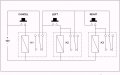
Now we know what you are trying to do! Let's keep it simple: You can take your indicator outputs from across the coils of K1 and K2.
TurnSignal.jpg
 

Reloadron

Joined Jan 15, 2015
7,869
Now, knowing what you want to do I would think about either using a type of latching relay or even going with a simple uC (Micro Controller) type circuit. Using a half dozen automotive relays to handle a Left, Right and Cancel turn signal affair is not really the simple way to go to handle turn signals on a motorcycle. The biggest benefit of using a uC is you can cancel or have auto off. You can handle just about any scenario using relatively simple code samples found online. I would think about a uC route using any of several readily available micro controllers or if you want relays use latching type designs with 12 volt coils.

Ron
 

KeithWalker

Joined Jul 10, 2017
3,604
This is the principle I started with, I cannot alter the control wiring however! The wiring diagram in my previous post shows how the switches are wired, I have drawn it out below. How could I integrate it with this?

If that is a single 12 volt battery in your diagram, you can short it out it by pressing the left and right buttons at the same time. I would hope that it is a centre biased rocker switch.
Please describe in detail what you want the circuit to do.
 

Thread Starter

themightyduc

Joined Aug 24, 2018
17
Now, knowing what you want to do I would think about either using a type of latching relay or even going with a simple uC (Micro Controller) type circuit. Using a half dozen automotive relays to handle a Left, Right and Cancel turn signal affair is not really the simple way to go to handle turn signals on a motorcycle.
Ron
I agree with you that it isn't elegant, I was working with the resources I had and focusing on reliability. A micro controller system sounds interesting, allowing programming etc. I will look into this. Any recommendations or links for these is welcome.

If that is a single 12 volt battery in your diagram, you can short it out it by pressing the left and right buttons at the same time. I would hope that it is a centre biased rocker switch.
Please describe in detail what you want the circuit to do.
Yes it is a centre bias rocker, as pictured below. My first effort on realising the situation was to rewire the switch, this proved a dead end. The wires could be shuffled but the switch has four terminals in the above order whichever way, so no resolution there (swapping the controls is also not an option).


KeithWalker

Joined Jul 10, 2017
3,604
I agree with you that it isn't elegant, I was working with the resources I had and focusing on reliability. A micro controller system sounds interesting, allowing programming etc. I will look into this. Any recommendations or links for these is welcome.


Yes it is a centre bias rocker, as pictured below. My first effort on realising the situation was to rewire the switch, this proved a dead end. The wires could be shuffled but the switch has four terminals in the above order whichever way, so no resolution there (swapping the controls is also not an option).

So, once again, what is the sequence of events that you want to happen as you push each button?
 

Thread Starter

themightyduc

Joined Aug 24, 2018
17
So, once again, what is the sequence of events that you want to happen as you push each button?
As labelled simply.

Press left, activate and hold the left indicator circuit.
Press right, activate and hold the right indicator circuit.
Press the grey button (C), disable both indicator circuits.

Sounds simple enough, the shared wire for L/R is the challenge.
 

KeithWalker

Joined Jul 10, 2017
3,604
As labelled simply.

Press left, activate and hold the left indicator circuit.
Press right, activate and hold the right indicator circuit.
Press the grey button (C), disable both indicator circuits.

Sounds simple enough, the shared wire for L/R is the challenge.
It does sound simple, but not knowing what your indicator unit inputs should be makes it an impossible task. Are the indicator units expecting a temporary or steady contact closure or a temporary or steady voltage change when a button is pushed?
 

Thread Starter

themightyduc

Joined Aug 24, 2018
17
It does sound simple, but not knowing what your indicator unit inputs should be makes it an impossible task. Are the indicator units expecting a temporary or steady contact closure or a temporary or steady voltage change when a button is pushed?
I think I see what you are saying, but you may be over complicating it. I'll try to answer all interpretations:
The indicator control will be an inconsistent contact, as done by hand, 1 second roughly.
The indicator circuit itself requires sustained contact closure at any speed, it is not sensitive to closure speed or voltage change.
The indicator circuit is negative feed (best seen in relay 3/4 in original diagram).

Remember this is part of a much larger circuit for the vehicle, complete with fuses and a voltage regulator/rectifier.
Hope this is sufficient.
 

KeithWalker

Joined Jul 10, 2017
3,604
This may do what you want. K2 will latch when the left button pressed and K3 will latch when the right button is pressed. They will unlatch when the clear button is pressed. I don't know what your turn signals need to activate them so I don;t know where you should take your outputs from on this circuit.
Flasher.jpg
 

eetech00

Joined Jun 8, 2013
4,704
Hello

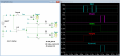
I think this will work. The graph below shows the state of each relay.
I believe each of the left and right relays will have enough holding current to remain energized after pick-up without energizing the opposite relay. So to cancel, just need to open the current loop by pressing "Cancel".

eT

upload_2019-2-24_12-4-27.png
 
Last edited:

KeithWalker

Joined Jul 10, 2017
3,604
Hello

I think this will work. The graph below shows the state of each relay.
I believe each of the left and right relays will have enough holding current to remain energized after pick-up without energizing the opposite relay. So to cancel, just need to open the current loop by pressing "Cancel".

eT

View attachment 170895
Almost the same circuit, different presentation. Great minds think alike!
 

Reloadron

Joined Jan 15, 2015
7,869
Looking back at your post #11 I see the Right and Left but no Cancel? Now I assume you get a pulse for Right, Left and Cancel for a duration of the switch press. Looking at the relay suggestions (Post 16 & 17) the Cancel relies on a N/C (Normally Closed) push button which opens when pressed. Would that be what you have?

Being slightly retro my current ride is a '92 Harley Electroglide and as early as '92 the turn signals are an independent module. I bump Right or Left and the turn signal starts. If I bump either again or change direction they Cancel or automatically take the direction change. If I do not brake they self cancel based on distance traveled. All here nor there for your bike.

I suggested a uC as everything, like relays, can be modular. As to a uC a Google of "Arduino motorcycle turn signals" will bring up plenty of hits but just about any uC can be used. Rather than relays driving the bulbs (or LEDs) I would consider using a few everyday MOSFETs (let a transistor switch drive the lamps). You can pretty much have whatever you want including auto cancel.

Run with whatever is easier for you and ride safe.

Ron
 
Top