Should be 12 volts.
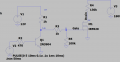
Check the resistor values of R1, R3 and R5.
If OK remove the transistor or disconnect the collector and measure the gate voltage which should be appx 12volts.
If not then the mosfet is defective.
I wonder how that could have happened? Both components were brand new and there is still a failure. Mabye there was a power surge somewhere or spike that blew out these components.
I do have a D44VH10 NPN transistor that I could try to work into the circuit to toggle the IN-3 tube if the voltage rating is high enough. It came from my attempt at making my own HV supply for the nixie tubes, turned out it was too inefficient under load.
Driving a Nixie tube does not require a device rated as high as the supply, because there is a breakover voltage for the tube. You can drive Nixie tubes with TI's TPIC6B595.
Driving a Nixie tube does not require a device rated as high as the supply, because there is a breakover voltage for the tube. You can drive Nixie tubes with TI's TPIC6B595.
Driving a Nixie tube does not require a device rated as high as the supply, because there is a breakover voltage for the tube. You can drive Nixie tubes with TI's TPIC6B595.
Your processor output will have enough current to drive a nixie tube. Have you considered driving it common base? Use a high voltage small signal transistor. Base to 5V or 3.3V. Current limiting resistor between emitter and gate output.
Your processor output will have enough current to drive a nixie tube. Have you considered driving it common base? Use a high voltage small signal transistor. Base to 5V or 3.3V. Current limiting resistor between emitter and gate output.
I’ve never considered that. I just assumed that a MOSFET would be the best option for switching since there was high voltage present. I did put in an order for more MOSFETS so I’ll likely keep with that, especially since the PCB I made for the clock uses a circuit like the one listed.

 Facebook
 Google
 GitHub
 Linkedin