Simplest way to observe resonant frequency

Thread Starter

Tutor88

Joined Feb 8, 2023
306
I did this with real components that I have on hand, L = 22 μH, C = 10 nF.
I had no problem finding a maximum amplitude at the resonance frequency of 340 kHz.
Function generator sinewave output is 1 V amplitude with 600 Ω output impedance.

Make sure that the triggering on the oscilloscope is setup properly.
When you say triggering do you mean connecting the signal generator output to the external trigger input on the scope?
 

MrChips

Joined Oct 2, 2009
34,892
When you say triggering do you mean connecting the signal generator output to the external trigger input on the scope?
No.
There are three important sections of an oscilloscope.
1) Input amplifiers that control the Y-axis, vertical voltage scale, VOLTS/DIV
2) Time sweep generator that controls the X-axis, horizontal time scale, TIME/DIV
3) Trigger control that determines when the oscilloscope will capture the waveform

You need to become a master user of all functions of the oscilloscope. In particular, you need to know how to set up and adjust all the functions of the trigger section.

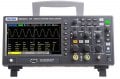
Post a photograph of your oscilloscope so that we can see the make and model, and the control panel.
 

Thread Starter

Tutor88

Joined Feb 8, 2023
306
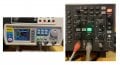
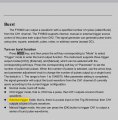
I have attached a picture of my two devices. I have not found a suitable output from the signal generator to use as a trigger input for the scope. There is a burst feature on it (see attached), but I doubt that it can be useful here. Using CH2, set to an identical frequency, in the hope that it is synchronous and tied to CH1, also fails according to some.

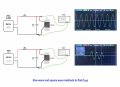
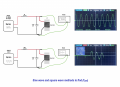
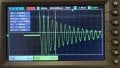
Despite this complication in using an external trigger, my second attempt to see resonance via the maximum amplitude method worked, so possibly due to a better earthing connection (overnight intervals have a habit of resolving small problems!). I have compared this with the square wave option that I use to find the parasitic capacitance of a coil, and have put both methods on a single slide. As you can see, with the square wave option, using the cursors on the damped resonant waveform gives a reasonably precise answer that is close to that for maximum amplitude using the 'sine wave' method. I suggest that the former can be more precise since there is a small bandwidth over which the amplitude is maximum, and finding the middle position introduces a >0.1kHz error. Anyway, these readings are adequate for my purposes here, and the VNA options will give even better results.

Regarding how to get an external trigger signal for the scope from my signal generator, I did try taking a feed off the top of the coil, which did something, but came up with an impedance error, so there may be some possibility there with a better impedance match.
 

Attachments

MrChips

Joined Oct 2, 2009
34,892
No. You do not need to use external trigger input. The oscilloscope is capable of triggering on CH1 alone.
Why are you using two input channels?
You only need one input channel, CH1.
Your diagram shows CH1 and CH2 connected to the oscilloscope. You are missing the GND connection.

1748793787117.png

It does not matter if your signal generator is set to output sine wave or square wave. The signal at resonant frequency will be a sine wave. That is because the LC circuit is a highly tuned band-pass filter, the inverse of a notch filter. It filters out frequencies below and above the resonant frequency. The inductor L is a short at low frequencies while the capacitor C is a short at high frequencies. That is the magic of an LC tuned circuit.

If you want to stimulate the LC oscillator with an impulse function, you need to set the signal generator to a square wave at a frequency much lower (20 times lower) that the resonant frequency. Again, setting up the trigger level of the oscilloscope properly is essential for proper viewing.
 

Thread Starter

Tutor88

Joined Feb 8, 2023
306
No. You do not need to use external trigger input. The oscilloscope is capable of triggering on CH1 alone.
Why are you using two input channels?
You only need one input channel, CH1.
Your diagram shows CH1 and CH2 connected to the oscilloscope. You are missing the GND connection.

View attachment 350319

It does not matter if your signal generator is set to output sine wave or square wave. The signal at resonant frequency will be a sine wave. That is because the LC circuit is a highly tuned band-pass filter, the inverse of a notch filter. It filters out frequencies below and above the resonant frequency. The inductor L is a short at low frequencies while the capacitor C is a short at high frequencies. That is the magic of an LC tuned circuit.

If you want to stimulate the LC oscillator with an impulse function, you need to set the signal generator to a square wave at a frequency much lower (20 times lower) that the resonant frequency. Again, setting up the trigger level of the oscilloscope properly is essential for proper viewing.
I was only using Ch2 for the tests. The other ‘socket’ in my scope drawing is the ground line. I should have coloured it black and not green like the signal line to indicate that. I have a 100x 5kV probe connected to Ch1 but that channel is switched off here and just the 10x probe is being used.

I can get a trace of the resonance but it is so jerky that it is a matter of luck that when I freeze the scope there is a suitable section showing. My query is how to make the display more stable and thought external triggering might help that.

For the square wave impulse option I use 10-20kHz.

I attach an example where I have caught a useful section for analysis.
 

Attachments

Last edited:

MrChips

Joined Oct 2, 2009
34,892
Let's start at square 1.

Remove the LC circuit for now.
Set the signal generator to 1 V, 20 kHz sine wave output.
Connect to the oscilloscope CH1 using a 10x probe. Connect both the probe and grounding clip.

Adjust,
(1) CH1 VOLTS/DIV
(2) TIME/DIV
(3) TRIGGER in continuous mode (not single capture freeze mode)
until you get a stable sine wave on the oscilloscope screen.
 

Thread Starter

Tutor88

Joined Feb 8, 2023
306
Let's start at square 1.

Remove the LC circuit for now.
Set the signal generator to 1 V, 20 kHz sine wave output.
Connect to the oscilloscope CH1 using a 10x probe. Connect both the probe and grounding clip.

Adjust,
(1) CH1 VOLTS/DIV
(2) TIME/DIV
(3) TRIGGER in continuous mode (not single capture freeze mode)
until you get a stable sine wave on the oscilloscope screen.
The scope trace is as expected but is not very stable. I can’t upload a short video here but instead here is a link to it on my storage site:

https://drive.google.com/file/d/1nuHpHg2CD8t9FCWUot5eTMa1_9HiXSmt/view?usp=drivesdk

Part of the difficulty in finding a clear resonant waveform using the square wave input method (10V@5kHz) is the jumping around of the trace. Maybe these are related?
 

MrChips

Joined Oct 2, 2009
34,892
At this test setup, we are not looking for resonance. There should be no LC circuit connected.

Remove the probe from CH2 on the oscilloscope. Use only one probe on CH1.
Do not use AUTO SET.
Press TRIG MENU button and setup the trigger selection:
Trigger Source: CH1
Trigger Mode: Normal
Trigger Slope: Rising

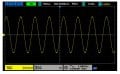
Use the TRIGGER LEVEL knob to adjust the voltage at which triggering will take place. Set it to a voltage greater than 0 V and lower than the peak signal voltage. Make sure that the trigger level is not at 0 V. There should be a yellow arrow [T] on the left side of the screen showing the trigger level. If not, the trigger voltage would be shown digitally on the top status bar [T].

At this point, the trace should be rock steady.


Hantek DSO2C10.jpg

Hantek DSO2C10 screen.jpg
 

Thread Starter

Tutor88

Joined Feb 8, 2023
306
At this test setup, we are not looking for resonance. There should be no LC circuit connected.

Remove the probe from CH2 on the oscilloscope. Use only one probe on CH1.
Do not use AUTO SET.
Press TRIG MENU button and setup the trigger selection:
Trigger Source: CH1
Trigger Mode: Normal
Trigger Slope: Rising

Use the TRIGGER LEVEL knob to adjust the voltage at which triggering will take place. Set it to a voltage greater than 0 V and lower than the peak signal voltage. Make sure that the trigger level is not at 0 V. There should be a yellow arrow [T] on the left side of the screen showing the trigger level. If not, the trigger voltage would be shown digitally on the top status bar [T].

At this point, the trace should be rock steady.


View attachment 350361

View attachment 350362
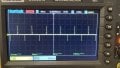
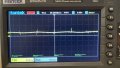
I followed your instructions (No LC circuit).

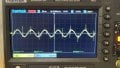
The attached is what I got with a sine wave (auto set), a square wave (auto set) and a sine wave with the Trig menu as you proposed.

Basically these suggest that my signal generator has failed. I get a nice 1 kHz square wave using the scope's available signal output.

Time to shop around!
 

Attachments

MrChips

Joined Oct 2, 2009
34,892
Set your signal generator to sinewave output. Don't use square wave output.

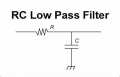
Connect this low-pass filter on the output of the signal generator.
R = 100 Ω
C = 10 nF
cutoff frequency = 160 kHz


1748881862460.png
 
Top