Simple voltage follower - not working

Status
Not open for further replies.

Thread Starter

bstdms

Joined Jun 14, 2023
22
Hi,

Thank you for your time in advance.
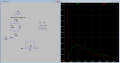
I tried to simulate the action of a silicon photomultiplier(SiPM) using a second-order RC circuit and it worked well. The output voltage is named sipm and is shown as the red curve in the plot pane.
Then I wanted to connect this output to a voltage follower using the component UniversalOpAmp2 provided by LTSpice. The output Vo is supported to be the same as sipm, however, I got the green curve, which seemed to be shaped by a filter. May I ask why I got the curve and which part did I do wrong?

Many thanks.
Sho
1.png
 

wayneh

Joined Sep 9, 2010
18,088
Without investigating details and purely speculating, could it be that the op-amp slew rate is too slow for this? Try slowing down the sipm curve and see whether the op-amp does a better job of following.
 

crutschow

Joined Mar 14, 2008
38,320
I got the green curve, which seemed to be shaped by a filter
Op amps have a limited frequency response, which is likely the cause of what you are seeing.
It's determined by the slew-rate and gain-bandwidth value of the op amp, which is 10MHz for that model.
You would need a much high gain-bandwidth to accurately reproduce that fast signal.
How much accuracy do you need?
 
Last edited:

WBahn

Joined Mar 31, 2012
32,703
Hi,

Thank you for your time in advance.
I tried to simulate the action of a silicon photomultiplier(SiPM) using a second-order RC circuit and it worked well. The output voltage is named sipm and is shown as the red curve in the plot pane.
Then I wanted to connect this output to a voltage follower using the component UniversalOpAmp2 provided by LTSpice. The output Vo is supported to be the same as sipm, however, I got the green curve, which seemed to be shaped by a filter. May I ask why I got the curve and which part did I do wrong?

Many thanks.
Sho

View attachment 296430
If you look at the initial rise of the opamp output, it goes up 12 mV in 10 ns. That's an average of 1.2 V/µs. The true slope is a bit higher than that, but those numbers are pretty typical slew rate limits for general purpose opamps. To track that signal, you are going to need an opamp with a minimum slew rate better than 100 V/µs and you might need one considerably faster than that.
 

WBahn

Joined Mar 31, 2012
32,703
I see it going up 54mV in an isstant, way under 1 nsec. It is too steep to actually read the time axis.
You are looking at the wrong signal. The opamp output is the green signal. It goes from 0 V to about 12 mV in about 10 ns.

The initial slope of the opamp output is perhaps 2x or 3x that average.
 
Status
Not open for further replies.
Top