Simple “off when on” relay

Thread Starter

ian.williams

Joined Feb 16, 2025
4
I know very little about electronics as you will quickly realise. There must be a simple relay available that will satisfy my needs but I cannot find one. Let me explain, I have a submersible pump in a well that I need to control via a float switch in my header tank but the float switch makes a circuit when in the up position ( when the tank is full ) I need the pump to be powered up when the float switch is down so I’m thinking I can use a simple relay to achieve this but I can’t find one. It needs to be 220/240v

any help or advice will be greatly appreciated
 

Lightium

Joined Jun 6, 2012
320
Relay flavors come in "NO" for normaly open and "NC" for normaly closesed. The other perameters are the same for switches, ie "SPST" for single pole single throw.
 

ronsimpson

Joined Oct 7, 2019
4,647
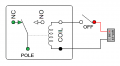
Here is a relay that has a Normally Open and a Normally Closed connections. They are very common and will do what you want.
When ordering a relay look for SPDT. Single Pole Double Terminal.
1739713282157.png
 

Tonyr1084

Joined Sep 24, 2015
9,744
It's described as a contactor.

The TS needs a relay simple as that. SPDT. Even SPST NO would do. Give me five and I'll bang out a drawing.
[edit]
The comment ab out an SPST relay working is in error.
[end edit]
 
Last edited:

Tonyr1084

Joined Sep 24, 2015
9,744
OK, the thing with the ball in it is my version of a float switch. When the float switch - as you described - is in the up position the pump runs. You want the pump to NOT run. Using a simple SPDT relay will do. As for my comment in post #8 - an SPST relay will NOT work. I was wrong.

The drawing depicts two conditions.

DRAWING DELETED DUE TO ERROR!

Tank full means the relay is ON and the pump is OFF.
Tank NOT full means the relay is OFF and the pump is ON.
Since posting this someone else has commented, which I have not yet seen.
 
Last edited:

Tonyr1084

Joined Sep 24, 2015
9,744
In the [EDIT] SEE POST #13 [END EDIT] diagram the relay is under constant load when the tank is full. At some point when the tank lowers the ball will roll away from the contacts and the pump will come back on. This has a potential of cycling the pump on and off at a high rate of ON/OFF cycling. There ARE better approaches.

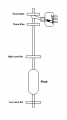
While this is not the only solution (there are many others) this is the sort of thing you'd want:
Screenshot 2025-02-16 at 8.53.56 AM.png
When the tank reaches a lower level the switch activates the pump. The pump continues to run until the float has risen and pushes the switch back to the off position shutting the pump off. That way the pump only runs periodically to maintain a given level, one you can set by adjusting the stop and start and the level sense settings. The float will rise and fall, hitting those limits and causing the switch to change states.

This drawing shows a toggle switch ONLY for the sake of indicating it's a switch. You can use a microswitch just as easily, with a slightly different switch activation approach.
 
Last edited:

Tonyr1084

Joined Sep 24, 2015
9,744
OK, the thing with the ball in it is my version of a float switch. When the float switch - as you described - is in the up position the pump runs. You want the pump to NOT run. Using a simple SPDT relay will do. As for my comment in post #8 - an SPST relay will NOT work. I was wrong.

The drawing depicts two conditions.
View attachment 342613
Tank full means the relay is ON and the pump is OFF.
Tank NOT full means the relay is OFF and the pump is ON.
Since posting this someone else has commented, which I have not yet seen.
OOPS! My drawing (post #10) is incorrect. Give me a bit and I'll fix it.
 

Tonyr1084

Joined Sep 24, 2015
9,744
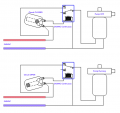
Here's the CORRECT drawing.
Screenshot 2025-02-16 at 1.50.41 PM.png
When the tank is full (upper diagram) the pump is OFF and the relay is ON.
When the tank is NOT full (lower diagram) the pump is ON but the relay is OFF.
 

MisterBill2

Joined Jan 23, 2018
27,186
The one concern I have about that scheme,(which will work)is that the relay will constantly be activated when the tank is full. So if the relay is battery powered that will be a problem because the battery will run down and the contacts will close again. So the next question is what starts the pump running??
Sincethe switch looks like it is "home made" why not arrange it with contacts that open when the tank is full?? THAT wil totally solve most of the problem.
 

Tonyr1084

Joined Sep 24, 2015
9,744
Tank full means the relay is ON and the pump is OFF.
the relay will constantly be activated when the tank is full.
I need the pump to be powered when the float switch is down. I’m thinking I can use a simple relay • • • but I can’t find one. It needs to be 220/240v
if the relay is battery powered that will be a problem because the battery will run down and the contacts will close again.
220 / 240 VAC, not battery powered.
 

MisterBill2

Joined Jan 23, 2018
27,186
OK, a 220/240 volt relay. Not a problem. Finding a relay with ONLY a normally closed contact may be a challenge, but finding one with both an NC and an NO contact will be simple. Both posts #3 and #4 describe what will work. The one question is how much current does the motor draw? THAT will determine the relay contact current rating. AND that does matter.
 

Tonyr1084

Joined Sep 24, 2015
9,744
There has been some confusion in this thread. So starting over, this is your "I NEED" statement:
I need to control via a float switch in my header tank but the float switch makes a circuit when in the up position ( when the tank is full ) I need the pump to be powered up when the float switch is down
So you have a tank you want to keep filled. Keeping it 100% filled at all times will result in early pump failure because the pump will cycle on and off nearly constantly. As you use some of the water in that tank the level will drop and the pump will immediately come back on to refill the tank.

What you need: (and want)
A switch that will turn the pump on when a certain "Low Level" sensor (or switch) turns the pump on. The pump continues to run until the tank reaches some "Full Level" sensor (or switch) turns the pump back off. This way the pump doesn't run every time you use a little water.

What you have:
A float switch that comes on when water level reaches a certain level. This is typically used in a sump situation where when rain water (or other source) accumulates to a point and the pump needs to come on to drain away the water. Likely it's ejected outside or down a drain.

There are a number of solutions:
The first is to decide on the approach you wish to take. You want something to work as is described in the "What you need" paragraph. To approach a practical solution the first thing we need to know is
What is a Header Tank? Is it steel? Metal? Fiberglass? Plastic? How tall is it? How many gallons does it hold? And can your pump keep up with prolonged demand for water?
Next: Are you willing to put holes in the tank?
Then: How many ports (pipe access points) do you have?
And: Does the whole thing NEED to be 240VAC?
Also: Is the tank under any kind of pressure? If so - how much?

As I said, there are many approaches. Years ago I built a float switch for an HHO system (Let's not go into HHO - it's a bad subject). The float consisted of a 2 inch PVC pipe with a 1 inch PVC short pipe capped at both ends. Inside that 1 inch PVC pipe was a strong magnet. On the outside of the 2 inch pipe there was a reed switch. When the water level dropped sufficiently the magnetic field would close the reed switch and turn a pump on. When the water level rose far enough the magnetic field became weak and no longer able to hold the reed switch closed, thus shutting the pump off. PVC was chosen for two primary reasons: 1) It didn't interfere with magnets and reed switches. 2) It wasn't under any kind of pressure.

I don't think this is the solution for you. But it has merits. IF (big "IF" there) IF you can connect a PVC pipe along side the tank then the pipe will have the same level of water in it as is in the tank. When the water in the tank rises the water in the pipe rises. A magnet inside the pipe can activate a reed switch indicating the tank is sufficiently filled. And moving the magnet is easy enough to adjust the water level. Nothing is inside the tank, nothing to corrode, no electricity of any kind, just a floating magnet. If the tank is large then you'd want a second reed switch near the low level to reactivate the pump. From those two reed switches you would need some low power electronics to control a relay to turn the pump on and off.

That's one solution. Others on this website will have other solutions, some possibly better than my approach. But it all depends on how involved you want this system to be.

Let us know the answers to the above questions please.
 

Tonyr1084

Joined Sep 24, 2015
9,744
Been 11 days since anything has been posted. While perusing YouTube I saw this:
It's an interesting system that detects water level. Exactly how you would employ it will need a decision on your part. Since it has been nearly two weeks I've forgotten a lot of what was discussed. Yeah, I could re-read it. But I just wanted to throw this out there. It MIGHT help solve your problem.
 

MisterBill2

Joined Jan 23, 2018
27,186
The float switch scheme described in post #17 is certainly the best choice by far. AND, with adding a bias magnet to the top level reed switch to make it operate in a normally closed manner, the whole control scheme can be done very well, and would outlast the pump and the tank. The hard part will be adjusting the position and polarity of the bias magnet so that the top reed switch will open when the floating magnet counteracts the bias magnet. The big benefit of using reed switches is that the contacts are protected from moisture.

If the present float switch could be re-arranged to be normally closed then the present switch could serve very well.
 
Top