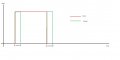
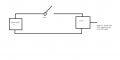
I need a simple circuit which will give a 100ms 5v pulse when an SPST switch is turned ON (i.e constant input) and a same 100ms 5v pulse when the SPST switch is turned OFF.Please help.
A combination of discrete components is preferred but if the IC solution gives a smaller footprint, then I will use IC.
Accuracy is not an issue as long as it is not less than 100ms.
But the input is fed from an SPST switch and cannot be changed.
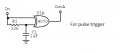
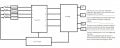
I have tried using xor gate with the complimentary RC values but the generated output is give a pulse when the SPST is turned ON and no pulse when it is OFF.Also when I turn ON and OFF the switch immediately the capacitor is taking time to discharge and not giving immediate output.
Thank you guys for all the replies.
The actual problem is I am building a home automation project which will have google assistant and Alexa integrated into it.
However, it should also work with the existing SPST switches of a home.
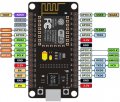
For this project, I am using NodeMCU and using PINS 1 2 7 8 as inputs from the switches.
The switches are fed 5v and from those, the voltage is step down to 3.3v and fed to the pins as mentioned above.
The pins 1 2 7 are working perfectly but the pin 8 is changing the mode due to constant input from the switch.
For this, I need to generate pulse instead of continuous input.
Can you post a link to the NodeMCU datasheet? The high output current for the pulse complicates things.
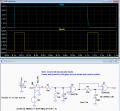
The reason the XOR circuit does not work is that when you turn on the switch, the input is pulled firmly up to 5 V, but when you turn off the switch, the input to the circuit is floating and the capacitor holds the input high so no pulse is generated. Ad another XOR gate in front of the IN node to act as a non-inverting buffer. At the inputs of the new gate, ground one and put a 10 K resistor and 1.0 uF capacitor in parallel from the other input to GND. This will debounce the switch without adding too much delay between turning off the switch and the second output pulse leading edge.
Can you post a link to the NodeMCU datasheet? The high output current for the pulse complicates things.
The reason the XOR circuit does not work is that when you turn on the switch, the input is pulled firmly up to 5 V, but when you turn off the switch, the input to the circuit is floating and the capacitor holds the input high so no pulse is generated. Ad another XOR gate in front of the IN node to act as a non-inverting buffer. At the inputs of the new gate, ground one and put a 10 K resistor and 1.0 uF capacitor in parallel from the other input to GND. This will debounce the switch without adding too much delay between turning off the switch and the second output pulse leading edge.
At the inputs of the new gate, ground one and put a 10 K resistor and 1.0 uF capacitor in parallel from the other input to GND. This will debounce the switch
A 1μF cap to ground would generate a large current spike through the switch as its bouncing, which would tend to cause arcing and weld the contacts.
To prevent that add a small resistor (say 50-100Ω) in series with the switch.
A 1μF cap to ground would generate a large current spike through the switch as its bouncing, which would tend to cause arcing and weld the contacts.
To prevent that add a small resistor (say 50-100Ω) in series with the switch.
Although the post #16 circuit gives the appropriate timing, the CD4070 cannot source '80 - 200mA', so a suitable buffer stage (BJT or logic-level MOSFET) would be required on its output.
Yeah, that still is a problem. I don't see any way to justify the pinouts in posts #11 and #13, so there still is more information needed. If the switches are driving GPIO pins, then1 mA should be enough.

 Facebook
 Google
 GitHub
 Linkedin