Simple LED 3.7V circuit?

Thread Starter

Ludilo

Joined Mar 19, 2015
16
Have fun. I hope there are not potholes in front of you. I broke my collarbone that way, riding at night with insufficient light. This was when I was eighteen and could still see well.

Bob
Hi Bob.

I can always make some changes. More LEDs, more power. I have to try it first.
 

Dodgydave

Joined Jun 22, 2012
11,395
The fet will give the same current evenly with a full charge or low voltage battery, if your using the Jfet, try a 100 ohms preset resistor to give 20 mA,then set it with a fixed resistor, if you need more current use a J113 fet, more leds means bigger battery.
 

Thread Starter

Ludilo

Joined Mar 19, 2015
16
The fet will give the same current evenly with a full charge or low voltage battery, if your using the Jfet, try a 100 ohms preset resistor to give 20 mA,then set it with a fixed resistor, if you need more current use a J113 fet, more leds means bigger battery.
In any case, I will definitely need a bigger battery.
 
Last edited:

MikeML

Joined Oct 2, 2009
5,444
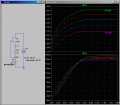
What Dodgy didn't tell you is that in order to use a the constant-current properties of a J112, the minimum voltage across it and its source resistor has to be a minimum of ~2.3V, so the min battery voltage for regulation is about 5.5V, so you cannot use your proposed battery. This circuit is better than just a resistor.

I plot the voltage across the LED V(for), and the current through the LED I(D1) as a function of the battery voltage V1.

Note how the regulator keeps the current more or less constant as long as the battery voltage is > 5.5V. I also show what happens to the LED current at temperatures from 0 degC to 40 degC. Note how the LED V(for) decreases at elevated temperatures, which is why you need current regulation.
cc.gif
 

Thread Starter

Ludilo

Joined Mar 19, 2015
16
What Dodgy didn't tell you is that in order to use a the constant-current properties of a J112, the minimum voltage across it and its source resistor has to be a minimum of ~2.3V, so the min battery voltage for regulation is about 5.5V, so you cannot use your proposed battery. This circuit is better than just a resistor.

I plot the voltage across the LED V(for), and the current through the LED I(D1) as a function of the battery voltage V1.

Note how the regulator keeps the current more or less constant as long as the battery voltage is > 5.5V. I also show what happens to the LED current at temperatures from 0 degC to 40 degC. Note how the LED V(for) decreases at elevated temperatures, which is why you need current regulation.
View attachment 82414
Any suggestions how to regulate current for 3.4V LED?
Something cheap and simple..?
 

Dodgydave

Joined Jun 22, 2012
11,395
If you're using a 4.2V battery, with a 3.4v led ,there isnt much headroom for a constant current regulator,so a resistor is the only way, better to use a 6V or 7.5V battery.
 

Thread Starter

Ludilo

Joined Mar 19, 2015
16
OK. Poor man's solution.

I have tried this:
3 x 3.4V LED
2 x LiPo 3.7V in series = 7.4V
4 x 22Ω resistor in series = 88Ω
Voltage across one LED = 3.13V
Amperage draw = 0.4 Amps
 

Dodgydave

Joined Jun 22, 2012
11,395
if your using 7.4V, then best to use the Jfets with a 33 ohms resistor,one fet and resistor per led, will give you 20mA per led,

work out the capacity of the battery, divide it by the total current drawn by all the leds, and that will give you the time it has.

Example if the battery is 1400mAh, then 5 leds at 20mA each is 100mA drain current,
so 1400mah/100ma = 14hrs approx.

7 leds = 10 hrs @ 20mA per led
10 leds = 7hrs@ 20mA per led
 
Last edited:

Søren

Joined Sep 2, 2006
472
Hi,

OK. Poor man's solution.

I have tried this:
3 x 3.4V LED
2 x LiPo 3.7V in series = 7.4V
4 x 22Ω resistor in series = 88Ω
Voltage across one LED = 3.13V
Amperage draw = 0.4 Amps
You will have a really low efficiency that way. LiPo cell goes down to 3.2V, so you won't get to use the full capacity of a single cell and with 2 cells, you will have a total loss of more than 50% (i.e. efficiency < 50%).
OTOH, almost every chip manufacturer makes LED boost drivers for single cell LiPo to a number of LEDs, with efficiencies ranging from around 85 and up (to over 95% in some situations).

A single example (out of an ocean of drivers) is the LM3410 from Texas Instruments:
http://www.ti.com/product/lm3410 which drives up to 24V worth of LEDs, with a low component count - add a (current set) resistor, 2 caps, a diode and a small inductance (and the LEDs obviously) and there's even an option for dimming w. PWM. With 4 LEDs, it operates at ~86..87% efficiency, giving you almost twice the battery life of a simple non-switching solution.

As said, there's a plethora of such drivers, so it shouldn't be too hard to get one as a free sample.

Regards,
Søren
 

Thread Starter

Ludilo

Joined Mar 19, 2015
16
Hi,


You will have a really low efficiency that way. LiPo cell goes down to 3.2V, so you won't get to use the full capacity of a single cell and with 2 cells, you will have a total loss of more than 50% (i.e. efficiency < 50%).
OTOH, almost every chip manufacturer makes LED boost drivers for single cell LiPo to a number of LEDs, with efficiencies ranging from around 85 and up (to over 95% in some situations).

A single example (out of an ocean of drivers) is the LM3410 from Texas Instruments:
http://www.ti.com/product/lm3410 which drives up to 24V worth of LEDs, with a low component count - add a (current set) resistor, 2 caps, a diode and a small inductance (and the LEDs obviously) and there's even an option for dimming w. PWM. With 4 LEDs, it operates at ~86..87% efficiency, giving you almost twice the battery life of a simple non-switching solution.

As said, there's a plethora of such drivers, so it shouldn't be too hard to get one as a free sample.

Regards,
Søren
Thanks Søren, this is very helpful.

As a matter of fact, after 3 hours of continuous work, LED's brightness and voltage falls down drastically...
 

RichardO

Joined May 4, 2013
2,270
Have fun. I hope there are not potholes in front of you. I broke my collarbone that way, riding at night with insufficient light. This was when I was eighteen and could still see well.

Bob
I broke my collarbone in bright daylight when a curb jumped out in front of me. I was _well_ beyond 18 at the time. I don't intend repeating that experience at night because of a dim light. :eek:
 

Søren

Joined Sep 2, 2006
472
I broke my collarbone in bright daylight when a curb jumped out in front of me. I was _well_ beyond 18 at the time. I don't intend repeating that experience at night because of a dim light. :eek:
You and Bob needs this https://www.youtube.com/watch?v=OMEfKPrMkug
Or perhaps this ;)


If I ever get my paws on a 3D printer (or build one), first thing to realize is my idea of an automatic zooming headlight - going fast, a long reaching narrow beam is fine, but when going slow, you need a wide beam (like before turning or looking for house numbers), so with a good optical design, I believe a LED of 1W..5W should do nicely as it's either/or (I seldom go past maybe 20..25km/h when it's dark anyway).


Regards,
Søren
 

ebeowulf17

Joined Aug 12, 2014
3,307
For a bicycle light, consider using a simple CMOS 555 timer circuit using LMC555 or TLC555.
Your battery will last twice as long and you wouldn't need series resistors.

Mind you, just using series resistors for continuous illumination is simple enough.
Probably a dumb question, but how does using the 555 eliminate the need for series resistors?
 

MrChips

Joined Oct 2, 2009
34,817
Assuming the battery is running around 4V, the 555 will drop some of that voltage. Also you can set the duty cycle to below 50% to extend battery life.

But this is a mute point since the TS needs continuous high power illumination.
 

MrChips

Joined Oct 2, 2009
34,817
I ride an ebike and regularly do 32km/h (20mph) at night.
Yes, I would prefer good illumination but in my case I'm more likely to run into a deer than a pot hole.

My headlight is powered directly off the 36V battery.
 

Thread Starter

Ludilo

Joined Mar 19, 2015
16
You and Bob needs this https://www.youtube.com/watch?v=OMEfKPrMkug
Or perhaps this ;)


If I ever get my paws on a 3D printer (or build one), first thing to realize is my idea of an automatic zooming headlight - going fast, a long reaching narrow beam is fine, but when going slow, you need a wide beam (like before turning or looking for house numbers), so with a good optical design, I believe a LED of 1W..5W should do nicely as it's either/or (I seldom go past maybe 20..25km/h when it's dark anyway).


Regards,
Søren
Ha! Great idea.
 

ScottWang

Joined Aug 23, 2012
7,501
CMOS 555 pwm → Bjt(or mosfet) ← 47Ω(22Ω) ← LED ← +V
Adding a pot to do the pwm and a switch to switch the resistor 47Ω and 22Ω.
 

Thread Starter

Ludilo

Joined Mar 19, 2015
16
I have tried this today:

1 x 3.7V LiPo 350 mAh
3 x LEDs 3.4V
1 x 22Ω resistor
1 x TP4056 Lithium Cell Charger Module

The battery was connected throgh the charger module on 3 LEDs and it has lasted twice as much.
For 6 hours it was glowing with 1100 Lx (acording to my cell phone), then it droped to 800 Lx for another hour and after that it dimmed.

Thanks to this little guy:


http://www.ebay.it/itm/281546116304...eName=STRK:MEWAX:IT&_trksid=p3984.m1423.l2649
 
Top