Signals and plane on the same layer

Thread Starter

Eyal0

Joined Mar 26, 2024
17
Hi, I’m working on a PCB layout, which is only about the second board I’ve ever designed. I’d appreciate some help with a few basic things. I’ll split my questions into separate posts.

This board has two layers:

  • The top layer is used for signals and power planes.
  • The bottom layer (shown in the images) is intended to be a ground plane.
I’ve tried to minimize the number of traces on the ground layer, but in some cases, routing constraints leave no choice.

My question is: When placing traces on this ground plane, is it better to:

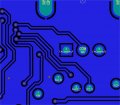
  1. Keep them as tightly packed as possible, grouping them into a concentrated "island" within the ground pour (Image 1)?
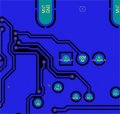
  2. Space them out slightly, allowing the ground pour to flow between them, thereby increasing the overall ground area surrounding the traces (Image 2)?
Additionally, a large power polygon runs above these signals on the top layer, meaning the traces are effectively crossing underneath it.
Maybe these images don't demonstrate the issue very well, but I’d love to hear your insights on the best approach anyway.

bottom1.jpgImage 1


Bottom2.jpgImage 2


Thanks in advanced for any answer,
Eyal
 

MrChips

Joined Oct 2, 2009
34,807
I would do neither.

Firstly, let us examine the purpose of ground and power planes. A ground plane is also a power plane. Both planes are expected to be low impedance connections with close to zero frequency components, i.e. DC. In some cases, large currents might flow in power and ground planes. The purpose of the plane is to prevent DC and AC differences between devices which would result in "ground loops".

Another function of power and ground planes is to provide capacitive coupling to signal traces. This minimizes signal radiating from HF (high frequency) signal and power connections. Conversely, it provides shielding from EMI (electromagnetic interference) to sensitive high impedance signal connections.

Finally, low impedance power or ground planes can minimize interference and cross-talk between adjacent signal traces.

Another benefit of ground planes is in mixed-signal applications where there are both analog and digital devices on the board. In a typical application, there could be amplifiers feeding an ADC (analog to digital converter) along with an MCU (microcontroller unit) and other digital devices. In such applications, you want to employ a split ground plane, i.e. separate ground plane underneath the analog and digital sections of the board.

You need to consider the function of the interconnection, the PCB trace on either side of the board. Is it a power or signal trace? Does it have a low or high impedance? Is it likely to be sensitive to EMI or be a source of EMI? Are the traces intended to carry HF signals that require proper transmission line impedance along the entire length of the trace, USB for example?

In summary, if the PCB trace is going to be problematic, you want the trace to be surrounded with either ground or power plane. This provides capacitive coupling (AC) to the low impedance plane. Avoid problematic traces running alongside each other in order to minimize cross-interference. Running traces at right angles to each other minimizes cross-interference.

Looking at your PCB layout, I am not a big fan of squiggles and bends in a trace. The rule of thumb is: keep the trace as short as possible.
 
Top