Signal Generator Amplifier DIY

Audioguru again

Joined Oct 21, 2019
6,826
Who is ART CHIP? They do not make ICs, instead they might buy then and sell them with errors in the specs.

Japan Radio invented the JRC4558 (JRC was Japan Radio Corp before they changed it to NEW Japan Radio (NJR).
Digikey sell a Texas Instruments copy called RC4558 and a new Japanese company makes a copy of the JRC4558. They say
IT IS NOT FOR NEW DESIGNS.
 

Attachments

Thread Starter

Frank Bolleri

Joined Sep 23, 2023
77
Who is ART CHIP? They do not make ICs, instead they might buy then and sell them with errors in the specs.

Japan Radio invented the JRC4558 (JRC was Japan Radio Corp before they changed it to NEW Japan Radio (NJR).
Digikey sell a Texas Instruments copy called RC4558 and a new Japanese company makes a copy of the JRC4558. They say
IT IS NOT FOR NEW DESIGNS.
I'm not Sony or Philips who makes a product to puts on the market.
I'm building a simple homemade device... and, considering all my limits and requiements, it works.

Francesco
 

MrAl

Joined Jun 17, 2014
13,709
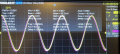
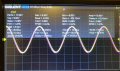
With gain 10X, approaching 50kHz appear a phase offset
View attachment 305573

Phase offset at 100 kHz
View attachment 305574

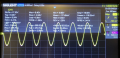
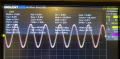
Approaching 250 kHz there is also a begin of amplitude reduction:
View attachment 305575

that progressively continue, togheter with the phase offset.
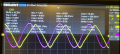
Here the signal at 500 KHz:
View attachment 305577

But I think is ok... my desire was to have something to attach to function generator to play with some load.
I don't need a wide bandwith for that.

I am satisfied! And I hope this thread can help someone in the future to have another option for "Signal Generator Amplifier DIY making".

Thanks to all,
Francesco
At higher frequencies op amps act like low pass filters so you can get some phase shift.
Eventually the slew rate limitations kick in also which causes the output to look more and more triangular.

The calculation for a 5v peak sine comes to over 3v/us so I am surprised you are getting results as good as that.
At 250kHz you can see it kicking in, and at 500kHz it becomes very obvious.
If you were to go up to 10v peak you would see it get worse.
 

Thread Starter

Frank Bolleri

Joined Sep 23, 2023
77
Frank, you are more than doubling the Absolute Maximum supply voltage on the opamps. Usually then they burn out soon.
A part that 44 is not the double of 32 36... but in any case, to be secure, I will lowering down again the power supplly to +/-18V instead of +/-22V.

Thanks,
Francesco
 
Last edited:

Thread Starter

Frank Bolleri

Joined Sep 23, 2023
77
At higher frequencies op amps act like low pass filters so you can get some phase shift.
Eventually the slew rate limitations kick in also which causes the output to look more and more triangular.

The calculation for a 5v peak sine comes to over 3v/us so I am surprised you are getting results as good as that.
At 250kHz you can see it kicking in, and at 500kHz it becomes very obvious.
If you were to go up to 10v peak you would see it get worse.
But my test are done with 10Vpp output.. there is something I am understanding wrong?
 

Thread Starter

Frank Bolleri

Joined Sep 23, 2023
77
But my test are done with 10Vpp output.. there is something I am understanding wrong?
Excuse me.. a doubt:
the signal in the image is 10Vpp, right? It is what you mean with 5V peak (because each portion above and below is 5V?)
Screenshot 2023-10-22 at 22.34.07.png

So when you tell "10V peak" you means a test with 20Vpp?
 
Last edited:

MrAl

Joined Jun 17, 2014
13,709
Excuse me.. a doubt:
the signal in the image is 10Vpp, right? It is what you mean with 5V peak (because each portion above and below is 5V?)
View attachment 305616

So when you tell "10V peak" you means a test with 20Vpp?
But my test are done with 10Vpp output.. there is something I am understanding wrong?
Hi,

Well, yes, but just the relationships between peak volts and peak to peak volts.
Peak volts are one-half of the peak to peak volts, as long as the sine wave is centered at zero.
So, 10vpp=5v peak. This just means the top half is above 0v and the bottom half is below 0v.

If the wave is not centered at 0v, then you have to measure the negative peak and the positive peaks from 0v. That would be with a DC offset.
If the DC offset was +2v for example, then the positive peak would be at 7v and the negative peak would be at -3 volts. Only with a DC offset of 0v the positive peak is at +5v and the negative peak at -5v.
 

Thread Starter

Frank Bolleri

Joined Sep 23, 2023
77
Hi,

Well, yes, but just the relationships between peak volts and peak to peak volts.
Peak volts are one-half of the peak to peak volts, as long as the sine wave is centered at zero.
So, 10vpp=5v peak. This just means the top half is above 0v and the bottom half is below 0v.

If the wave is not centered at 0v, then you have to measure the negative peak and the positive peaks from 0v. That would be with a DC offset.
If the DC offset was +2v for example, then the positive peak would be at 7v and the negative peak would be at -3 volts. Only with a DC offset of 0v the positive peak is at +5v and the negative peak at -5v.
Thanks for the explanation! Now i get the meaning, sorry for my gaps in terminology.
This evening i will repeat the frequency test with suggested voltage settings and let you know the results.

have a nice day
Francesco
 

Thread Starter

Frank Bolleri

Joined Sep 23, 2023
77
Hi,
following Audioguru's kind suggestion, I lowered the power supply voltage to 18V.
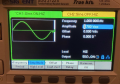
So I set the AWG amplitude to 1.7 Vpp to obtain 17 Vpp with a gain of 10X (little less of the max reachable).

I have started from 1 kHz.

Screenshot 2023-10-23 at 22.03.39.png

Here are the screens.

1 kHz
Screenshot 2023-10-23 at 22.08.19.png

50 kHz
Screenshot 2023-10-23 at 22.08.49.png

100 kHz
Screenshot 2023-10-23 at 22.11.04.png

250 kHz

and here there is a decrease in amplitude, a lot of phase shifting and a distotion of waveform
maybe this is what you anticipate?


Screenshot 2023-10-23 at 22.11.33.png

But for my desire of 100 kHz it is enough precise.

Ciao
Francesco
 

MrAl

Joined Jun 17, 2014
13,709
Hi,
following Audioguru's kind suggestion, I lowered the power supply voltage to 18V.
So I set the AWG amplitude to 1.7 Vpp to obtain 17 Vpp with a gain of 10X (little less of the max reachable).

I have started from 1 kHz.

View attachment 305691

Here are the screens.

1 kHz
View attachment 305692

50 kHz
View attachment 305693

100 kHz
View attachment 305694

250 kHz

and here there is a decrease in amplitude, a lot of phase shifting and a distotion of waveform
maybe this is what you anticipate?


View attachment 305695

But for my desire of 100 kHz it is enough precise.

Ciao
Francesco
Hi,

Wow, I am surprised you are getting such a fairly good result at 100kHz, makes that op amp look pretty good. In calculation we would need 5v/us slew rate. I know a regular LM358 will not do that good.
Just one thing, does your scope have THD measurements? That would be of interest also to see how well the op amp is doing with the sine.

Yes at 250kHz you can see the effect of the limited slew rate. Near the peaks the dv/dt is lower so we almost see the peaks come out almost normal, but as the wave moves away from the peaks the slope increases and that's when the slew rate can't keep up.
Does your sig gen have square wave output too? Try that and see how it ramps up.

Just for the heck of it, if you have an LM358 around, try that too with a sine you'll see the difference.
 

Thread Starter

Frank Bolleri

Joined Sep 23, 2023
77
Hi,

Wow, I am surprised you are getting such a fairly good result at 100kHz, makes that op amp look pretty good. In calculation we would need 5v/us slew rate. I know a regular LM358 will not do that good.
Just one thing, does your scope have THD measurements? That would be of interest also to see how well the op amp is doing with the sine.

Yes at 250kHz you can see the effect of the limited slew rate. Near the peaks the dv/dt is lower so we almost see the peaks come out almost normal, but as the wave moves away from the peaks the slope increases and that's when the slew rate can't keep up.
Does your sig gen have square wave output too? Try that and see how it ramps up.

Just for the heck of it, if you have an LM358 around, try that too with a sine you'll see the difference.
I will thank you for your suggestions and proposal - I will try to make some of the test when I will have some time to dedicate.
I've never heard about THD - Google tell me this mean Total Harmonic Distortion, but I don't have readed more now...it is night here and I am tired.

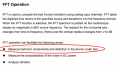
In the manual of my Siglent SDS-1202X-E there is no written "THD".
But there is this, under the description of FFT function:

Screenshot 2023-10-24 at 01.33.55.png
Maybe this is the same functionality?

Good night
 

Audioguru again

Joined Oct 21, 2019
6,826
Most opamps work well up to 100kHz at all levels. All audio opamps produce low noise and produce very low distortion.
A lousy old LM358 has trouble above 3kHz at high levels, produces hisss and produces crossover distortion.
 

MrAl

Joined Jun 17, 2014
13,709
I will thank you for your suggestions and proposal - I will try to make some of the test when I will have some time to dedicate.
I've never heard about THD - Google tell me this mean Total Harmonic Distortion, but I don't have readed more now...it is night here and I am tired.

In the manual of my Siglent SDS-1202X-E there is no written "THD".
But there is this, under the description of FFT function:

View attachment 305720
Maybe this is the same functionality?

Good night
Hello again,

The FFT function measures all the frequency components. It is related to the THD by a sort of summation. As the FFT finds the frequencies present in the signal, the 'sum' of those becomes the THD, which gives you a quick overview of the deviation from a pure sine (your input presumably) so you do not have to study each harmonic alone. However, seeing the harmonics will also help you to see how much the output sine deviates from the input. You should also do an FFT on the input though to make sure the sig gen is putting out a pure sine.
Once you do this for both 50kHz, 100kHz, and 250kHz, you'll see how the FFT helps to show the deviations which are imperfections in the sine.
The THD is actually slightly more complicated than the sum, but that's a good way to look at it in brief.
 

Thread Starter

Frank Bolleri

Joined Sep 23, 2023
77
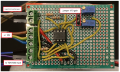
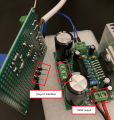
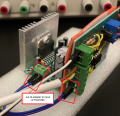
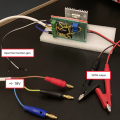
Hi! To finish the project, I invested some time today to move the components onto a prototype PCB.
I tried to make it "fit" with the TDA7293 board as "plugin".

Maybe it is not beautiful, but it works very well!
Next time I will ty to find a box to enclose it (removing the jumper and connecting a switch) and maybe putting BNC for input and output.

I'll post some photos, maybe it can be useful for someone to see how it ended.

Screenshot 2023-10-29 at 23.09.24.png

Screenshot 2023-10-29 at 23.09.51.png

Screenshot 2023-10-29 at 23.10.19.png

Screenshot 2023-10-29 at 23.10.55.png

Ciao
Francesco
 

MrAl

Joined Jun 17, 2014
13,709
Hi! To finish the project, I invested some time today to move the components onto a prototype PCB.
I tried to make it "fit" with the TDA7293 board as "plugin".

Maybe it is not beautiful, but it works very well!
Next time I will ty to find a box to enclose it (removing the jumper and connecting a switch) and maybe putting BNC for input and output.

I'll post some photos, maybe it can be useful for someone to see how it ended.

View attachment 306206

View attachment 306207

View attachment 306208

View attachment 306209

Ciao
Francesco
Hi,

Oh yes, looks pretty cool.
How long did it take to get that all together?
 

Thread Starter

Frank Bolleri

Joined Sep 23, 2023
77
Hi,

Oh yes, looks pretty cool.
How long did it take to get that all together?
Thanks! A couple of hours to design and assemble, plus half hour to make test and re-calibrate the trimmers.
I have used again Fritzing, changing the breadboard with a stripboard/perfboard.

Screenshot 2023-10-29 at 23.58.35.png

But honestly, I have used it only for (more or less) place the components... at the time of wiring I improvised :)
 

MrAl

Joined Jun 17, 2014
13,709
Thanks! A couple of hours to design and assemble, plus half hour to make test and re-calibrate the trimmers.
I have used again Fritzing, changing the breadboard with a stripboard/perfboard.

View attachment 306211

But honestly, I have used it only for (more or less) place the components... at the time of wiring I improvised :)
Hello again,

That's very cool really. The only question I had was how does this chip run with such a high slew rate. Maybe it is entirely different than a regular LM358. I wonder now if it was an attempt to improve on the LM358. There are chips out there with the same pinout that go higher in both BW and slew rate, but they are usually more expensive.
 

Audioguru again

Joined Oct 21, 2019
6,826
The LM324 quad and the LM358 dual were designed a long time ago for a low operating current.
Therefore stray capacitance reduces the slew rate and the class-B instead of class-AB output causes their crossover distortion.
 
Top