Signal Generator Amplifier DIY

MrChips

Joined Oct 2, 2009
34,828
Hello all,
I am truly sorry that I have caused a bitter discussion among you due to my ignorance.

I will try to learn something from the suggestions I get from some of your posts above before update my schematic.
I realize reading here that maybe is better I don't try to run it as is, in order to avoid the explosion of my home:)
But I kindly ask you: was I wrong to sign up to this forum? Is it intended only for professionals?
If so, I apologize because I didn't understand and I will unsubscribe.

Thanks,
Francesco
What makes you think that this forum is intended only for professionals?

Members join because they have a question, lack the knowledge and experience to answer their own questions, and/or they have some doubts and uncertainties. This applies to both hobbyists and professionals. The knowledgeable and experienced members don't usually ask questions because they have developed the skill and methodology to formulate their own answers.

The members who respond to queries are usually of the latter class, in other words they have the knowledge and experience to feel confident to provide answers.

If you felt intimidated by some of the responses then that is most unfortunate. You have to understand that we are all human and each with different personalities. If you want to unsubscribe that is your decision. However, you need to realize that everyone has to start on a learning curve somewhere and along the path you will always encounter someone behind you and someone ahead of you. Hopefully you will gain knowledge from someone who has traveled the path before you and not from someone who is just at your peer level.
 

Thread Starter

Frank Bolleri

Joined Sep 23, 2023
77
No, everyone is welcome here. My comment was not directed at you. It comes from frustration with some posters who just cannot grasp the simplest concept. And even they are welcome. I will try to answer anyone’s questions, but often give up after several posts that have no impact.
Thank you for the clarification.
So, when I will do some progress I will be back.

Wishing everyone a pleasant day,
Francesco
 

BobTPH

Joined Jun 5, 2013
11,524
Using an analog amplifier to drive a motor with PWM is not a good idea. A lot of heat is dissipated in the output transistors, partly because most analog amplifiers are not good at producing a squarewave, which is basically a digital signal.
Yes, exactly. Many beginners refer to what is basically level shifting as amplification.

If you have an on / off signal that is 0V when off and X volts when on, and you want an output that is 0V when off and Y volts when on, that is what I call a level shifter. What it does with any intermediate voltage is irrelevant. This makes the circuit much simpler than a linear amplifier, which must amplify all voltages in a range by the same factor, known as the gain. A level shifter is generally done by using a transistor as a switch.
 

Thread Starter

Frank Bolleri

Joined Sep 23, 2023
77
What makes you think that this forum is intended only for professionals?

Members join because they have a question, lack the knowledge and experience to answer their own questions, and/or they have some doubts and uncertainties. This applies to both hobbyists and professionals. The knowledgeable and experienced members don't usually ask questions because they have developed the skill and methodology to formulate their own answers.

The members who respond to queries are usually of the latter class, in other words they have the knowledge and experience to feel confident to provide answers.

If you felt intimidated by some of the responses then that is most unfortunate. You have to understand that we are all human and each with different personalities. If you want to unsubscribe that is your decision. However, you need to realize that everyone has to start on a learning curve somewhere and along the path you will always encounter someone behind you and someone ahead of you. Hopefully you will gain knowledge from someone who has traveled the path before you and not from someone who is just at your peer level.
Thanks for the clarification.
I evidently misunderstood some of the messages I read earlier.
Now I understand that I can participate too, even if I'm a beginner.

Thanks
Francesco
 

Thread Starter

Frank Bolleri

Joined Sep 23, 2023
77
Yes, exactly. Many beginners refer to what is basically level shifting as amplification.

If you have an on / off signal that is 0V when off and X volts when on, and you want an output that is 0V when off and Y volts when on, that is what I call a level shifter. What it does with any intermediate voltage is irrelevant. This makes the circuit much simpler than a linear amplifier, which must amplify all voltages in a range by the same factor, known as the gain. A level shifter is generally done by using a transistor as a switch.
Now that you explain, I think I understand what you mean and I thank you for that.

However, I would like to point out that in reality my aim was not to make the motor run in PWM - I was just testing whether that little OPA541 circuit was able to do it: I made it run for a few moments, and then it burned out.

OPA541.png

I think a possibile cause was the modification attempt to have DC coupling described here; maybe I have done it in a wrong way.

My power supply has never scored anything remotely close to the 5A declared by the board (among other things, my power supply delivers 3.2A at most).

Thanks
Francesco
 

Audioguru again

Joined Oct 21, 2019
6,826
The OPA541 amplifier for a function generator can produce peak outputs of 10A.
Yours burned out probably because your load was car incandescent light bulbs that draw about 10 times more current until the filament is at its rated 2000 degrees temperature.
 

Thread Starter

Frank Bolleri

Joined Sep 23, 2023
77
The OPA541 amplifier for a function generator can produce peak outputs of 10A.
Yours burned out probably because your load was car incandescent light bulbs that draw about 10 times more current until the filament is at its rated 2000 degrees temperature.
Thanks for your idea.
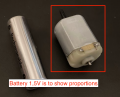
But I have not connected any light bulb, just a little DC motor (I think 3V):
Screenshot 2023-10-16 at 23.05.28.png

Until I connect it without attempt the modification for DC coupling, the motor vibrate and circuit don't burn.
OPA chip became hot, but nothing too bad happen. I do these test for a couple of days, in sessions of minutes - waiting for make OPA return at ambiental temperature.

Then, when I realize that was impossibile to make run the motor providing an AC signal, I make the modification to be able to introduce DC offset in order to have an only positive signal.
It works, but just for some seconds.

Please note that, because my power supply is unable to provide > 3.2 A current, I think is not possibile I have exceeded the max current of OPA.
Maybe I do something bad because most of the components are SMD and I do not have the appropriate tools - so I make connections on SMD components to implement the hack with a normal welder.


Francesco
 

Audioguru again

Joined Oct 21, 2019
6,826
The article of the Chinese amplifier shows it being tested with two car light bulbs in series. It heated to 109 degrees C.
Your 3V motor probably overloaded and burned out your amplifiers.
 

Thread Starter

Frank Bolleri

Joined Sep 23, 2023
77
What exactly burned out? What was the load, the 3 volt motor?
I am unable to answer you about "what exactly is burned".
I make some test and seems to me that both IC on the board (OPA445 first stage - OPA541 second stage) do strange things now.
Another thing I want to do when I have some time is disassemble the board and make some other test.

The load, yes, was the 3V motor. If I remember well I make it running providing a 0V-2.5V square wave, playing with duty cycle for see speed changing. I don't remember exactly the frequency I have used, I think 30/40 Hz.

But is ok... I was more intersted in learn how to produce a similar board by myself (the first post).

Thanks for your intersting.
Francesco
 

Thread Starter

Frank Bolleri

Joined Sep 23, 2023
77
The article of the Chinese amplifier shows it being tested with two car light bulbs in series. It heated to 109 degrees C.
Your 3V motor probably overloaded and burned out your amplifiers.
But so my supposition that looking at the current measured out of the power supply I never see exceed the current (even because it is not possible, my Siglent SPD3303X-E is able just to provide 3.2 A max) is wrong?
Maybe providing the square wave 0V-2.5V playing with duty cycle I can have overloaded the motor?

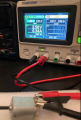
If I run the motor directly connected to the power supply (CC, without square wave) what I see in terms of current (340 mA) can be less of what is absorbed providing a square wave? Seems strange to me..

Screenshot 2023-10-17 at 01.44.47.png
 

MrAl

Joined Jun 17, 2014
13,709
No, my point was that people who come here not understanding the fundamentals rarely get anything out of the discussion.
Hi,

That's a bold statement. If not anything else, they learn where to go to get more answers, and how to ask questions better. They may also pick up on some formulas that interest them.

I do not think it is fair at all to judge people like that. Everyone is different and comes from different backgrounds and have learned less or more about a subject already. It would be hard to lump them all into one category and demand they do not come here for help. I'm sure you can see the fallacy in thinking like that.
 

MrAl

Joined Jun 17, 2014
13,709
Hello all,
making experiments on Control Dyson DC35 Multifloor vacuum cleaner motor I discover that exists labs devices like Siglent SPA1010 or TS250
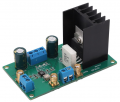
Searching, I found this article Low Cost Function Generator Amplifier DIY where is described an hack to obtain a similar device using a popular board equipped by IC OPA541 .
I have purchased that board and it works well out of the box, AC coupled; but doing the hack described to transform it into a DC coupled, after some minute of usage it fail (driving a little 3V motor in PWM...).

In any case, I was fascinated by the idea to control power devices using signal generator and I was stimulated to design a personal solution for a similar device.

This is my diagram:
View attachment 305083

I will post also the link of Falstad Online circuit simulator, the one I have used to design it.

Because I am a complete newbie, I am pretty sure it is too simple and contains some stupid errors.
In next days, when I will have some time, I will try to build and test it.

Meanwhile I will be happy if someone with experience can give me some suggestion and help me to learn.

Francesco
Hi,

The LM358 will have to have a large output voltage swing to be able to drive those two mosfets properly. Because of the slew rate combined with the required voltage swing, that will also limit the frequency to some lower value although i am not sure how high in frequency you wish to go.
Maybe try some logic level mosfets?
 

Thread Starter

Frank Bolleri

Joined Sep 23, 2023
77
Thanks for your anwser!

i am not sure how high in frequency you wish to go.
In reality I have no a specific need - I am playing just for fun.
In any case, I imagine a frequency range from DC to 30 or 50 KHz - even 100 KHz if possible - not more.

Maybe try some logic level mosfets?
Do you mean use some mosfet optimized for a ON-OFF usage to obtain some "square" output?
In reality I like to have a tool able to follow all the waveforms my signal generator is able to do - to be flexible in experimentations.
 

Audioguru again

Joined Oct 21, 2019
6,826
In your circuit that uses a +30V and -30V power supply, the LM358 will instantly burn out because its maximum allowed supply is only 32V.
If you used a high voltage opamp with an input peak of 2V and a circuit voltage gain of 10 times then the output from the Mosfets will have 20V peaks and the peak currents in the 4 ohms load will be only 20V/4 ohms= 5A peak, not 17A peak.

To get peak currents of 17A into the 4 ohms load from the Mosfets, their power supply must produce 17A x 4 ohms= 68V peaks and the output from the opamp feeding the Mosfets must produce peak voltages of 78V.
 
Top