Signal Generator Amplifier DIY

MrAl

Joined Jun 17, 2014
13,709
Thanks for your anwser!


In reality I have no a specific need - I am playing just for fun.
In any case, I imagine a frequency range from DC to 30 or 50 KHz - even 100 KHz if possible - not more.


Do you mean use some mosfet optimized for a ON-OFF usage to obtain some "square" output?
In reality I like to have a tool able to follow all the waveforms my signal generator is able to do - to be flexible in experimentations.
Hi,

You will need mosfet driver IC's for 100kHz.

A logic level mosfet has a lower gate/source drive voltage meaning you need less power supply voltage to drive it. Since there can be a lot of loss there, the lower the gate/source voltage the lower the power supply needed unless you move to using a boost circuit or similar to help drive the mosfets.

If you want a good drive signal like with your two output mosfets, look into a mosfet "half bridge".

Do you want to provide an analog output so it can do sine waves too for example, or just PWM? There's a big difference. PWM alone is easier to do, analog means you have to design a linear amplifier which is more involved.
 

atferrari

Joined Jan 6, 2004
5,012
Do you want to provide an analog output so it can do sine waves too for example, or just PWM? There's a big difference. PWM alone is easier to do, analog means you have to design a linear amplifier which is more involved.
I dare to suggest this circuit (which I built twice, with success), designed by member @DickCappels. Go to his site, here

BTW, he was certainly helpful answering questions about it. Buena suerte.
 

Thread Starter

Frank Bolleri

Joined Sep 23, 2023
77
Hi,

You will need mosfet driver IC's for 100kHz.

A logic level mosfet has a lower gate/source drive voltage meaning you need less power supply voltage to drive it. Since there can be a lot of loss there, the lower the gate/source voltage the lower the power supply needed unless you move to using a boost circuit or similar to help drive the mosfets.

If you want a good drive signal like with your two output mosfets, look into a mosfet "half bridge".

Do you want to provide an analog output so it can do sine waves too for example, or just PWM? There's a big difference. PWM alone is easier to do, analog means you have to design a linear amplifier which is more involved.
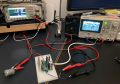
Unfortunately, in my limitations I can only understand this last part of your comment well - and this is because other members explained the same point to me a few days ago.
But yes - in my desires - the output is analog - like sine waves.

Reading suggestions from you all I'm getting a lot of stimulating questions in my mind, which I will try to study to find an answer.
Among other things, I saw that the site offers an "EDUCATION" section which I intend to follow.

I thank everyone for their participation and sorry if I never give you adequate feedback...
you are too advanced for a level like mine.

In any case, thanks
Francesco
 

Thread Starter

Frank Bolleri

Joined Sep 23, 2023
77
I dare to suggest this circuit (which I built twice, with success), designed by member @DickCappels. Go to his site, here

BTW, he was certainly helpful answering questions about it. Buena suerte.
Thank you!
In addition to the circuit you suggest, I see that there are a lot of other projects by the same author, it seems to me a valuable link to be saved in favorites.

Have a nice day
Francesco
 

Thread Starter

Frank Bolleri

Joined Sep 23, 2023
77
This evening I have tested with the same purpose another solution... what is described here.
The module is a cheaper TDA7293 100W audio amplifier (available on Amazon), modified for DC coupling as described in the link with just 2 jumpers.
From my point of view, is great that is traditional (not SMD), so a lot more easy to alter with a common welder.

It works well!

I have powered the damn 3V little motor with a square wave 74mVpp + 37mV offset PWM (which produce around 0-2.5 V output).
Useless, but funny and intersting, I have tried several frequencies and several duty cycle values.

Screenshot 2023-10-20 at 01.11.14.png


Here the noisy aspect is that the gain factor is fixed at 33, which make less immediate the setup of the driving waveform parameters.

Maybe I can try to design another bizarre, weird and wrong circuit to insert in between the signal generation and the board, to divide the input signal by 3.3 and have finally a 1:10 ratio, much easier to use...:)

Francesco
 

MrAl

Joined Jun 17, 2014
13,709
This evening I have tested with the same purpose another solution... what is described here.
The module is a cheaper TDA7293 100W audio amplifier (available on Amazon), modified for DC coupling as described in the link with just 2 jumpers.
From my point of view, is great that is traditional (not SMD), so a lot more easy to alter with a common welder.

It works well!

I have powered the damn 3V little motor with a square wave 74mVpp + 37mV offset PWM (which produce around 0-2.5 V output).
Useless, but funny and intersting, I have tried several frequencies and several duty cycle values.

View attachment 305380


Here the noisy aspect is that the gain factor is fixed at 33, which make less immediate the setup of the driving waveform parameters.

Maybe I can try to design another bizarre, weird and wrong circuit to insert in between the signal generation and the board, to divide the input signal by 3.3 and have finally a 1:10 ratio, much easier to use...:)

Francesco
Hi,

That stuff can be a lot of fun to play around with, and one day you may be able to use it for something practical. It's at the heart of building a robot. You need controlled motors for any movements.

Congrats on getting this far. I hope you stick with it as I look forward to reading more about what you are doing.
 

Thread Starter

Frank Bolleri

Joined Sep 23, 2023
77
Maybe I can try to design another bizarre, weird and wrong circuit to insert in between the signal generation and the board, to divide the input signal by 3.3 and have finally a 1:10 ratio, much easier to use...
Hello all,
looking around in the forum, I have discovered that exists "LTSpice" from Analog Devices and it is free.
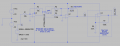
I have tried to use it (hoping it is more reliable compared with Falstad simulator) to develop the idea in the previous post.

The "TDA7293 BOARD EQUIVALENT" box is just to simulate the final output value.. it is not part of the circuit itself.

Screenshot 2023-10-21 at 02.26.07.png

LTSpice seems to me a great software, considering also that is free.
However, using it I face some issues:

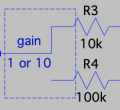
A) I was unable to enter a manual switch, so I have drawed by hand this box - I can move the connector to have the two gain values.
Screenshot 2023-10-21 at 02.32.24.png

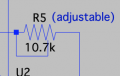
B) I was also unable to enter an adjustable resistor - so I have drawed manually in that way:
Screenshot 2023-10-21 at 02.34.51.png

If someone have some advice about these two point, I will appreciate a lot.

In any case, seems to works, if the simulation is reliable:)

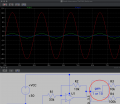
With 10x gain:
GAIN 10.png

With 1x gain:
GAIN 1.png

It is better than the previous experiment? (it is just my second circuit...)

Finally, someone can suggest me an OPAMP to use for U1 and U2?

Good night
Francesco
 

MrAl

Joined Jun 17, 2014
13,709
Hello all,
looking around in the forum, I have discovered that exists "LTSpice" from Analog Devices and it is free.
I have tried to use it (hoping it is more reliable compared with Falstad simulator) to develop the idea in the previous post.

The "TDA7293 BOARD EQUIVALENT" box is just to simulate the final output value.. it is not part of the circuit itself.

View attachment 305447

LTSpice seems to me a great software, considering also that is free.
However, using it I face some issues:

A) I was unable to enter a manual switch, so I have drawed by hand this box - I can move the connector to have the two gain values.
View attachment 305448

B) I was also unable to enter an adjustable resistor - so I have drawed manually in that way:
View attachment 305449

If someone have some advice about these two point, I will appreciate a lot.

In any case, seems to works, if the simulation is reliable:)

With 10x gain:
View attachment 305451

With 1x gain:
View attachment 305452

It is better than the previous experiment? (it is just my second circuit...)

Finally, someone can suggest me an OPAMP to use for U1 and U2?

Good night
Francesco
Hi,

Probably need something with a GBP of maybe 10MHz, and slew rate maybe 0.1v/us.
You need the bandwidth to get to the max frequency, and slew rate that is at least equal to the fastest rate of rise of the sine near the zero crossing.
There should be a lot of op amps that can do this, but do you really need a 30v power source? What amplitude output are you looking for, like the peak of the sine wave?
 

Thread Starter

Frank Bolleri

Joined Sep 23, 2023
77
Hi,

Probably need something with a GBP of maybe 10MHz, and slew rate maybe 0.1v/us.
You need the bandwidth to get to the max frequency, and slew rate that is at least equal to the fastest rate of rise of the sine near the zero crossing.
There should be a lot of op amps that can do this, but do you really need a 30v power source? What amplitude output are you looking for, like the peak of the sine wave?
Hi,
I always put +30V -30V by default because this is the maximum value I can have out from my Siglent power supply in serial mode, but is not a strict requirement.

My function generator have instead a maximum of 20 Vpp.

The obsession for gain 1 or 10 come out instead from having a mindless proportion to calculate in usage.
For bandwith, I think that tange from DC to 100KHz is more than sufficient.

For 100KHz Google suggest 32V/us slew rate as a limit.
Screenshot 2023-10-21 at 15.13.46.png

Current for each channel (if I have used well LT Spice simulator) is always less than 1mA.
I have at home 10 of these UA741CN - so I think I have to decrease the general power supply from +/-30V to +/- 20V, and I can use this...
 

MrAl

Joined Jun 17, 2014
13,709
Hi,
I always put +30V -30V by default because this is the maximum value I can have out from my Siglent power supply in serial mode, but is not a strict requirement.

My function generator have instead a maximum of 20 Vpp.

The obsession for gain 1 or 10 come out instead from having a mindless proportion to calculate in usage.
For bandwith, I think that tange from DC to 100KHz is more than sufficient.

For 100KHz Google suggest 32V/us slew rate as a limit.
View attachment 305502

Current for each channel (if I have used well LT Spice simulator) is always less than 1mA.
I have at home 10 of these UA741CN - so I think I have to decrease the general power supply from +/-30V to +/- 20V, and I can use this...
Ok but you can't use plus and minus 30 volts with most regular op amps.

I meant to say 10v/us but ended up inverting it to 0.1v/us which is far too slow, even the older LM358 can do at least 0.5v/us (ha ha). There are some special purpose op amps that only do 0.1v/us but obviously you do not want that here.

The slope of a sine wave with peak amplitude A and frequency f is:
m=2*pi*f*A, in volts per second.
Using f=100kHz and A=15 volts, we get:
m=9.42 volts per microsecond.

If you really intend to go to 30 volts peak (which i don't think you easily can) that doubles 'A' and so 'm' doubles to 19 volts per microsecond.
That 100kHz would then often be referred to as the "power bandwidth".

You can go higher on the slew rate but then the bandwidth usually goes up too, and that makes the wiring a little more critical in order to avoid unwanted oscillations and/or ringing.
 

MrAl

Joined Jun 17, 2014
13,709
A 741 opamp was designed 55 years ago and has such poor specs that it should be buried.
This is one area where i have to agree, the 741 is almost not worth even thinking about. At the very least, move to an LM358 which has a much better input operating range and lower power supply requirements.
 

Thread Starter

Frank Bolleri

Joined Sep 23, 2023
77
Thank you.
Immediately after Audioguru's observation on 741 I went to see what was available at home and found this other JRC4558, with +/-22V power supply range - I used this one.

It's a success!
Here are the steps I took.

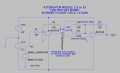
1) Refine the schematics
I have removed the emulated TDA7293 block in order to have just my circuit.
More, I have changed idea about the variable esistors for tuning - I provide both channel with its own trimmer - doubling the value of the resistor (10k become 20k trimmer, 100k become 200k trimmer), hoping in that mode to be able to fine compensate the gain.
FINAL SCHEMATICS.png

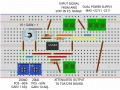
2) Study a breadboard layout using Fritzing
DESIGNED BREADBOARD.png

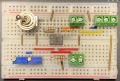
3) Realization on real breadboard
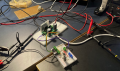
REAL BREADBOARD.png

4) Arrange for test and fine tuning of the trimmers
My module take from TDA7293 board the power supply - for the test I have provided +/- 10V.
I have connected signal generator to my module input and to channel 2 of oscilloscope.
The output of my module was connected to input of TDA7293 and on output of TDA7293 board I have connected channel 1 of oscilloscope.
WIRING FOR TEST.png
I make necessary tuning of the trimmers for the two optionsgain 1X and 10X.

5) Final test!

Gain 1X:
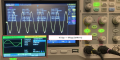
GAIN 1X.png

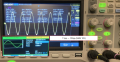
Gain 10X:
GAIN 1OX.png

I am so satisfied! :)
 

MrAl

Joined Jun 17, 2014
13,709
Thank you.
Immediately after Audioguru's observation on 741 I went to see what was available at home and found this other JRC4558, with +/-22V power supply range - I used this one.

It's a success!
Here are the steps I took.

1) Refine the schematics
I have removed the emulated TDA7293 block in order to have just my circuit.
More, I have changed idea about the variable esistors for tuning - I provide both channel with its own trimmer - doubling the value of the resistor (10k become 20k trimmer, 100k become 200k trimmer), hoping in that mode to be able to fine compensate the gain.
View attachment 305562

2) Study a breadboard layout using Fritzing
View attachment 305563

3) Realization on real breadboard
View attachment 305564

4) Arrange for test and fine tuning of the trimmers
My module take from TDA7293 board the power supply - for the test I have provided +/- 10V.
I have connected signal generator to my module input and to channel 2 of oscilloscope.
The output of my module was connected to input of TDA7293 and on output of TDA7293 board I have connected channel 1 of oscilloscope.
View attachment 305565
I make necessary tuning of the trimmers for the two optionsgain 1X and 10X.

5) Final test!

Gain 1X:
View attachment 305566

Gain 10X:
View attachment 305567

I am so satisfied! :)
Hi,

Yeah, that's an LM358 with a higher voltage supply capability :) and *maybe* a little faster (requires good testing over several units).
You probably have to test up to 100kHz as that chip may then be on the functional borderline of working/not working without objectionable distortion, depending on how high you set the output amplitude.

I am not sure that is a good choice though for reliable 100kHz operation if you were to build a lot of these circuits instead of just one. Also, it may work, but in the future if you have to replace the op amp with a new one it may not work as well after that.

There are three main things we have to consider for an op amp choice:
1. Bandwidth, the minium specification.
2. Slew rate, the minimum specification.
3. The output amplitude, the maximum needed.
 
Last edited:

Thread Starter

Frank Bolleri

Joined Sep 23, 2023
77
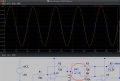
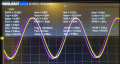
With gain 10X, approaching 50kHz appear a phase offset
Screenshot 2023-10-22 at 17.16.07.png

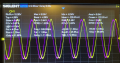
Phase offset at 100 kHz
Screenshot 2023-10-22 at 17.17.31.png

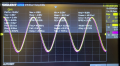
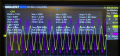
Approaching 250 kHz there is also a begin of amplitude reduction:
Screenshot 2023-10-22 at 17.19.07.png

that progressively continue, togheter with the phase offset.
Here the signal at 500 KHz:
Screenshot 2023-10-22 at 17.21.16.png

But I think is ok... my desire was to have something to attach to function generator to play with some load.
I don't need a wide bandwith for that.

I am satisfied! And I hope this thread can help someone in the future to have another option for "Signal Generator Amplifier DIY making".

Thanks to all,
Francesco
 

Audioguru again

Joined Oct 21, 2019
6,826
The JRC4558 dual opamp is also Very Old. Like most old opamps, its Absolute Maximum supply is +18V and -18V for a total of 36V. You are burning yours with a total of 60V!
 

Thread Starter

Frank Bolleri

Joined Sep 23, 2023
77
The JRC4558 dual opamp is also Very Old. Like most old opamps, its Absolute Maximum supply is +18V and -18V for a total of 36V. You are burning yours with a total of 60V!
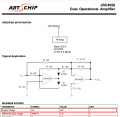
I have readed this value in datasheet
Screenshot 2023-10-22 at 17.59.50.png

and I have retouched my design to lower the power supply:
Screenshot 2023-10-22 at 18.00.57.png

What is wrong this time?
Where did you find the value of +/- 18V?
 
Top