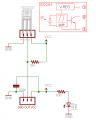
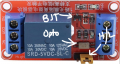
The reason why it's 1.4V and not 0 has to do with how much the transistor is conducting based on light available. There is no The signal input to the relay is buffered by opto and transistor and direct to the solenoid.
You might be able to get by with a BJT (e.g. 2N3904) emitter-follower to drive the relay.
The output will be about 0.7V below the sensor output, but that's likely sufficient to operate the relay.
Just connect the base to the sensor output, the collector to V+, and the emitter to the relay.
I have a 12 volt relay on my bench right now. I've tested it with a varying voltage. It clicks in at 8.8 volts and holds till it drops out at 3.7 volts. And that's an old relay out of something for which I can't remember where it comes from. A diode's forward drop is not going to prevent a 12 volt relay from clicking in. Of course, we're not mentioning current. As long as there is sufficient current - it will click in. THAT is something I can't answer - how much current. A 10KΩ resistor in series with the coil is NOT going to give you sufficient current. That much is born out by the facts of the current I posted regarding a 5 volt supply and a 10KΩ resistor.
@Tonyr1084 for the last time that’s the pull-up current. It switches on the low. The 10k doesn’t matter. It’s bypassed when the transistor is saturating.
OK, not sure what I'm missing here. IF pin 3 goes low then 500 µA flow through the resistor but pulls both legs of the relay to Low. If the output of the sensor pin 3 does not go high then what energizes the relay? Not that I need to know, this is not my thread. However, if I'm mis-understanding something then I'm giving out bad information. Maybe I should just back out of this thread and let others help the TS.
When it's off it's outputting 5V through the 10k pull up resistor.
When the photodiode is on it turns on the internal "amp" and turns on the internal transistor giving you a LOW output or a path to ground.
When the LOW is activated the relay circuit bypasses the 10K pull up and goes through the internal transistor. Hopefully this is enough current to turn the relay on. We are not sure because TS should change the jumper to "L" setting on the relay. It will never trip on a high due to low current (500 uA).
I have the same LASER Detector board laying here. The Red LED is merely a power indicator and illuminates anytime power is applied. One 10 K resistor is in series with the LED as drawn and limits LED current. The remaining 10 K Ohm resistor acts as a pull up resistor since the actual photo transistor sensor uses an open collector output. Less that external 10 K resistor the open collector out would just be floating, thus the need for the resistance.
Your problem is as was mentioned, sensors like this can typically only source 0.010 Amp (10.0 mA) so any relay coil needing in excess of 10 mA (and that is pushing it) will simply load the sensor down and we can call game over. Your options are to use either a BJT Transistor or MOSFET to drive your relay coil and if using a MOSFET you want a Logic Level MOSFET. The module output is digital in that there is 5 Volts when LASER is striking the sensor and about 0 volts when no LASER light is detected. Anyway the reason for your low output voltage is the inability to source adequate current for your relay coil. They do make relay boards like this one which allow a simple logic signal to power a relay, I have seen them with one or more relays.
If you want a read on your sensor or similar sensors it can be found here. Take note of the Open Collector outputs found on page 3 of 8.