Sensing when generator is running

Thread Starter

billrvolz

Joined Jul 20, 2021
34
You should check for the presence of the presumed 60V. I suspect this is a bad assumption and the generator actually doesn't output any voltage until full speed is reached.
Yes, before I do anything I will check the voltage. On my generator at home, it seems to run at 2/3 speed. Frequency is 40 vs 60 and voltage is 145 vs 240. I also need to check that the generator energizes the wires all the way to the transfer switch.
 

Thread Starter

billrvolz

Joined Jul 20, 2021
34
Consider that the purpose of the test is to verify that the generator IS ABLE TO SUPPLY POWER, not just able to start. So every bit of the system needs to be verified as functional.
In a good quality well engineered system, the check would verify that the generator was delivering the specified voltage, not simply spinning. Thus verifying the output of the generator would be a requirement. And hopefully also verifying that it is delivering some rated amount of power to some sort of load. It would be useful to know just what exactly is being tested each time.
At least a few brands of generator start, come up to full speed, and then transfer to the intended load during the test. No shortcuts taken. Every part of the entire package is verified during the test.
Is it possible that the system only gets up to half speed because at no load that can produce full voltage?
Ian makes a good point, but as we do not know any of the operation details that is an unknown.
And now another question: Does the system have an output that would report the failed condition?? A test is of rather limited value if you do not know the results. Some systems display an external green light when they are verified as ready and able.
For my application that would be overkill. If I need that there are montoring relays such as this https://www.amazon.com/Voltage-Moni...1-2-spons&sp_csd=d2lkZ2V0TmFtZT1zcF9hdGY&th=1

I have the 3 phase version that monitors the incoming 3 phases for my pump motors so they don't burn out if the utility drops one leg.
 

Thread Starter

billrvolz

Joined Jul 20, 2021
34
Load test seems to be outside scope of the ask.
A true load test inherits the "running or not" question.
I not even sure if that gen senses load side. No load (xfer switch did not do cutover) then the gen probably just idles at lower rpm's (maybe, depends on gen type). The gen might also go full rpm's if it knows util lost power but the xfer switch failed to cutover.

I guess the periodic test is their normal "can we start" test. The gen side assumes the xfer switch gear is good. There's several fail modes to be had, like the gen starts because of lost util power, the xfer switch does it's thing, but gen just stays idling at low rpm's.

I just just all that familiar with the Generac gen systems.

Sensing running or not, possibly even at low speed vs high speed, is easy.
The problem I want to solve beyond if it's running or not is this - For several years the generators would not auto-start so there was no exercise. They would just crank until the battery died. If the power went out, we had to go over to the site and start them using starter fluid. I want to know that they are exercising weekly. The starting problem was fixed recently and turned out to be the internal fuel regulators. They auto-start now. So now I want to make sure they are starting.
 

Thread Starter

billrvolz

Joined Jul 20, 2021
34
I didn't see Hymie's post before I said the same thing in #27. Again, if the resulting signal is fully isolated and talking to a rPi, Arduino, etc, then you don't need a filter cap; the software can filter it. In fact, since a pulsing signal is way more noise-immune, no filter cap is better. The uC can detect not only signal presence, but frequency before making a decision to produce an indication.

ak
The signal would be going into one of the analog inputs on this https://controlbyweb.com/x420/ The input analog mode can be set to digital input and I'd feed it 5 Vdc as the signal that would turn on/off via a relay. I can use the state change to send emails. I'm concerned that sending a rectified input that it would just trigger 60 times a second.
 

Hymie

Joined Mar 30, 2018
1,347
Here is a circuit that I designed & built for work that outputs 5Vdc whenever the input is between 100-240Vac – which is as described in my post #2.

The purpose of the circuit was to allow mains on/off timing to be measured using a calibrated instrument requiring low voltage input signal levels. In operation the circuit output (5V/0V) is switched within 15ms regardless of where in the mains cycle the switching occurs (which was well within the timings required). The secondary 5Vdc supply was provided by a USB power source.

Note that the 22kΩ resistor immediately following the bridge rectifier is dissipating 2.6W with an input voltage of 240Vac. The two paralleled 47µF capacitors could be increased in value in your application since fast switching between states is not required.
 

Attachments

DC_Kid

Joined Feb 25, 2008
1,242
The problem I want to solve beyond if it's running or not is this - For several years the generators would not auto-start so there was no exercise. They would just crank until the battery died. If the power went out, we had to go over to the site and start them using starter fluid. I want to know that they are exercising weekly. The starting problem was fixed recently and turned out to be the internal fuel regulators. They auto-start now. So now I want to make sure they are starting.
I myself like a no-contact passive solution.

Two NO micro switches with correct size paddle attached to them, located in a cooling airflow, can just be 5v signals to your X-420. One low speed (it started for the weekly low rpm test), and one high speed (it started and it's not running low speed, likely util power fail).

If you don't care to know the diff, then just one switch with right size paddle for low speed, but I would install two in parallel for switch fail reasons. With some logic on the user end (email, etc), with just one switch, if there's a notice of "running" and it's not at the known specified weekly test time, then you know it's running full speed, but don't necessarily know 100% that util power failed, it would be assumed.

If the X-420 has any A-to-D inputs, you could use that to determine load on the gen by using a pickup coil wrapped around one of the gen CCC lines.

Here is a circuit that I designed & built for work that outputs 5Vdc whenever the input is between 100-240Vac – which is as described in my post #2.
The gen itself may not switch on it's output during a low rpm "test" run. I think this is done for safety reasons, to keep high volts off the xfer switch until the util power actually fails.
 
Last edited:

MisterBill2

Joined Jan 23, 2018
27,522
I just want to know if the generator is running, either in exercise or due to an outage. I have a UPS/Raspberry plus power monitors on some 3 phase motors that will notify me of any real outage.
OK, so you are covered by a different arrangement and the generator is a backup, not a UPS. That is also done for systems that do not allow even momentary glitches or gaps.
The relay in the photo is a 2-pole normally open contacts relay. It could be part of a transfer/change-over system but it is not an actual TRANSFER relay. Transfer includes disconnecting one feed and connecting another. Those are the systems that supply the power where the possibility of dropouts is forbidden. And transfer relays cost a lot more that the relay in the picture.
 

Reloadron

Joined Jan 15, 2015
7,889
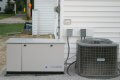
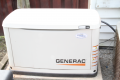
This is a 13 KW older Generac:
Old Genset.png

This is a newer 16 KW Generac:
New Genset.png

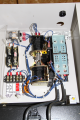
This is a Generac Transfer Switch:
Transfer Switch.png

When these generators do an "exercise routine" they start at full speed and then throttle down to an idle for the exercise routine duration. There is a caveat here in that during exercise the genset does not produce any voltage as in zero, zip. No transfer takes place. No during exercise the output voltage does not drop to 60 volta or any volts since there is no output. The downside is while the user is fat dumb and happy because the genset starts and runs an exercise routine it is or can make power. That is flawed thinking. The only way to know if the genset will make power is to drop out mains power and see if the unit auto starts, transfer happens, and as we say the lights come on. I learned this the hard way and thank God I still had an old 4 KW Coleman Power Mate and gasoline. The sump was overflowing. :(

In the interest of both compatibility and getting good monitoring data the genset after market kits can be had from Generac. If the genset has a plug as seen in the video it will take the aftermarket kit. The WiFi tells you anything you could want to know.

Next if you only care about engine running you can sense oil pressure and likely just use the existing oil pressure switch.

Remember exercise = no output voltage.

Ron
 

MisterBill2

Joined Jan 23, 2018
27,522
That change over mechanism looks quite interesting. two solenoids to force a switch to change.
I think that I would use a gear-motor driven cam to drive a snap action lever to move contacts similar to those in a 50 amp motor starter. Fast make, fast break, and a lower power drive mechanism, with the motion from a cocked spring mechanism.
My current change over scheme has six high current toggle switches and is totally manual.
 

drjohsmith

Joined Dec 13, 2021
1,601
That change over mechanism looks quite interesting. two solenoids to force a switch to change.
I think that I would use a gear-motor driven cam to drive a snap action lever to move contacts similar to those in a 50 amp motor starter. Fast make, fast break, and a lower power drive mechanism, with the motion from a cocked spring mechanism.
My current change over scheme has six high current toggle switches and is totally manual.
A good old contactor is designed for switching , safe and reliable .
 
Apologies if I missed it somewhere in the last 72 posts but has anyone suggested a good old fashioned transformer with primary/secondary ratio matched to the AC voltage when the generator is running at it's test speed, full wave rectified (anyone old enough to remember power supplies that were not switchers?), smoothing capacitor, LM317 voltage regulator set to the output voltage needed for a relay? Voltage into LM317 not to exceed its maximum specified when the generator is actually in use generating a higher AC voltage.

Although a resistive divider, diode and opto isolator as already suggested sounds nice.
 

strantor

Joined Oct 3, 2010
6,875
Apologies if I missed it somewhere in the last 72 posts but has anyone suggested a good old fashioned transformer with primary/secondary ratio matched ...
I don't blame you for not reading all that but one thing you missed was this:

during exercise the genset does not produce any voltage as in zero, zip. No transfer takes place. No during exercise the output voltage does not drop to 60 volts or any volts since there is no output.
[...]
Remember exercise = no output voltage.
 
There is a caveat here in that during exercise the genset does not produce any voltage as in zero, zip. No transfer takes place.
I don't blame you for not reading all that but one thing you missed was this:
Thanks for pointing this out. I found it now in post #70 although I think we've not yet had that confirmed by the thread starter and even then, surely if the alternator is spinning there will be a voltage being generated, albeit not connected to the output? If not, which would presumably require some kind of clutch arrangement, this would be more expensive than a circuit breaker?

So the oil pressure sensor as already suggested would be easy to tap into. Presumably, if these are standby generators, there will normally be mains power available adjacent to them to power the electronics - or just the genset starter battery. Which suggests, maybe monitor the battery voltage - if it does a sudden drop and then recovers it suggests a successful genset start.
 

DC_Kid

Joined Feb 25, 2008
1,242
In post #70, from that load center switch, there should be auto sense control signal wire that goes to the gen outside. I suspect a low AC voltage is present. One could sense that voltage (or lack of) at the gen to know if util failed.

So, there are two contactless sensor points that can give all the data needed.

gen run & power states defined
state1 - running with util power ok (typically the test run on known schedule)
state2 - running with no util power, but xfer failed, no load
state3 - running with no util power, has load

Paddle micro switch configured to close when gen runs "normal" load rpm's.
Coil pickup wrapped around one of the gen #00 (CCC) power wires.

The paddle switch will close at any gen rpm's, thus indicating it is running.
With signal from pickup coil you'll know if xfer of power was success or not.

A run at any other time outside known test run schedule, should mean util power failed and there should be load. The pickup coil indicates the load/no-load condition.
 

strantor

Joined Oct 3, 2010
6,875
Thanks for pointing this out. I found it now in post #70 although I think we've not yet had that confirmed by the thread starter and even then, surely if the alternator is spinning there will be a voltage being generated, albeit not connected to the output? If not, which would presumably require some kind of clutch arrangement, this would be more expensive than a circuit breaker?
It's an alternator as you said, and a brushed one, with a regulator (AVR). The output voltage will be whatever the AVR tells it to be; no clutch necessary. This is just a SWAG but if the engine is at 1/2 speed or 2/3 speed then I would expect the AVR to tell the alternator to produce 0V. The SWAG that TS is operating under, is that the AVR will tell the alternator to output 1/2 voltage or 2/3 voltage. Does not make sense to me. Why would it do that? At half speed why would the AVR command half voltage? I would expect at half speed to have either full voltage at 30Hz or 0 volts (with 0V being much more likely). Another Generac owner (2 units owned) who has actually measured the output and isn't making SWAGs has confirmed 0 volts as I suspected. I may be jumping the gun by considering 0V output confirmed, but it seems pretty safe to do so from where I stand.
Here is a Generac 13kw sample schematic.

So the oil pressure sensor as already suggested would be easy to tap into. Presumably, if these are standby generators, there will normally be mains power available adjacent to them to power the electronics - or just the genset starter battery. Which suggests, maybe monitor the battery voltage - if it does a sudden drop and then recovers it suggests a successful genset start.
It should have a low oil sensor and prior to finding the schematic above I assumed it would be connected to the HV coils to ground them like a "kill switch." But it seems more likely now that it is going to a PCB which is probably monitoring the switch with some low DC voltage that should be easy to detect. So yeah, if that's the case then I am 100% onboard with using the oil pressure switch.
 

ThePanMan

Joined Mar 13, 2020
920
Jumping in way late and I didn't read any of the posts other than the first; if it's a gasoline or natural gas powered generator put a thermocouple in the exhaust stream. That's GOING to get HOT. Use that to trigger a comparator which triggers your indicator circuitry.
 

DC_Kid

Joined Feb 25, 2008
1,242
Jumping in way late and I didn't read any of the posts other than the first; if it's a gasoline or natural gas powered generator put a thermocouple in the exhaust stream. That's GOING to get HOT. Use that to trigger a comparator which triggers your indicator circuitry.
Not a bad idea, but is more complicated.

If the gen unit has no power to hook into, then everything needs to be wired to another location, or, some power needs to be brought to the gen unit for the monitoring electronics to run (TC wire is not exactly cheap). The x-420 dac does have a 5vdc output that can be used. The x-420 also has analog inputs rated with ± , so that sounds like it can look at AC voltage too. A pickup coil around one of the gen CCC's can feed a x-420 analog input, and then in the x-420 config you set a threshold for an alert. That threshold would be TBD, but this gives good indication that the gen is running because util power failed, and the xfer switch did good.

One micro switch w/ paddle and a pickup coil, is just 4 small AWG wire cable (outdoor rated for longevity).

My next contactless/proximity idea for running or not, a tiny FET with a floating gate placed in proximity to gen rotating coil. Should be enough static from a running gen to have some SD current (turn on). FET on 2 wires with say a 10k on D side, a small rat-tail wire on the gate as an "antenna", a little heatshrink tubing over it, zip tie inside the gen housing. $3 in parts, plus some wire to the x-420.
 
Last edited:
Top