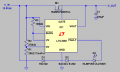
Those resistor values give a 14V cutoff.
Is that what you want?
Is that board compatible with the pinout pattern of the surface mount devices you ordered?
Why are is the 10kΩ resistor 0.1% while the 270kΩ resistor is 1%?
They should both be the 0.1% if you are trying to tighten the tolerance of the cutoff voltage.
If you want the voltage to be adjustable you could substitute a 20kΩ trimpot for the 10kΩ resistor.
Otherwise I see no obvious problems with your part's list.
Those resistor values give a 14V cutoff.
Is that what you want?
Is that board compatible with the pinout pattern of the surface mount devices you ordered?
Why are is the 10kΩ resistor 0.1% while the 270kΩ resistor is 1%?
They should both be the 0.1% if you are trying to tighten the tolerance of the cutoff voltage.
If you want the voltage to be adjustable you could substitute a 20kΩ trimpot for the 10kΩ resistor.
Otherwise I see no obvious problems with your part's list.
With you previous post showing me how you calculate the divider I have made a slight change and changed the 10kohm for 9.76k. This should give a 14.3v cutoff if I'm not mistaken, .5v above the input.
Having just worked this out and reread you reply, yes, perhaps an adjustable option could be a good idea.
The tolerances were a complete oversight, thanks for pointing it out.
Where you say 'is that board compatible...' do you mean my actual power supply unit that I currently have?
Just had a look again at resistor tolerances and a lowest I can see for the 270k is 1%.
Could I possibly juggle these two around bringing one down to maybe get the lower tolerance & raising the other to the limit of 0.1%. Something for me to look at
Not quite sure what you mean, but it makes no difference which resistor is the 1% and which is the 0.1%, the effect on the cutoff voltage tolerance is the same (1.1% total).
That is correct.
I mean are the solder pad spacings on the SMT board compatible with the pin spacing of the parts you are ordering.
Not quite sure what you mean, but it makes no difference which resistor is the 1% and which is the 0.1%, the effect on the cutoff voltage tolerance is the same (1.1% total).
Thanks to everyone that's has help thus far, pointing me gently in the right direction & a special big thanks to @crutschow for all the pestering he allowed me.
All parts ordered for the LTC4365 setup, I'll post back my findings.
It's just a 2 milliamp limiter for the LED. I don't know why you can't do that with a resistor (because you know what the input voltage is). Mfg. = Central Semiconductor.
I could do this with a 2N4416 j-fet, but that would be running you on a strange errand when a resistor will do.
After a little more searching I found the D3 as shown on the schematic was a surface mount 2.1v, so my choice is not correct, I have now changed this to: http://uk.rs-online.com/web/p/products/7693586/
Or you could put 560 ohms where D2 is.
Or make the pot 2K and place that in series with 8.2K 5% or 8.87K 1% for a finer range of adjustment.
These are not important changes. Just options, mostly to demonstrate the kind of fine tuning methods that come from experience in designing analog circuits.

 Facebook
 Google
 GitHub
 Linkedin