Amplifier Crowbar Circuit Help

Thread Starter

jkelly662

Joined Mar 10, 2024
5
Hi,

I've reverse engineered the crowbar circuit on a large amplifier I'm working on. I understand the basics of how a crowbar is supposed to work, but this particular design is difficult for me to grasp. The input voltage is +/-250 VDC. The K1 relay appears to disable the crowbar when the relay coil is energized. I am trying to figure out how the crowbar is triggered. It looks to me like the relay must be in it's 'OFF' state to power the SCR. Any help is appreciated.

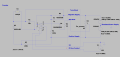
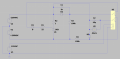
Schematic from LTSpice is attached.

Thanks,
 

Attachments

crutschow

Joined Mar 14, 2008
38,316
My view of the schematic shows faint lines, with some not visible, giving open connections.
Also it does not follow the normal left-to-right signal flow.
So really is impossible to read.
 

Thread Starter

jkelly662

Joined Mar 10, 2024
5
Thanks for responding. I'll upload a new version of the diagram. The layout mimics the physical layout of the board which made it easier to create, but more difficult to read.

The faint lines are probably the non-functional box around the terminal block. It's not part of the diagram. The unconnected lines on the relay are unconnected on the actual circuit but are necessary to show in LTSpice in order to probe them.
 

Ian0

Joined Aug 7, 2020
13,097
Would its main purpose be to discharge the power supply capacitors when the amplifier is off?
It certainly doesn't look like the usual audio amplifier crowbar which protects the loudspeakers from DC
 

Thread Starter

jkelly662

Joined Mar 10, 2024
5
Would its main purpose be to discharge the power supply capacitors when the amplifier is off?
It certainly doesn't look like the usual audio amplifier crowbar which protects the loudspeakers from DC
That's an interesting idea I hadn't thought of. It very well could be for that purpose. This particular amplifier does have 12x very large 10,000uF capacitors on the 250VDC power supply. It's an amplifier for powering a shaker/vibration table which has a large field coil.
 

Ramussons

Joined May 3, 2013
1,567
Hi,

I've reverse engineered the crowbar circuit on a large amplifier I'm working on. I understand the basics of how a crowbar is supposed to work, but this particular design is difficult for me to grasp. The input voltage is +/-250 VDC. The K1 relay appears to disable the crowbar when the relay coil is energized. I am trying to figure out how the crowbar is triggered. It looks to me like the relay must be in it's 'OFF' state to power the SCR. Any help is appreciated.

Schematic from LTSpice is attached.

Thanks,
The Crowbar works by sensing something fundamental - Voltage, Current, Power, Temperature,......
What does your Crowbar sense?
 

LadySpark

Joined Feb 7, 2024
194
That's an interesting idea I hadn't thought of. It very well could be for that purpose. This particular amplifier does have 12x very large 10,000uF capacitors on the 250VDC power supply. It's an amplifier for powering a shaker/vibration table which has a large field coil.
To me it looks like a shutdown circuit that discharges a capacitor bank when powered off. There should be some sort of interlock circuit that energizes this relay before powering up the power supply.
 

Ian0

Joined Aug 7, 2020
13,097
I think that discharging 500V through a 1Ω resistor is a little unkind on the capacitors, and would accomplish the process well within the legally required time even if the discharge resistor were substantially higher.
 

LadySpark

Joined Feb 7, 2024
194
I think that discharging 500V through a 1Ω resistor is a little unkind on the capacitors, and would accomplish the process well within the legally required time even if the discharge resistor were substantially higher.
Since we don't have a diagram of the power supply/capacitor network, it could have that resistor tied off the last dropping resistors in the power supply and it wasn't illustrated in the relay circuit drawing.
 

MisterBill2

Joined Jan 23, 2018
27,164
Given that the primary purpose of an actual "CROWBAR" circuit is to short-circuit the power supply output when the regulation fails, so as to prevent over-voltage damage. An actual Crowbar is triggered only by over voltage.
A safety-discharge circuit is quite different, in that it is intended to drain the charged capacitors before some fool can grab a live conductor. Connecting 500 volts across a one ohm resistor will pass 500 amps thru the switching device for a period of quite a few seconds. And,as power = current x current x resistance, that is 250,000 watts!!
So my guess is that is actually a 1K ohm resister rated at 250 watts. Those numbers are believable.
And my guess is that the capacitors are in series/parallel, because a 250volt 10,000uF capacitor would be a monster.
 

Thread Starter

jkelly662

Joined Mar 10, 2024
5
To me it looks like a shutdown circuit that discharges a capacitor bank when powered off. There should be some sort of interlock circuit that energizes this relay before powering up the power supply.
You're right! There is an external relay that energizes the crowbar/safety circuit relay prior to powering up the +250/-250 power supply.

Given that the primary purpose of an actual "CROWBAR" circuit is to short-circuit the power supply output when the regulation fails, so as to prevent over-voltage damage. An actual Crowbar is triggered only by over voltage.
A safety-discharge circuit is quite different, in that it is intended to drain the charged capacitors before some fool can grab a live conductor. Connecting 500 volts across a one ohm resistor will pass 500 amps thru the switching device for a period of quite a few seconds. And,as power = current x current x resistance, that is 250,000 watts!!
So my guess is that is actually a 1K ohm resister rated at 250 watts. Those numbers are believable.
And my guess is that the capacitors are in series/parallel, because a 250volt 10,000uF capacitor would be a monster.
It's six 250V 10,000uF capacitors in parallel and in series with another six 250V 10,000uF capacitors, so I think 30,000uF total. Agreed that the 1 Ohm resistor just doesn't make sense. It might explain why I had to replace it after I found it burned up. This is a massive amplifier cabinet that weights around 1000 lbs. I still need to trace some of the circuitry and re-create it in LTSpice to have any chance of understanding how it all works together. I only understand pieces of it currently.
 

Attachments

MisterBill2

Joined Jan 23, 2018
27,164
The secondary purpose of a crowbar circuit is to assure that there is no hazardous voltage present while any person is working on the apparatus. That is, the intention is to short circuit any voltage that may be accidentally applied.
A serious caution is that random short circuiting of high voltages will often result in serious damage and destruction of portions of that system. A classic example is some fool discharging the high voltage supply of an RF amplifier by connecting the discharge propbe to the plate cap of the amplifier tube, thus damaging the plate circuit RF Choke coil.
 
Top