Schottky transistors in TTL

Thread Starter

xxxyyyba

Joined Aug 7, 2012
289
Not really homework question but maybe it is not so wrong to post it here.
We know that in basic TTL circuits, BJTs work in cut-off, saturation and in reverse-active region. I read that Schottky transistors don't enter saturation mode. In which mode then Schottky transistors in TTL work? In general, what are equations that describe operation of Schottky transistors?
 

crutschow

Joined Mar 14, 2008
38,388
A "Schottky" transistor is just a standard BJT with a Schottky diode connected from base to collector to form a "Baker Clamp".

Since the Schottky diode has a lower forward drop than the base-emitter junction, it will start to conduct current away from the base as the collector voltage drops below the difference between the base-emitter junction drop and the smaller Schottky diode forward drop, keeping the transistor from further turning on and saturating.

In general the equations for this operation are fairly complex because of the diode and BJT equations in the mix.
Much easier to simulate it.
 
Last edited:

MrAl

Joined Jun 17, 2014
13,677
Not really homework question but maybe it is not so wrong to post it here.
We know that in basic TTL circuits, BJTs work in cut-off, saturation and in reverse-active region. I read that Schottky transistors don't enter saturation mode. In which mode then Schottky transistors in TTL work? In general, what are equations that describe operation of Schottky transistors?

Hi,

As had been said, the equations are not super simple but they are interesting. They involve at least four diodes and the Schottkey would be one of those four, but we can simplify down to just two diodes to get a good idea how this works if we dont want to use a simulator for some reason.

The idea is quite simple though, it's just solving the equations are a little more difficult than we like to do sometimes because they involve at least those two diodes and a current controlled current source.

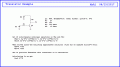
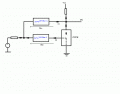
There's one diode that is the base emitter diode and that has one equation, the equation for a diode, and the other diode would be the Schottkey diode from collector to base, and the current generator is from collector to emitter, with the current arrow pointing down, and the sense input for the current generator senses the current through the base emitter diode. From this two non linear equations are formed and solved. They can sometimes be solved directly or using a multi variable solver, or using an algorithm such as steepest decent. We had talked about this not too long ago and i had shown an example. The attachment 2.gif shows just the arrangement for the solution but if you'd like to look at this in more detail we can do that too, and attachment 1.gif shows the two equations and solution for one example circuit.

Because the diode in your circuit would be a Schottkey, the circuit would enter pseudo saturation but the transistor itself would not enter saturation because the internal collector base diode would never become forward biased unless there was something else in the circuit that could force the collector voltage to drop more than the transistor alone would allow (such as another parallel transistor with no clamp or driven separately).

LATER:
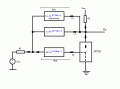
I had to correct one of the drawings and then i added another one showing the Schottkey also.
In the drawing with the Schottkey, the current I2 will be negative and very small even as the collector voltage drops, so the effects of that diode can probably be ignored. That means the equations shown can still be used just with a different diode for the one that depends on Vbc.
 

Attachments

Last edited:
Top