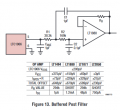
Note that for opamps LT1880 and LT2050, the value of RB is zero. That means it is just a wire. For the others, I note the very small values of I_SQ. If I had to guess, and that it all it is, the value of 294kΩ specified in the table for LT1494 and LT1077 is pretty close to the sum of resistances in the forward path:
The opamp is still a unity gain buffer because the resistance in the forward path is approximately equal to the resistance in the feedback path and is an attepmt to minimize offset and bias current errors.
ETA: I could not find a parameter I_SQ in the LT1880 datasheet, but it was only a cursory examination.
RB is there for bias current cancellation/compensation.
Depending on the circuit and the parts, the input pins to an opamp can either source or sink and very small current. This is the base current needed for the input transistors to function. If the currents into the two pins are not equal, this can cause a DC offset error in the output signal. Sometimes these errors are so low that the designer can choose to ignore them.
The first-order approach to mitigate this error is to make the DC resistance paths for the two inputs to be equal. In this case, make the resistance seen by the inverting input equal to the sum of all of the resistances in series with the non-inverting input. Note that these resistance paths do not have to be to GND; they have to be to a low impedance point, such as the circuit's own output or the output stage of a previous circuit.
The filter topology shown is sometimes called "DC-accurate", meaning the DC operating point of the output is equal to the DC component of the input signal. RB is there to make it more accurate.
RB is there for bias current cancellation/compensation.
Depending on the circuit and the parts, the input pins to an opamp can either source or sink and very small current. This is the base current needed for the input transistors to function. If the currents into the two pins are not equal, this can cause a DC offset error in the output signal. Sometimes these errors are so low that the designer can choose to ignore them.
The first-order approach to mitigate this error is to make the DC resistance paths for the two inputs to be equal. In this case, make the resistance seen by the inverting input equal to the sum of all of the resistances in series with the non-inverting input. Note that these resistance paths do not have to be to GND; they have to be to a low impedance point, such as the circuit's own output or the output stage of a previous circuit.
The filter topology shown is sometimes called "DC-accurate", meaning the DC operating point of the output is equal to the DC component of the input signal. RB is there to make it more accurate.
I think many of you are missing one salient point, the value of RB is 50% bigger than the DCR on the -ve input. Is it possible that RB also serves as a stability component? RB together with the -ve input terminal capacitance will form a low pass filter and reduce the feedback at higher frequencies as well as introduce a pole somewhere possibly relevant.
Sallen Key topology requires the opamp to have a low impedance output in the stopband. The action of RB will be to leave the output impedance closer to the open loop output impedance which does not sound nearly so good but,could it be necessary for performance reasons or stability reasons. 294k is a very big value. Could it be helping improve distortion? Such a big value will be adding to noise on the output.
Just asking the less obvious questions because the circuit seems to be more complex than it looks. Plus, I like throwing the cat in amongst the pigeons, to make people think more.

 Facebook
 Google
 GitHub
 Linkedin