Facebook
 Google
 GitHub
 Linkedin

I have read TI's application note Active Low-Pass Filter Design a couple of times.
Although it is probably explained in the paper, I still don't understand some concepts.
I make a practical case referring again to the document I attached.
Let's assume I need to cut-off my signal at 10kHz and amplify it by a factor of K = 4 .. and let's assume that I have to use (for example) a 2° order Sallen-Key Butterworth filter (I don't care if it's correct to use this filter ... it's just an example where the use of this filter is forced on me!).
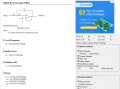
The circuit I need to make is this one:
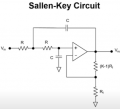
1) Is the K gain tabulated?
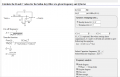
I found this table online that "imposes" to choose these fixed gains to ensure that I am using a Butterworth filter ... so I am forced to choose K = 1.586, rigth?
So to achieve an overall K = 4, I will realize an amplifier stage (subsequent to this filter stage) with gain K = 4/1.586 = 2.522

Is everything correct so far?
2) If the answer is yes, it is not very clear to me why these gain values are set, how they were found, and especially what happens if I choose the resistance Rf and (K-1)Rf so that I have a gain K different from 1.586
3) In addition to this K gain contrain, is there any other value/limit/rule that I have to comply with to ensure that I am using a Butterworth filter?
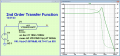
I ask this because online I found this image that seems to impose another limitation:
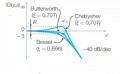
If so ... I should make sure to use a damping coefficient = 0.707 ... but how?
I know the transfer function of the second order low pass Butterworth filter:
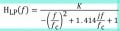
..but in practice I don't know what I should do
Although it is probably explained in the paper, I still don't understand some concepts.
I make a practical case referring again to the document I attached.
Let's assume I need to cut-off my signal at 10kHz and amplify it by a factor of K = 4 .. and let's assume that I have to use (for example) a 2° order Sallen-Key Butterworth filter (I don't care if it's correct to use this filter ... it's just an example where the use of this filter is forced on me!).
The circuit I need to make is this one:
1) Is the K gain tabulated?
I found this table online that "imposes" to choose these fixed gains to ensure that I am using a Butterworth filter ... so I am forced to choose K = 1.586, rigth?
So to achieve an overall K = 4, I will realize an amplifier stage (subsequent to this filter stage) with gain K = 4/1.586 = 2.522

Is everything correct so far?
2) If the answer is yes, it is not very clear to me why these gain values are set, how they were found, and especially what happens if I choose the resistance Rf and (K-1)Rf so that I have a gain K different from 1.586
3) In addition to this K gain contrain, is there any other value/limit/rule that I have to comply with to ensure that I am using a Butterworth filter?
I ask this because online I found this image that seems to impose another limitation:
If so ... I should make sure to use a damping coefficient = 0.707 ... but how?
I know the transfer function of the second order low pass Butterworth filter:
..but in practice I don't know what I should do