Facebook
 Google
 GitHub
 Linkedin

I brushed up a little bit, and came up with the following:
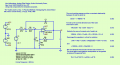
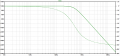
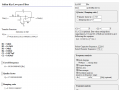
The gain at DC is 20*log(4) = 12 dB. The response is halfway between 12 dB and 6 dB, so down 3 dB at the putative corner frequency. The maximal flatness condition appears to be satisfied with Q=0.707
Verify using:
\( \omega_0\;=\;(\sqrt{R_1R_2C_1C_2})^{-1}\;=\;3146.9\text{ rad/sec}\;=\;500.844\text{ Hz.} \)
The determination of Q is a bit hairy, so bear with me:
\( Q\;=\;\cfrac{\omega_0}{\cfrac{R_1+R_2}{C_1R_1R_2}+\cfrac{1-K}{R_2C_2}}\;=\;\cfrac{3.1469\times10^{3}}{12.0024\times10^{3}\;-\;7.5758\times10^{3}}\;=\;0.71091 \)
and the gain K is:
\( K\;=\;\left( 1\;+\; \cfrac{RB}{RA}\right )\;=\;4 \)
These calculations are in excellent agreement with the Okawa-Denshi design program output.
The gain at DC is 20*log(4) = 12 dB. The response is halfway between 12 dB and 6 dB, so down 3 dB at the putative corner frequency. The maximal flatness condition appears to be satisfied with Q=0.707
Verify using:
\( \omega_0\;=\;(\sqrt{R_1R_2C_1C_2})^{-1}\;=\;3146.9\text{ rad/sec}\;=\;500.844\text{ Hz.} \)
The determination of Q is a bit hairy, so bear with me:
\( Q\;=\;\cfrac{\omega_0}{\cfrac{R_1+R_2}{C_1R_1R_2}+\cfrac{1-K}{R_2C_2}}\;=\;\cfrac{3.1469\times10^{3}}{12.0024\times10^{3}\;-\;7.5758\times10^{3}}\;=\;0.71091 \)
and the gain K is:
\( K\;=\;\left( 1\;+\; \cfrac{RB}{RA}\right )\;=\;4 \)
These calculations are in excellent agreement with the Okawa-Denshi design program output.
Last edited: