Unexpected Second-Order Active Low Pass Filter Behavior?

Thread Starter

userhangaar

Joined Sep 16, 2024
12
Hello AAC,

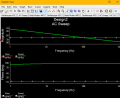
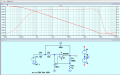
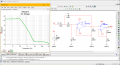
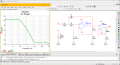
I want to design a low pass filter with a cutoff frequency of 100Hz that would take a 150Hz input. The first photo is my simulation schematic, and the second has the bode plots from the AC sweep analysis. I didn't expect the roll-off to look like that, so I thought I might be doing something wrong.

Simulating with a 741 gives the same behavior. My best guess is its either a thing about the RC values/connections, or a technical limitation with my input and cutoff frequencies. What could I be doing wrong?

Thank you.
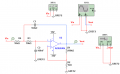
1726917727887.png

1726917531469.png
 

BobTPH

Joined Jun 5, 2013
11,463
Your feedback indicates a gain of 1000. I suspect that is causing your problem. Make the gain 1 by connecting the inverting input directly to output and see if that changes anything.

I checked the R and C and they are correct for a 100Hz cutoff. If the gain is 1. Don’t know how your high gain affects it.
 

crutschow

Joined Mar 14, 2008
38,316
The gain of 1000 is significantly affecting the filter characteristics as compared to a gain of 1, which those filter values were likely calculated for.
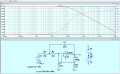
Below is the sim with C1 reduced by a factor of 1000 to mostly compensate for the gain, which gives a response that is -2.8dB @ 100Hz.

Better would be to use a filter with a gain of one and generate the high gain with a separate stage in front of that.

What generates the signal that you need a gain of 1000?

1726925659672.png
 

BobTPH

Joined Jun 5, 2013
11,463
Yes, I put the values into a calculator with a gain 1 stage and they appear be correct for that. I don’t understand why the gain of 1000 requires a capacitor 1000 tmes smaller, but, apparently it does.
 

Thread Starter

userhangaar

Joined Sep 16, 2024
12
Thank you @ericgibbs, @BobTPH, and @crutschow

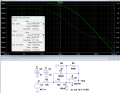
I think it was indeed the high gain that was messing with the frequency response. Below is a circuit with the cascade suggested by @crutschow:

Better would be to use a filter with a gain of one and generate the high gain with a separate stage in front of that.
1726928232130.png

Here's the same circuit, this time with a flatter passband from having a filter gain (1.5) closer to the one recommended for second-order butterworth filters:

1726928481739.png

What generates the signal that you need a gain of 1000?
ECG
 

Thread Starter

userhangaar

Joined Sep 16, 2024
12
I don’t understand why the gain of 1000 requires a capacitor 1000 tmes smaller, but, apparently it does.
Me neither

He has miscalculated the 160n capacitor by an order of 1000.
Should 0.16n
Below is the sim with C1 reduced by a factor of 1000 to mostly compensate for the gain, which gives a response that is -2.8dB @ 100Hz.
Is there a formula for this? I thought it'd be handy to know the math since I'm gonna design another filter, this time for EEG, which require much higher gain (>>10,000)
 

schmitt trigger

Joined Jul 12, 2010
2,027
Just a comment:
If you are going to use opamps in a filter application, it is far better to use either a TL082 or better TL072 instead of the LM358 or LM741.
Not only their higher impedance will load the feedback components much lower, resulting in an actual circuit which more closely resembles the simulation. but its higher slew rate and GBWP will also yield improved signal fidelity.
More so, at higher gains.....
 

BobTPH

Joined Jun 5, 2013
11,463
@crutschow

I think it was indeed the high gain that was messing with the frequency response. Below is a circuit with the cascade suggested by @crutschow
Your circuit has a gain of two, not 1. To get a gain of 2, connect the - input directly to to output, no divider.
 

Thread Starter

userhangaar

Joined Sep 16, 2024
12
Your circuit has a gain of two, not 1. To get a gain of 2, connect the - input directly to to output, no divider.
Right, I missed that. Is there a way to have a gain of 1 while still having feedback resistors whose parallel configuration equals 10k from the RC values? Since I'm using a 741 I wanted to account for input bias current with a nulling circuit just in case
 
Last edited:

crutschow

Joined Mar 14, 2008
38,316
I don’t understand why the gain of 1000 requires a capacitor 1000 tmes smaller, but, apparently it does.
Basically the feedback through the capacitor is increased by 1000, so its capacitance needs to be reduced by the same amount to keep the feedback factor the same.

Edit: Of course the capacitor change also changes the time-constant, so further tweaks would perhaps be necessary to achieve the desired roll-off characteristics.
 
Last edited:

schmitt trigger

Joined Jul 12, 2010
2,027
Is there a formula for this? I thought it'd be handy to know the math since I'm gonna design another filter, this time for EEG, which require much higher gain (>>10,000)
Gain of 10,000 ?!?
You won't achieve it with normal opamps. The ambient noise will swamp it. You require a CMRR of perhaps 90 dB, which can only be achieved with instrumentation amplifiers.
 

crutschow

Joined Mar 14, 2008
38,316
Right, I missed that. Is there a way to have a gain of 1 while still having feedback resistors whose parallel configuration equals 10k from the RC values? Since I'm using a 741 I wanted to account for input bias current with a nulling circuit just in case
Just connect the output directly to the (-) input with no gain resistors.

Note that a gain of 1000 will amplify any DC offset voltage by that value.
 

Thread Starter

userhangaar

Joined Sep 16, 2024
12
Just a comment:
If you are going to use opamps in a filter application, it is far better to use either a TL082 or better TL072 instead of the LM358 or LM741.
Not only their higher impedance will load the feedback components much lower, resulting in an actual circuit which more closely resembles the simulation. but its higher slew rate and GBWP will also yield improved signal fidelity.
More so, at higher gains.....
Thanks so much, I'll look for them

Gain of 10,000 ?!?
You won't achieve it with normal opamps. The ambient noise will swamp it. You require a CMRR of perhaps 90 dB, which can only be achieved with instrumentation amplifiers.
Right. now that I know this, I have a better idea of the gains I should aim for. I initially got the 1000x for ECG and 10000x for EEG figures from a site and ran with them, but I guess those were clinical standards... I reckon I'll go for 100x to 200x for ECG, and 500x to 1000x for EEG for a hobby project like this
 

schmitt trigger

Joined Jul 12, 2010
2,027
1000X is still *a lot* of gain. I would still recommend an instrumentation amplifier to fight the common mode noise at the very first stage.
You may still add a post filter later.
 

Ian0

Joined Aug 7, 2020
13,097
I checked the R and C and they are correct for a 100Hz cutoff. If the gain is 1. Don’t know how your high gain affects it.
Because if there is a gain of 1000, then the current through the capacitor would be 1000 times what it would be if the gain were unity.
So, reducing the capacitance by a factor of 1000 produces the same current as it would have if the gain were unity.
 
Top