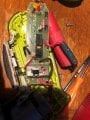
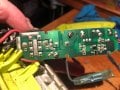
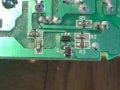
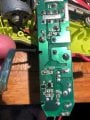
Ryobi 4v cordless drill

Connect drill to charger and measure voltage across R4 shunt (3.9 ohm) with multimeter.
It should be about 0.5V. If the voltage is there a current flows to battery.
 

Thread Starter

spike1947

Joined Feb 4, 2016
537
Connect drill to charger and measure voltage across R4 shunt (3.9 ohm) with multimeter.
It should be about 0.5V. If the voltage is there a current flows to battery.
Hi
Thanks for that, not getting anything , strange thing is, I am getting 6.23v to the board, but if I measure from the + lead on the board to each side of R4, I am getting 9.21v !.
 

LesJones

Joined Jan 8, 2017
4,511
In post #5 when you say " 5.7v from + and each side of R4 with battery disconnected " Which + are you referring to ? (Battery + , + from the charger or something else.)
Is the black wire from near the bottom left of the microswitch connected to the battery negative ? Is there continuity between the black charger input wire and the black wire to near the bottom of the microswitch ? (I can't follow the etch around the area of U1, Q1, R,2 & R3 in your picture of the etch side of the board.) What is the part number of U1 ?

Les.
 

Thread Starter

spike1947

Joined Feb 4, 2016
537
In post #5 when you say " 5.7v from + and each side of R4 with battery disconnected " Which + are you referring to ? (Battery + , + from the charger or something else.)
Is the black wire from near the bottom left of the microswitch connected to the battery negative ? Is there continuity between the black charger input wire and the black wire to near the bottom of the microswitch ? (I can't follow the etch around the area of U1, Q1, R,2 & R3 in your picture of the etch side of the board.) What is the part number of U1 ?

Les.
[/QUOTE
In post #5 when you say " 5.7v from + and each side of R4 with battery disconnected " Which + are you referring to ? (Battery + , + from the charger or something else.)
Is the black wire from near the bottom left of the microswitch connected to the battery negative ? Is there continuity between the black charger input wire and the black wire to near the bottom of the microswitch ? (I can't follow the etch around the area of U1, Q1, R,2 & R3 in your picture of the etch side of the board.) What is the part number of U1 ?

Les.
1: Reading from the + at the charging lead coming onto the board.
2: Yes Black wire connected to the batt neg terminal.
3: Is there continuity between black charger input and the black wire near microswitch, Yes with batt connected, No with batt disconnected.
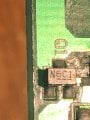
4: # U1 =GBDH

Cheer
Spike
pcb Ryobi Drill 4v.jpg
Back of pcb full.jpg
 
Last edited:

LesJones

Joined Jan 8, 2017
4,511
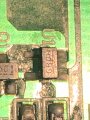
It looks like there is no continuity of the etch on the negative supply between the charger input and the battey negative connection. I suspect that U1 and Q1 control the charging current. I can't find any data on U1 so I cant see a way to diagnose the problem further. You new picture of the area around U1 & Q1 is clear enough to see that there is no direct path between the negative charger input and the battery connection. The positive path is just via the PTC, and the 2 diodes. (R4 R5 and Q2 just drive the charge indicator LED.) From your previous voltage readings I was not clear to EXACTLY you connected your meter leads.
Set your meter to the DC volts range. With the battey NOT connected connect your negtive meter lead to the point on the board where the black charging wire is connected. Connect the positive lead from your meter to the point on the board where the red charging lead is connected and note the voltage reading. move the positive meter lead to the other side of the PTC and note the voltage reading. Move the positive meter lead to the point on the board where the red battery lead is connected and note the meter reading. If you have a resistor of about 100 ohms available connect it between the point where the black charger lead is connected to the board and the point where the red battery lead is connected to the board. Repeat the previous voltage tests again noting the readings. Thes test are to check the positive side of the path between the charger and the battery. Connecting the 100 ohm resistor ts to put some load on the circuit in case the fault is not a total open circuit.

Les.
 

Thread Starter

spike1947

Joined Feb 4, 2016
537
It looks like there is no continuity of the etch on the negative supply between the charger input and the battey negative connection. I suspect that U1 and Q1 control the charging current. I can't find any data on U1 so I cant see a way to diagnose the problem further. You new picture of the area around U1 & Q1 is clear enough to see that there is no direct path between the negative charger input and the battery connection. The positive path is just via the PTC, and the 2 diodes. (R4 R5 and Q2 just drive the charge indicator LED.) From your previous voltage readings I was not clear to EXACTLY you connected your meter leads.
Set your meter to the DC volts range. With the battey NOT connected connect your negtive meter lead to the point on the board where the black charging wire is connected. Connect the positive lead from your meter to the point on the board where the red charging lead is connected and note the voltage reading. move the positive meter lead to the other side of the PTC and note the voltage reading. Move the positive meter lead to the point on the board where the red battery lead is connected and note the meter reading. If you have a resistor of about 100 ohms available connect it between the point where the black charger lead is connected to the board and the point where the red battery lead is connected to the board. Repeat the previous voltage tests again noting the readings. Thes test are to check the positive side of the path between the charger and the battery. Connecting the 100 ohm resistor ts to put some load on the circuit in case the fault is not a total open circuit.

Les.
Hi
Thanks for your help, here goes as per below readings


Set your meter to the DC volts range. With the battery NOT connected.

1: Connect your negative meter lead to the point on the board where the black charging wire is connected, connect the positive lead from your meter to the point on the board where the red charging lead is connected and note the voltage reading. = 6.356v ( With 100 ohms load = 5.799v


2: Move the positive meter lead to the other side of the PTC and note the voltage reading. = 6.355v ( Is the PCT what looks like a ceramic cap ?) ( With 100 ohms load = 5.741v)


3: Move the positive meter lead to the point on the board where the red battery lead is connected and note the meter reading. = 0.423v ( With 100 ohms load = 0.486v )


If you have a resistor of about 100 ohms available connect it between the point where the black charger lead is connected to the board and the point where the red battery lead is connected to the board.

Repeat the previous voltage tests again noting the readings.

These tests are to check the positive side of the path between the charger and the battery.

Connecting the 100 ohm resistor to

put some load on the circuit in case the fault is not a total open circuit.

Cheers
Spike
 
Last edited:

LesJones

Joined Jan 8, 2017
4,511
The readings do not make sense. The first reading is the charging voltage supplied by the charger. I would expect this to be about 6 volts so the 0.4 4 volt reading suggests that the charger is faulty. The second reading is a mystery. As the battery is disconnected and you have just shown that there is almost nothing coming from the charger then what is the source of the 6.35 volts.
Also the PTC (Positive temperature coefficient resistor.) should behave like a low value resistor at room temperature so the voltage on each of its leads should be about the same.

Les.
 

Thread Starter

spike1947

Joined Feb 4, 2016
537
The readings do not make sense. The first reading is the charging voltage supplied by the charger. I would expect this to be about 6 volts so the 0.4 4 volt reading suggests that the charger is faulty. The second reading is a mystery. As the battery is disconnected and you have just shown that there is almost nothing coming from the charger then what is the source of the 6.35 volts.
Also the PTC (Positive temperature coefficient resistor.) should behave like a low value resistor at room temperature so the voltage on each of its leads should be about the same.

Les.
Hi
Sorry my bad, must of got a bit mixed up there, 1st readings are more or less the same has the 2nd readings.
it seems that there is not a current flow from the red feed to the board up to where the battery connects to the board !.
 

LesJones

Joined Jan 8, 2017
4,511
With the negative meter lead connected as before measure the voltages at the following points with and without the 100R resistor connected. (Do this directly on the component leads on the component side of the board.)
1- D1 anode
2 - D1 cathode (Silver band end.)
3 - D2 anode
4 - D2 cathode.

Les.
 

Thread Starter

spike1947

Joined Feb 4, 2016
537
With the negative meter lead connected as before measure the voltages at the following points with and without the 100R resistor connected. (Do this directly on the component leads on the component side of the board.)
1- D1 anode
2 - D1 cathode (Silver band end.)
3 - D2 anode
4 - D2 cathode.

Les.
on the component leads on the component side of the board.)
1- D1 anode 6.232v ( With Resistor 5.723v 0
2 - D1 cathode (Silver band end.) = 0.451v ( with resistor 0.427v )
3 - D2 anode 0.455v ( with resistor 0.435v)
4 - D2 cathode. 0.446v ( with resistor 0.443v)

This is with battery disconnected !
Cheers
 

LesJones

Joined Jan 8, 2017
4,511
D1 Is faulty. It looks like a normal 1 amp silicon diode. Any one of the 1N400x series should be OK. ( The x will be a digit between 1 and 7.) This digit is an indictor for the peak inverse voltage rating. Any one of the range should be OK for this application.

Les.
 

Thread Starter

spike1947

Joined Feb 4, 2016
537
D1 Is faulty. It looks like a normal 1 amp silicon diode. Any one of the 1N400x series should be OK. ( The x will be a digit between 1 and 7.) This digit is an indictor for the peak inverse voltage rating. Any one of the range should be OK for this application.

Les.
Hi
Great, thank you so much, will have a rumble in my component box !.

cheers
 
Top