rlc problem

WBahn

Joined Mar 31, 2012
32,844
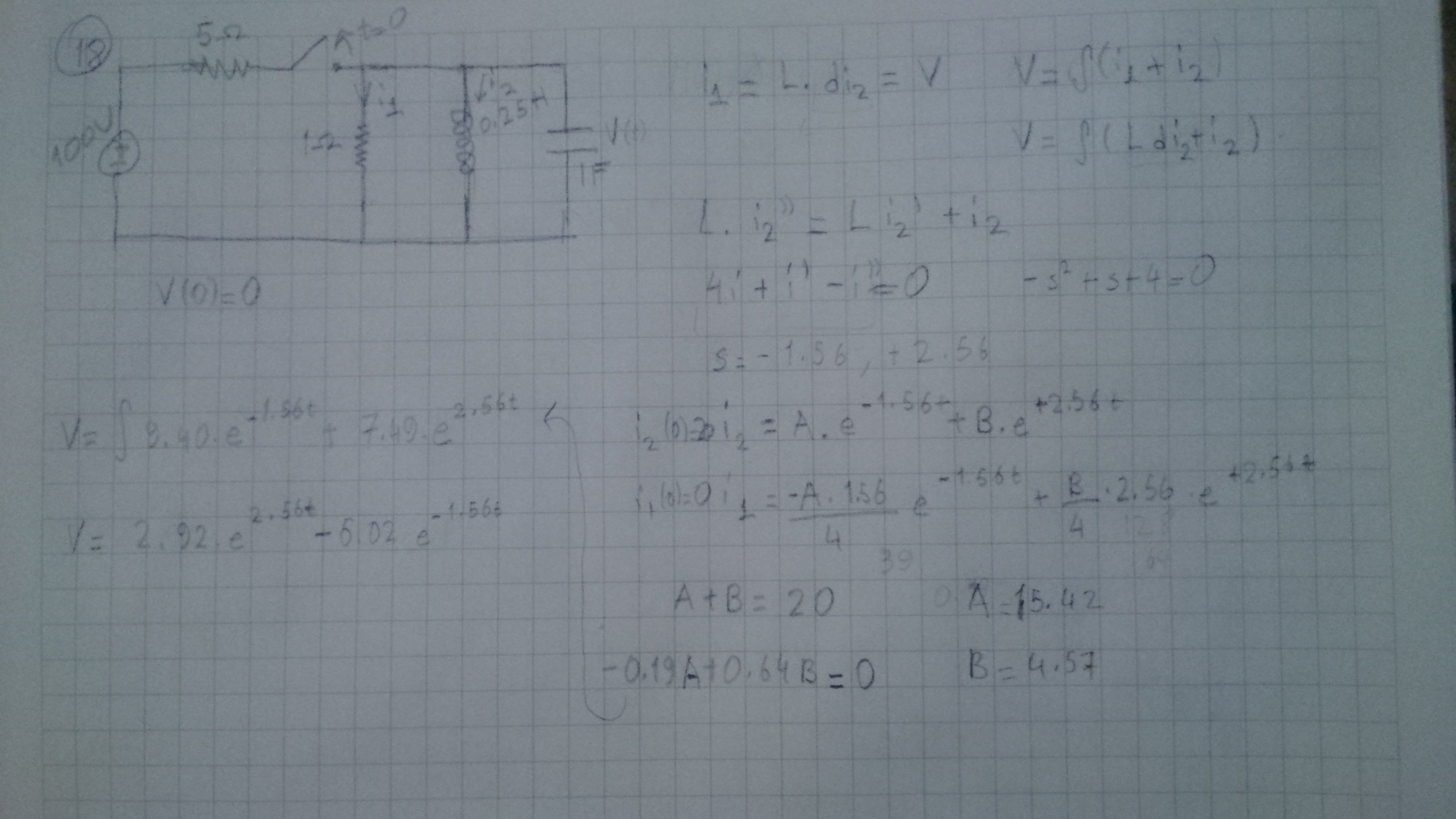
Just a cursory glance at your work shows several equations that are fundamentally impossible.

Consider:

\(
i_1 \; = \; L \cdot di_2 \; = \; V
\)

The first term is a current and the last term is a voltage and you are saying that they are equal. The middle term is neither a current nor a voltage.

And then:

\(
V \; = \; \int \( i_1 \; + \; i_2 \)
\)

Aside from the fact that this isn't even an valid integral, you are claiming that the integral of a current yields a voltage.

Then you haven't even taken into account the current in the capacitor (which would probably be i3).

You really need to stop being so sloppy with your math.
 

MrAl

Joined Jun 17, 2014
13,704
Hello,

I cant read that dark, blurry drawing so i'll just offer a hint going by what it looks like you are after.

First, i assume that the switch was on for a long time relative to the longest time constant of the circuit, then at t=0 it is turned off (opened), and you want a solution such as the voltage across the capacitor which is the voltage across the lower RLC network.

If that is the case, then the only element that has energy in it at t=0 is the inductor so you can handle this circuit as a parallel RLC circuit with only initial energy in the inductor. So the inductor current at t=0 is the only thing that drives the solution (no other driving force at that point in time).
 
Top