Ringing a buzzer when timing is over with a 555 monostable

crutschow

Joined Mar 14, 2008
38,543
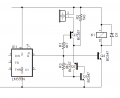
If the buzzer is to stay on until power is reset, perhaps a thyristor is the answer:
The buzzer only comes on after the time delay ends and then stays on until reset.
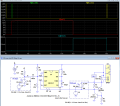
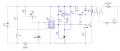
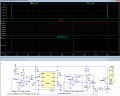
An SCR won't work, but you can use boostbuck's two transistor latch that emulates a thyristor, by connecting to the PNP input which triggers from the falling edge at the end of the 555 delay pulse (sim below):

1737357961557.png
 

eetech00

Joined Jun 8, 2013
4,709
The tweak to the simulator was that I added a series resistor between OUT and the buzzer. It worked once. Never again. (?)
Afterwards, almost playing, I hit the STOP button while the timer was running. Then it beeped again.
I think the simulator is not working properly.
The issue that motivated me to post is the one I mentioned before. Whenever OUT is low, it will beep, whether the timer has been activated or not. I think your opinion is different and more well-founded. I am just an amateur with little knowledge.
Which simulator are you using?
 

sghioto

Joined Dec 31, 2017
8,634
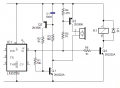
Does that have an advantage over using just two transistors?
If refering to your circuit in post #21 then yes.
The buzzer and the relay are not to be activated at the same time as in your circuit.
I mentioned this before:
Power ON: relay and buzzer OFF
Press Start button: timer starts, relay ON buzzer OFF
Timer ends: relay OFF, buzzer ON until manually reset.
 

boostbuck

Joined Oct 5, 2017
1,051
Does that have an advantage over using just two transistors?
As far as I can see, your circuit has the buzzer in parallel with the relay, but the spec asks for the buzzer to sound AFTER the relay. The third transistor inverts the output to cause the buzzer to sound when the 555 finishes timing.
 

crutschow

Joined Mar 14, 2008
38,543
As far as I can see, your circuit has the buzzer in parallel with the relay, but the spec asks for the buzzer to sound AFTER the relay. The third transistor inverts the output to cause the buzzer to sound when the 555 finishes timing.
Okay.
I missed that the relay is energized during the delay time.

So it's a tradeoff between using an SCR, or one more transistor to provide an emulated SCR triggered by the negative going 555 output pulse.
 

boostbuck

Joined Oct 5, 2017
1,051
.....an emulated SCR triggered by the negative going 555 output pulse....
No, still not there, sorry. The 'SCR' is triggered by the positive going timing pulse, and serves to hold the buzzer off from power-on until the timing pulse occurs. Once the timing pulse triggers the SCR the buzzer is still off until the end of the timing period when the low output of the 555 switches the upper PNP on as well as the SCR.

I've (carelessly) used 'thyristor' to refer to both an SCR device and to the construct of back-to-back transistors that emulates the SCR behaviour. My apologies - a bit confusing when I look back.
 

crutschow

Joined Mar 14, 2008
38,543
What's to prevent Q2 from activating when first powered ON since the output of the 555 is Low?
Yes it's possible to activate if the power is rapidly applied, so the Reset PB may have to be initially pressed after power on.
Shouldn't be a problem unless the circuit is frequently powered on and off.
 

boostbuck

Joined Oct 5, 2017
1,051
"Desirable"?

The transistors are not an SCR (although configured to behave as one) so won't have the optimised current paths an SCR die would have.

But the limit of Ib should be determined by power dissipation. The only example I found is the 2N3904 which gives max base current of 100mA, a third of maximum collector current.
 

sghioto

Joined Dec 31, 2017
8,634
"Desirable"?

The transistors are not an SCR (although configured to behave as one) so won't have the optimised current paths an SCR die would have.

But the limit of Ib should be determined by power dissipation. The only example I found is the 2N3904 which gives max base current of 100mA, a third of maximum collector current.
All depends on how much current the buzzer requires.
 
Top