Rex-C100 PID - CKC Tinner - Troubleshooting

Thread Starter

JK29

Joined Mar 22, 2019
32
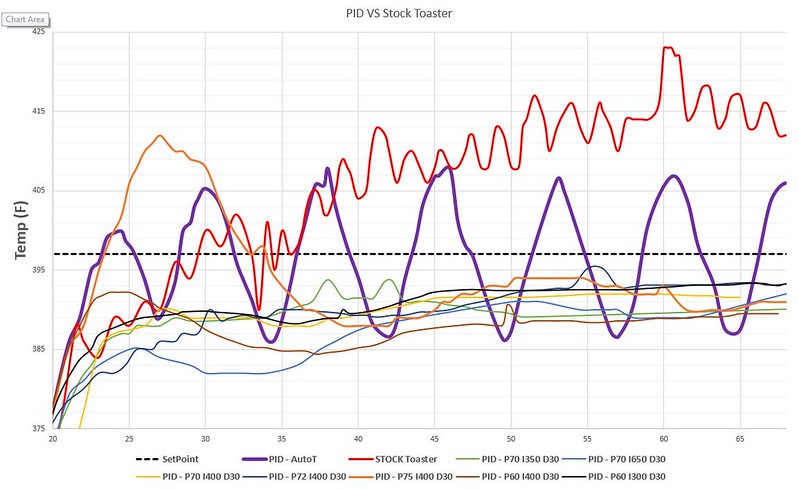
So I just had a thought... and want yall's opinion on this. I just re-ran the Auto tune on the controller. It's plotted as the PURPLE line below.

Musing the thought that just popped in my head:

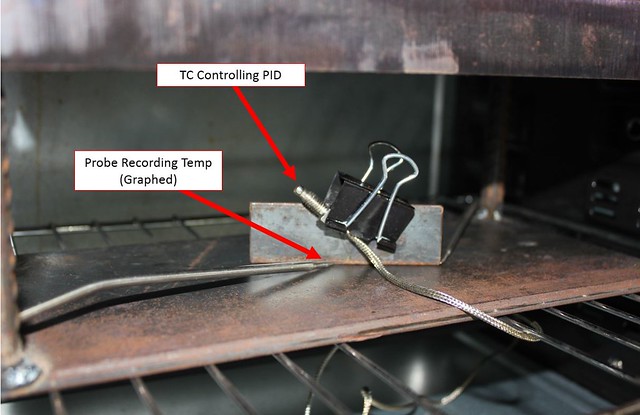
This whole time I've been reading the temperature off the probes I have sitting in the rack resting on the plate (As seen in the picture below). Do yall think that since these probes are "open air" they're showing a larger swing then what the PID's thermocouple screwed into the plate is actually reading? Maybe the plate is actually being held at the 397 F set-point and this Chinese controller isn't trash after all!?! :eek:


*Figure 5


*Testing Set-up


Any thoughts appreciated!

Cheers,
JK
 

SamR

Joined Mar 19, 2019
5,510
Sidebar- Food for thought

I had a Chemical Engineer who was a specialist in industrial distillation tell me he could control a distillation column to within 0.01°C. I thought he was crazy... We installed the sensors he specified and I integrated them into the distributed control system and programmed it with his mathematical algorithms for PID and damned if he wasn't right!
 

MrChips

Joined Oct 2, 2009
34,952
Here are my thoughts.

I believe you are correct. If your data recorder temperature sensor is different from the PID controller's temperature sensor then you can expect some discrepancies.

With that new knowledge, the graphs in post #18 look good.
The steady-state error could simply be a result of off-calibration and I would not be too concerned about that.
 

atferrari

Joined Jan 6, 2004
5,017
Hola JK

I designed from scratch an analog PID controller for a simple heater. I gained some understanding and experience but above all I really enjoyed the journey. http://www.chatzones.co.uk/discus/messages/7/16598.html

Being temperature of a mass, located in the middle of a room, I realized that the location of sensors could be easily affected by unexpected air streams, bad isolation or undesired contact with parts that I was not aware of.

Additional comment: after starting with crazy tweaking of all parameters I soon convinced myself to progress methodically keeping one (or two) parameters steady enough to get track of the better tuning.

Buena suerte.
 

Thread Starter

JK29

Joined Mar 22, 2019
32
Here are my thoughts.

I believe you are correct. If your data recorder temperature sensor is different from the PID controller's temperature sensor then you can expect some discrepancies.

With that new knowledge, the graphs in post #18 look good.
The steady-state error could simply be a result of off-calibration and I would not be too concerned about that.
Thanks for the feedback. It seems like it would be adventitious to have the TC in open air... maybe have the tip protrude up thought the plate by 1/16th. Wouldn't you want the TC to be the most sensitive thing in the oven?
 

Thread Starter

JK29

Joined Mar 22, 2019
32
So I had some time to get an initial test run.

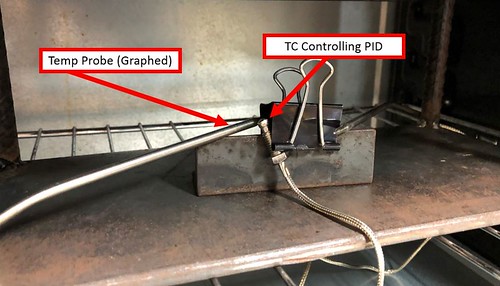
This is the setup:


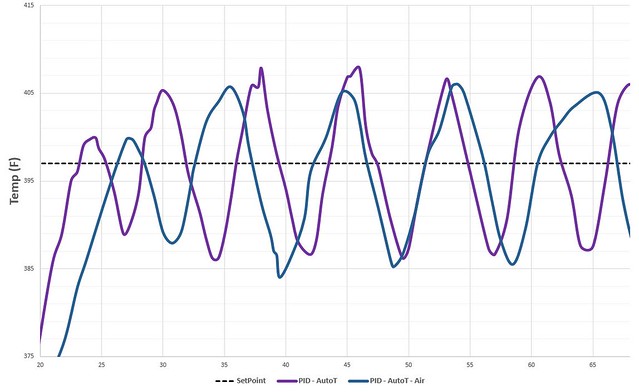
And these are the results of the first auto tuning cycle run by the controller with the TC in the air.


Byen

Joined Apr 20, 2019
7
JK, I recently bought one of these knockoff C100s for controlling a lead pot (its in transit). Have spent the last week looking all over the web for all information on them, especially if I get the dreaded 3-digit only ones (unable to unlock, no auto tune). Your work here is a breath of fresh air - very informative on how to approach manual tuning! Did you ever get it to unlock? Auto tune? If so, mind sharing? I'm an engineer by trade so i like the technical challenges involved :D
 

Thread Starter

JK29

Joined Mar 22, 2019
32
JK, I recently bought one of these knockoff C100s for controlling a lead pot (its in transit). Have spent the last week looking all over the web for all information on them, especially if I get the dreaded 3-digit only ones (unable to unlock, no auto tune). Your work here is a breath of fresh air - very informative on how to approach manual tuning! Did you ever get it to unlock? Auto tune? If so, mind sharing? I'm an engineer by trade so i like the technical challenges involved :D
Hey Byen, to get the auto-tune to unlock you have to change P to 1.. then you should see it on the menu.

Glad you enjoyed my struggle here! ;)

I must say... although I think I've gotten it good enough for my application; I still recently ordered a legit Rex-C100 to replace the knockoff. I'll post those results over the next few weeks once I have the new controller.
 

Thread Starter

JK29

Joined Mar 22, 2019
32
Ok... I think we're getting somewhere here. Got the new Rex-C100 RKC made in Japan PID controller wired up. And I swapped out the TC since my new controller came with a new TC and I trust it better than the one that came with the Chinese knockoff.

Testing Setup:


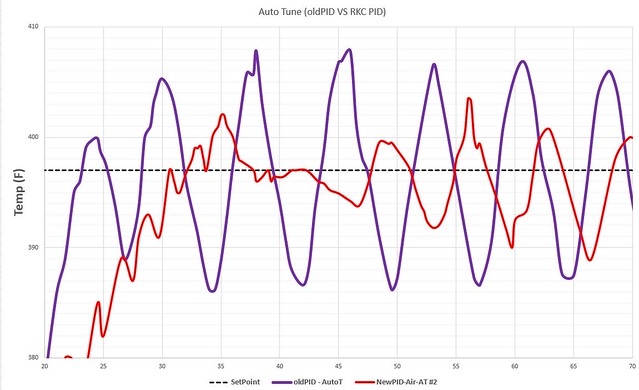
Head to Head Auto Tune performance (Knockoff Chinese version in PURPLE and New RKC PID in RED):


Notes / Vague Questions:


  • The AutoTune on the new controller yielded a P of 13 and I of 198 and a D of 49.
    • This may be a good starting place to tweak via manual tuning, I think.
  • Once the new RKC PID got up to the SV (setpoint) of 203C, the PV (measured via TC) never faltered from 203C. o_O
    • So... Maybe the cooking probe I'm using to record temp is slightly more sensitive than the TC? Or would that make the TC more sensitive than the TC... ?
    • Maybe the slight distance between the probe and the TC is what's causing the oscillation in the data (Red line on the graph)...?
      • They ended up being about 0.75'' apart in the test rig.
  • After getting up to temp, the total variance from the set-point of 397.4F was +6.1F above the set-point and -8.4F below the set-point (403.3F and 389F respectively).
    • According to the cooking probe


What do you guys think? :cool:

Cheers,
JK

Edit:

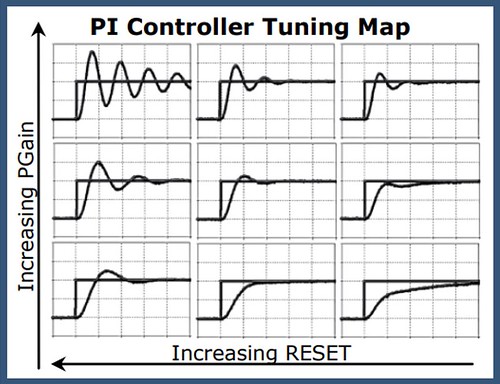
To attempt some manual tuning... it seams like I'll need to decrease my reset (I value). I think this means to make the I value bigger on the controller... So maybe a good next test is bringing the I from 198 to 300 and see how it changes.


Edit #2:

This is the new RKC RexC100 controller I purchased: https://www.ebay.com/itm/REX-C100-T...e=STRK:MEBIDX:IT&_trksid=p2057872.m2749.l2649
 
Last edited:

Byen

Joined Apr 20, 2019
7
Jk, does it have a "dF" menu setting? In my hours of researching these C100's, several times it was recommended to reduce dF to 000 to get most precise temp readings. Its a "noise filter" added to supposedly minimize oscillations..also, check that the "r" (or "t") is set low, like 2 - SSR's can typically handle the switching on a low cycle time "r" vs mechanical relays..
Mine has arrived - Berme type c100 from Amazon. the instructions are good, 3 digit model but instructions are written for it, and get you to every menu. Forgot to put the SSR in there though :rolleyes:
 

Thread Starter

JK29

Joined Mar 22, 2019
32
Jk, does it have a "dF" menu setting? In my hours of researching these C100's, several times it was recommended to reduce dF to 000 to get most precise temp readings. Its a "noise filter" added to supposedly minimize oscillations..also, check that the "r" (or "t") is set low, like 2 - SSR's can typically handle the switching on a low cycle time "r" vs mechanical relays..
Mine has arrived - Berme type c100 from Amazon. the instructions are good, 3 digit model but instructions are written for it, and get you to every menu. Forgot to put the SSR in there though :rolleyes:
Good tip! My df was set to 0001. I set it to 0. I'll have to re-run a test (maybe tomorrow)

My "r" value (working cycle) is set to 20 and I couldn't find the "t". What does the working cycle do?

Thanks for your help!
 

Byen

Joined Apr 20, 2019
7
Sorry - the "r" is the "t".. Looks like an r, but instructions will call it a "t". If you are running a separate SSR relay, you can probably use a 2 there. That "r" value is seconds, decides how often PID loop will make decisions and apply ON-OFF. You'll switch on off more often - SSR can handle it better than mechanical switches.
 

Thread Starter

JK29

Joined Mar 22, 2019
32
So I set the r value to 5 seconds and the df to 0000. Then re-auto-tuned the system.

Pretty much got the same results. It changed the P to 17, the I to 227 and the D to 56. The temp wings are the same as the red line above though. They mirror each other right on.
 

Byen

Joined Apr 20, 2019
7
JK could have sworn changing cycle time would help lower variation.. I am fresh out of tricks. Perhaps just a difference in TC performance?
 

Thread Starter

JK29

Joined Mar 22, 2019
32
I left the df at 000 and the r @ 5

Then increased the "i" value to 450 (P17 and D 56).

That change brought the operating range to 400-392 with a setpoint of 397.

That's a total oscillation range of 8 degrees. It was oscillating with a range of 14.3 before increasing the "i" component. I think I may bring the "i" up a little more and see what happens.

I guess I could try bringing the P down first.
 

Thread Starter

JK29

Joined Mar 22, 2019
32
Another thought... should I be trusting the cooking temp probes at all? Should the RED PV that reads out "current TC temp" be more accurate?

When auto-tuned that red PV stays flat at the set point.

It almost seems like the temp probes are more sensitive than the TC.

On the last run I described in post #37, the red PV number got up to 205 C which matched perfectly with the temp probes. It never got below 203 C which is the setpoint even though the probe showed a value of 200.5 C.
 

Byen

Joined Apr 20, 2019
7
Cooking temp probes looked thinner than the TC meaning they likely respond faster.. I have similar occuring in my lead pot - control TC is inside copper tube, monitor TC is a thinner wire like setup.. Wire TC was showing +\- 6 deg C swing, while copper tube TC was +/-4 or so.. Not too bad..
 

Thread Starter

JK29

Joined Mar 22, 2019
32
Cooking temp probes looked thinner than the TC meaning they likely respond faster.. I have similar occuring in my lead pot - control TC is inside copper tube, monitor TC is a thinner wire like setup.. Wire TC was showing +\- 6 deg C swing, while copper tube TC was +/-4 or so.. Not too bad..
I think you're right. Good news is that the knives I'm tempering are thicker than the probes. I'm still going to mess with it some. Busy this weekend but next week for sure. I think I can tighten it up with the manual tuning.

Only thing I wonder is that if I have the oven "tuned" to the probe is that ideal opposed to having it tuned to the TC. I think the answer is yes since the probes are potentially more sensitive.
 
Top