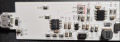
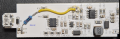
The PCB has 3 IC packages having 8 leads each. It has a total of at least 61 other components and at least one transistor. So this is not a simple circuit package. While two of the IC packages appear to have numbers the middle one does not appear to have much of a label. In addition, the white solder mask cover makes following conductors rather challenging.
So tracing out much of the circuit will be a serious challenge, even if information is available about the 3 IC devices, which I do not expect it to be available.
I doubt that the TS has the time to trace out the circuit, and who else would spend that much time on it??
,
I know this is an old thread, but I have solved this issue so I wanted to share my solution. Hope this helps someone!
There are 3 ICs on the board.
The one closest to the USB connection is a CS32F302, a small MCU from CR Micro (Chineese company), small description available in Chineese here. I have not been able to figure out all of the pin functions, but pin 8 seems to output either a PWM or an analog value, to control the LED driver IC.
The second closest is the LED driver IC. It is a MT7282 from Maxic, small datasheet available here. It is the IC driving the current for the LEDs. Pin 2 is called ADJ, and is used to control the dimming of the LEDs, either using an analog singal or PWM. It is connected to the MCU pin 8 via some resistors and capacitors.
The third IC is a battery charging/control IC. When running only on USB this can be ignored.
Since the workings of the MCU is hard to know, as I do not have the code, I will try and bypass that. By measuring the ADJ pin on the LED driver IC for the various dim levels I can see that at the brightest it seems to be at ~1.6V. To acheive that without the MCU interfering, I removed R43 and R45, and pulled the ADJ pin to 5V via a 20k resistor. With 10k resistor (R58) down to GND still present, I get a voltage division and end up with ~1.6V at the ADJ pin. Thus, making the LEDs turn on as soon as I have 5V, i.e. the USB connected.

 Facebook
 Google
 GitHub
 Linkedin