Resistor values in flash slave

Thread Starter

rouke

Joined Jul 21, 2017
7
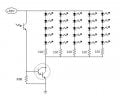
I'm trying to make a flash slave as in the attached diagram. The light source consists of five series of ten bright white LEDs, each series with it's own 100 ohm resistor. The unit works well, although not as bright as flash tube, but good for macro photography. I want it to be triggered by the camera's built in flash, but I can't get it to work satisfactorily. When I shine a torch on the photo resistor, it saturates and the LEDs light up bright, but when I try to activate the system with the flash, the LEDs don't seem to work. The photo transistor is probably an IR type (can't find a visible light one), but I expect a flash tube to emit a broad light spectrum including sufficient IR to saturate the photo transistor. R1 is 100k and R3 is 50k. I've looked on-line and saw some diagrams without an R1 or an R2, but wouldn't that blow the BD649 or the photo transistor when it saturates? Does anyone have any suggestions?
 

Attachments

Ylli

Joined Nov 13, 2015
1,092
Do you realize how short that flash from the camera really is? For a Xenon Flash Tube, typical flash duration is 1/1000 second.

Now your circuit most likely will not even respond that quickly, and if it does you are not going to see the LEDs come on for <1/1000 second.

What you want to do is allow the input power source to charge up a capacitor, and then when your light sensor senses the external flash, dump that cap into the LEDs. Generally a good job for an SCR.
 

#12

Joined Nov 30, 2010
18,224
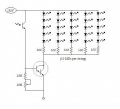
I would start by re-designing this. Eliminate R1. Measure the current through the opto-transistor in ambient light. Set R2 to allow that current to create not more than one volt. Test fire.

Lets try 30 ua in ambient light. That would make R2 = 33K
OK. Let's try that.
What? You want adjustability?
Maybe on my second try.
How are you with mosfets?

Will this work if you don't have any way to stop the LEDs quickly?
That's what an SCR and a capacitor will do. You get the power in the capacitor and you can't stop the light until the capacitor is empty.

The opto-transistor can only allow .0005 amps. That's not going to blow out anything.
 

Attachments

Last edited:

Thread Starter

rouke

Joined Jul 21, 2017
7
Do you realize how short that flash from the camera really is? For a Xenon Flash Tube, typical flash duration is 1/1000 second.

Now your circuit most likely will not even respond that quickly, and if it does you are not going to see the LEDs come on for <1/1000 second.

What you want to do is allow the input power source to charge up a capacitor, and then when your light sensor senses the external flash, dump that cap into the LEDs. Generally a good job for an SCR.
Hi Ylli, the flash duration is probably much shorter than that. I expect the response time of my circuit to be in micro seconds. It should easily respond to this. If we're talking about an audio amp the circuit will have to be able to reproduce 20,000 Hz, or have a response time of 1/20,000 of a second. This is a very simple circuit, so I don't think response time is not the problem here. The reason why I don't want to use a capacitor is because I would have a hard time controlling the duration of the flash; when the capacitor is discharged. What is an SCR?
 

Jazz2C

Joined May 27, 2016
52
Hi Ylli, the flash duration is probably much shorter than that. I expect the response time of my circuit to be in micro seconds. It should easily respond to this. If we're talking about an audio amp the circuit will have to be able to reproduce 20,000 Hz, or have a response time of 1/20,000 of a second. This is a very simple circuit, so I don't think response time is not the problem here. The reason why I don't want to use a capacitor is because I would have a hard time controlling the duration of the flash; when the capacitor is discharged. What is an SCR?
An SCR (silicon controlled rectifier) is a monopolar gated thyristor. Getting back to your circuit, if the pt and amp are sufficiently fast the leds may not be (bright leds have loads of parasitic capacitance) if I were you I'd try stretching the pulse to 50 ms and take it from there.
 

Thread Starter

rouke

Joined Jul 21, 2017
7
I would start by re-designing this. Eliminate R1. Measure the current through the opto-transistor in ambient light. Set R2 to allow that current to create not more than one volt. Test fire.

Lets try 30 ua in ambient light. That would make R2 = 33K
OK. Let's try that.
What? You want adjustability?
Maybe on my second try.
How are you with mosfets?

Will this work if you don't have any way to stop the LEDs quickly?
That's what an SCR and a capacitor will do. You get the power in the capacitor and you can't stop the light until the capacitor is empty.

The opto-transistor can only allow .0005 amps. That's not going to blow out anything.
Thanks #12. Yes I can see where you're going with this. Answering exactly my questions. However, the opto-transistor as you call it allows for .5mA at Vce = 5V. What would it do at 32V?
Oh, I don't see where you're going with mosfets. Are they faster?
And I guess with "you don't have any way to stop the LEDs quickly" you are referring to Ylli's reply? I'm not considering using a capacitor. I want to keep it simple. I haven't got much room for more components.
 

Thread Starter

rouke

Joined Jul 21, 2017
7
An SCR (silicon controlled rectifier) is a monopolar gated thyristor. Getting back to your circuit, if the pt and amp are sufficiently fast the leds may not be (bright leds have loads of parasitic capacitance) if I were you I'd try stretching the pulse to 50 ms and take it from there.
Thanks Jazz2C. That's probably what's causing the problem then. 50mS is not very fast for a flash (moving insects are my favourite), so I may have to rethink the whole idea. I knew it looked too simple.
 

Jazz2C

Joined May 27, 2016
52
Thanks Jazz2C. That's probably what's causing the problem then. 50mS is not very fast for a flash (moving insects are my favourite), so I may have to rethink the whole idea. I knew it looked too simple.
Please experiment with it! The leds might be fast enough! I'm suggesting 50 ms as a guaranteed starting point to work down from.
 

#12

Joined Nov 30, 2010
18,224
allows for .5mA at Vce = 5V. What would it do at 32V?
According to your specification of 30 volts maximum, it shorts out and turns into smoke.
Another way to look at the specs is that the opto uses up 5 volts while allowing 500 ua.
This opens up the possibility of a lot more current when you apply higher than 5 volts.
Maybe that's why the original design has R3 in it. That would limit the current to the power transistor to 616 ua.
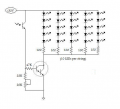
Here's a drawing with R3 put back in.
What I tried to do was design the shortest path from the opto through the power transistor.
Assuming a photo flash is a fast event, and you can drive most parts way past their alleged power limit for a few hundred milliseconds without melting them.
R1 was very much in the way. That 100K would limit the current in the drive path to 200 ua.
I hope I demonstrated that measurements are where to start, then you can figure how many ohms are needed.
If this still doesn't work with R1 taken out, it's going to get complicated.
You have demonstrated that this works if you shine a light on the sensor. I'm working on better gain, hoping to get it to respond faster.
50 milliseconds is 1/20th of a second. Way too slow for photography unless the camera closes off when it has enough light.

I tried to look up ZD1950 and got no results.
Can you post a datasheet?
 

Attachments

Thread Starter

rouke

Joined Jul 21, 2017
7
According to your specification of 30 volts maximum, it shorts out and turns into smoke.
Another way to look at the specs is that the opto uses up 5 volts while allowing 500 ua.
This opens up the possibility of a lot more current when you apply higher than 5 volts.
Maybe that's why the original design has R3 in it. That would limit the current to the power transistor to 616 ua.
Here's a drawing with R3 put back in.
What I tried to do was design the shortest path from the opto through the power transistor.
Assuming a photo flash is a fast event, and you can drive most parts way past their alleged power limit for a few hundred milliseconds without melting them.
R1 was very much in the way. That 100K would limit the current in the drive path to 200 ua.
I hope I demonstrated that measurements are where to start, then you can figure how many ohms are needed.
If this still doesn't work with R1 taken out, it's going to get complicated.
You have demonstrated that this works if you shine a light on the sensor. I'm working on better gain, hoping to get it to respond faster.
50 milliseconds is 1/20th of a second. Way too slow for photography unless the camera closes off when it has enough light.

I tried to look up ZD1950 and got no results.
Can you post a datasheet?
Thanks again. Here's a copy of the datasheet. 50ms is indeed way too slow. I've read up on parasitic capacitance etc. and switch times for LEDs in general. They're talking in terms of ns and ps. I'm happy with 1,000 ns (that's still 1 us, or 1/1,000,000 of a second)! I've read somewhere though that the opto transistor may get oversaturated at high light levels at which the efficiency drops again. I think it's still sufficient to drive the darlington pair. Does anyone have an idea about this? Would it make sense to put a (eg. IR) filter in front of the opto transistor? I've tried a little bit but without success, but with a little encouragement from people in the know I may try a little harder. I don't think going the mosfet way is the answer. BTW, I actually use 18 ohm in series with the LED strings fpr flash purposes, 100 ohms for continuous light. The full circuit is a bit more complex but doesn't affect what I'm trying to work out here.
 

Attachments

Tonyr1084

Joined Sep 24, 2015
9,744
OK, I'm going to open my mouth on this. I may be wrong - honestly, I'm not sure. But if your PT (photo transistor) is rated for 50 mS and you opt for one that is much faster, the next question is: "How fast is the darlington pair?"

Here's my point: Suppose the PT is 5 mS and the darlington is 20 mS. That's going to be 25 mS delay in the flash of the LED's.

Just playing devil's advocate here.
 
m happy with 1,000 ns (that's still 1 us,
You might get an LED to respond at that 'speed' howbeit luminous flux will be disappointing and the afterglow is a killer (i.e. you'll still require 'shutter';))

FWIW: The topic of suitability of LEDs to 'flash' applications has been well explored at both the theoretic and empirical levels HERE and HERE with, I'm sorry to say, less than auspicious findings:(


Best regards and good luck!
HP:)
 
I'm trying to make a flash slave as in the attached diagram. The light source consists of five series of ten bright white LEDs, each series with it's own 100 ohm resistor. The unit works well, although not as bright as flash tube, but good for macro photography. I want it to be triggered by the camera's built in flash, but I can't get it to work satisfactorily. When I shine a torch on the photo resistor, it saturates and the LEDs light up bright, but when I try to activate the system with the flash, the LEDs don't seem to work. The photo transistor is probably an IR type (can't find a visible light one), but I expect a flash tube to emit a broad light spectrum including sufficient IR to saturate the photo transistor. R1 is 100k and R3 is 50k. I've looked on-line and saw some diagrams without an R1 or an R2, but wouldn't that blow the BD649 or the photo transistor when it saturates? Does anyone have any suggestions?
DIY LED ring flashes are often times used as "on always" lighting for macro photography - switch them on, shoot, switch them off. See an example AAC project.

If I understand it, you want to use the LED ring as an actual flash. I read some of the misgivings about LEDs as flash units in previous posts, but there are many commercial products for this like here and here and here. I have not used one, but they look pretty decent and I see no reviews that fundamentally discount them.

What I note, however, is that they all use a shoe to get the trigger as is typical of most any slave flash. Assuming you have a shoe on your camera, why not tap into that for the trigger rather than messing around with the pt?

hs 8558.jpg
 
Last edited:

#12

Joined Nov 30, 2010
18,224
I think it's still sufficient to drive the darlington pair. Does anyone have an idea about this?
I didn't mention that because I ran the math and it's good. The original drawing, "should" work, but it doesn't, so I tried to goose the speed by simplification. According to the spec sheet, I did some good guessing on leakage current but I did not know that higher load resistance slowed down the opto-transistor. I just felt it instinctively. Now that I have the datasheet, I can say the parallel resistance of the adjuster leg and the darlington leg should be equal to or greater than 6400 ohms. Again, I guessed pretty good in the third drawing. If the adjuster current and base drive are too low in resistance, R1 is added to pad out the resistance to keep the current through the opto down to .00616 amps in the original drawing.

What I'm getting from the BD649 datasheet is, for a full amp through the LEDs, you have a gain of 1000 to 2200. The base drive for that is 100 ua to 46 ua. No problem when you have 500 ua to start with. I attached the datasheet in case one amp is a wrong estimate.
I don't think going the mosfet way is the answer.
We would only go to mosfets if this circuit turns out bad because they're hella fast.
Just playing devil's advocate here.
Bad noobie! You have no clue about megahertz switching, which the BD649 will do.
I don't hate you, I'm just saying, "Don't pee in the soup" when you're just guessing.;)
Last graph in the datasheet. Rise and fall times in microseconds vs load resistance.
why not tap into that for the trigger rather than messing around with the pt?
Excellent idea!
Right now, I'm thinking about using a twisted pair of wires to move the opto transistor right in front of the master flash, and an IR filter off a TV remote control would work. The circuit you posted is basically good. I think you're fighting a sensor problem.

Does your camera work in what I call Light Dominant mode where the iris shuts down when it has enough light? That would make the time to stop the LEDs irrelevant. We only need to get the LEDs to come on quickly and persistence be damned.
 

Attachments

Last edited:

Thread Starter

rouke

Joined Jul 21, 2017
7
Parallel resistance? Adjuster leg? Are you referring to R3?

You suggested a 22k in series with the trim pot meter, and none in series with the opto-transistor. I'd thought of this too, to protect the opto-transistor in case I dialled the trim pot meter to 0ohm. But if it's in series with the opto-transitor, it's multifunctional. I think there should be one in series with the opto-transistor, so I can adjust the voltage at the point to the darlington to be 0v at ambient light. Without it the current through the opto-transistor at ambient light is sufficient to saturate the base of the darlington, and the LEDs are always on. But I think that's what you're saying albeit in other words ;-) However, if R1 (and R2) are high enough, the current through the base of the darlington would also be limited to a safe level. So I guess my main question is, how do I calculate the size of R1 (and R2) so it protects both the opto-transistor and the base of the darlington (at 0.500A/1500=333uA? Have I got that right? I'm a newbie)

The recommended current through the LEDs is 20mA and the max 120mA (OK for a short flash), hence the smaller resistors when the system is in flash mode. At 18ohms I believe I set it to 100mA, times five strings = 500 mA. The datasheet says the gain is about 750, but you seem to have a different data sheet with different gain values for different mA and volt values. I guess it'll always be 3 volt, and in my case .5A, so yes, a gain of 1500.

The camera is an SLR with i-TTL flash control. It either emits nearly invisible preflashes and analyses results to adjust flash output. I'm working on the idea that when the built-in flash is blocked by a large macro lens at close range, the LED ring will compensate, and the camera will calculate from whatever it 'sees' through the lens. Whether that be from it's own flash or any other light source. But yes, speed matters. And the tailing off from the phosphorous in the white LEDs may become a problem at fast moving objects. But that's something I can olny find out when the electronics work. And it looks like they should work.

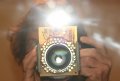
Now, putting the opto-transistor right in front of the built-in flash? Why? If the current assumption is that it receives too much light and we have to reduce it with the IR filter. As you could see from my pictures, the unit is a rectangular circuit board that slides in a Cokin filter holder with the LEDS facing forward and the opto-transistor mounted on the reverse side of the circuit board, facing the built-in flash. So, yes I guess the IR filter might help, but the twisted pair is perhaps excessive?

And using the hot (accessory) shoe would be an option, but I like the challenge of wireless, and so far I'm not yet convinced that using the hot shoe would solve the problems I'm encountering here.
 

#12

Joined Nov 30, 2010
18,224
First measure the current through the opto transistor in ambient lighting conditions to find the (off) leakage current.
Then the adjustment leg is designed to develop less than (1) volt at that current, and some adjustability to compensate for ambient light. You can not get to zero volts and you don't need to. The Darlington transistor needs about 1.2 volts to fire and will ignore lower voltages.

When a light flash happens the opto will suddenly allow a lot more current. You route that to the base of the transistor. You size R3 to limit the total opto current to 0.005 amps. About 30V/.005 amps = 6000 ohms. Make it 6.2K or 6.8 K ohms as an easy to buy resistor value and because some current will flow in the adjustment leg. R1 should only be necessary if the adjustment leg will eat too much current when the flash fires.

If the current assumption is that it receives too much light and we have to reduce it with the IR filter.
If the current assumption is that the opto already receives too much light, then the secondary circuit is already flashng and this whole conversation is moot.
 
Top