Resistor Question

sghioto

Joined Dec 31, 2017
8,634
If you use the 220 ohm resistors, you’ll be drawing almost twice the current from the Arduino. 650 mA
Impossible. Each display module is composed of 25 LEDs with a common anode in series with a 220 ohm resistor. Max current is only 14 ma shared between 25 LEDs when all segments are ON.
 

Thread Starter

Ticrandall

Joined Dec 31, 2021
40
If you use the 220 ohm resistors, you’ll be drawing almost twice the current from the Arduino. 650 mA from a source that can only supply 200 mA. The Arduino will quickly fail.

You need to drive each segment with a transistor: a BJT, MOSFET or a ULN2003A. That will only require 1/10th the current from the Arduino. You’ll need one resistor per discrete transistor to set the drive current.

Then, you can increase the current to the LEDs to make them brighter.

Also, you need one resistor per segment, to keep a 1 the same brightness as an 8. At low levels (such as st 6 mA), the differences may not be great. But if you want the LEDs brighter, it will become obvious.
Most of this is over my head. I dunno how I would drive each segment with a transistor at this point. Sounds like starting over, which I won't do with this design.. Ill figure something else out. One resistor per segment also not possible on the positive side the way the board was made originally, I would have to unsolder 200 leds to change the common. Nope. I get it, this is all not ideal. Hopefully itll last a few years, its a scoreboard, so Itll be used.... 40 hours a year maybe.
 

sghioto

Joined Dec 31, 2017
8,634
I've got another solution. On each wire from the Arduino going to a segment install a series 150ohm resistor and connect the common anode of the module directly to 5 volts. This will isolate the segments and should produce a more uniform lighting. Similar to post #53 but you don't need the transistors and you do not need to change the code.
 
Last edited:

dl324

Joined Mar 30, 2015
18,327
I would have to unsolder 200 leds to change the common.
I haven't seen any suggestion that would require you to unsolder 200 LEDs. Each of the digit displays has 7 segments. You're already driving them with the Arduino. Still not clear what the 470 ohm resistors are being connected to. The resistors would be removed and the common anodes connected to 5V. The segment drivers from the Arduino would have their polarity reversed and they'd drive a transistor or MOSFET which would allow higher current in the LEDs.

That's what I showed in my schematic for several segments of one digit.
 

Thread Starter

Ticrandall

Joined Dec 31, 2021
40
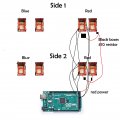
Untitlsded-1.jpg


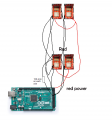
Reed lines are 5v to Arduino, 470 resistors are between Arduino and 7 segment numbers. black lines are the individual segments that go to the Arduino.
 

djsfantasi

Joined Apr 11, 2010
9,237
Impossible. Each display module is composed of 25 LEDs with a common anode in series with a 220 ohm resistor. Max current is only 14 ma shared between 25 LEDs when all segments are ON.
14 mA x 8 digits… 112 mA.

my earlier math might have been wrong. But it’s 8x more than 14 mA

It’s 25 LEDs (actually 28) per DIGIT. 4 digits per side. 2 sides. 8 digits.
 

Thread Starter

Ticrandall

Joined Dec 31, 2021
40
Not too bad, just cut a wire and install a resistor again and again and........
:D
and again and again and again and again and again and again and again and again and again and again and again and again and again and again and again and again and again and again and again and again and again and again and again and again and again and again and again and again and again and again and again and again and again and again and again and again and again and again and again and again and again and again and again and again and again and again and again and again and again and again and again and again and again
 

Thread Starter

Ticrandall

Joined Dec 31, 2021
40
LOL
Like I said if changing the 470 ohm resistor doesn't work this is your best option.
It's only the wires going to the display segments.
I know.. but.. there's like 35 of em, and two joints.. I've already donated about 15 hours on this project lol.
 

BobTPH

Joined Jun 5, 2013
11,515
I've got another solution. On each wire from the Arduino going to a segment install a series 150ohm resistor and connect the common anode of the module directly to 5 volts. This will isolate the segments and should produce a more uniform lighting. Similar to post #53 but you don't need the transistors and you do not need to change the code.
Which I said in post #12. But all the TS wants to do is argue with me. Installing 14 resistors is too much work.

That said, now that we know how it is wired, there are too many LEDs to drive directly from a pin, so I agree with others that a a transistor is required in each segment. 14 transistors and 14 resistors now.

You might able to do it without transistors if you only play in a dimly lit room.

Bob
 
Last edited:
Top