Facebook
 Google
 GitHub
 Linkedin

Hi, I’m studying the AAC textbook and on this page:
https://www.allaboutcircuits.com/worksheets/resistors/
Question 8 has three questions which aren’t solvable with the information given in any linked resources from the site. We’re supposed to:
“Determine the nominal resistance values of these resistors, given their band colors, and also express the allowable tolerance in ohms.
For example, a 25 kΩ resistor with a 10% tolerance rating would have an allowable tolerance of /- 2.5 kΩ.”
But these three aren’t solvable with the provided info:
Grn, Brn, Yel
Org, Org, Gld
Vio, Red, Sil, Gld
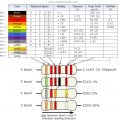
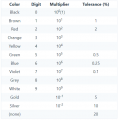
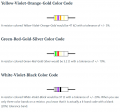
I looked around elsewhere on the internet and found that three-band resistors are 20% tolerance by default. That solves the first one. The second one requires you to know that a third metallic band is a 0.1 (G) or 0.01 (S) multiplier. Finally, the third question is still mysterious to me even though I understand how the given answer was arrived at (72 x 0.01 ±20%) because I couldn’t find a resource saying how a gold fourth band ever equal a 20% tolerance.
Unless I completely missed it in the provided and linked materials, I think including this information on-site would be better than having the student, who is a noob at this point, “figure it out for themselves” because there’s no way for us to know whether the question is a mistake, what happens in this special case when the fourth band is silver (if gold here is 20% tolerance, is silver 40% tolerance or 10% tolerance?) or when we would expect to encounter such specimens in real life. Other than that, I’m enjoying the course.
Thank you.
https://www.allaboutcircuits.com/worksheets/resistors/
Question 8 has three questions which aren’t solvable with the information given in any linked resources from the site. We’re supposed to:
“Determine the nominal resistance values of these resistors, given their band colors, and also express the allowable tolerance in ohms.
For example, a 25 kΩ resistor with a 10% tolerance rating would have an allowable tolerance of /- 2.5 kΩ.”
But these three aren’t solvable with the provided info:
Grn, Brn, Yel
Org, Org, Gld
Vio, Red, Sil, Gld
I looked around elsewhere on the internet and found that three-band resistors are 20% tolerance by default. That solves the first one. The second one requires you to know that a third metallic band is a 0.1 (G) or 0.01 (S) multiplier. Finally, the third question is still mysterious to me even though I understand how the given answer was arrived at (72 x 0.01 ±20%) because I couldn’t find a resource saying how a gold fourth band ever equal a 20% tolerance.
Unless I completely missed it in the provided and linked materials, I think including this information on-site would be better than having the student, who is a noob at this point, “figure it out for themselves” because there’s no way for us to know whether the question is a mistake, what happens in this special case when the fourth band is silver (if gold here is 20% tolerance, is silver 40% tolerance or 10% tolerance?) or when we would expect to encounter such specimens in real life. Other than that, I’m enjoying the course.
Thank you.
Last edited:



 . Cheers.