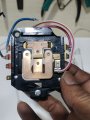
Is this a 4 or 5 band Resistor ?

Thread Starter

R!f@@

Joined Apr 2, 2009
10,004
I got confused with this simple thing.
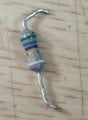
R4.jpg

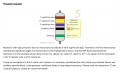
I clearly see 5 band.
But white is not in the 5th band.
I did a search and white is not referred as the 5th band.

Question is, is this a 56R or a 560R.
Got confused, so I drew the circuit.

I attached the pdf for reference. R4 is the culprit.
FYI, the triac shorted and R4 is damaged as a result of 220VAC input when the equipment motor was designed for 110VAC. ( USA item ).

Need some expert advice. More expert than me i.e. :)
 

Attachments

panic mode

Joined Oct 10, 2011
4,864
it depends on whatever is the left of R4 but 56.1 Ohm would be rather low for that circuit. most of the time value there is 330/470/560 Ohm and sometimes lower like 220/100. according to BT136 datasheet gate current can be up to 2A (peak) though usually it is few mA (<25mA). 25mA*560Ohm=14V. looks good to me since typical trigger circuit would be 5-12V
 
Last edited:

eetech00

Joined Jun 8, 2013
4,704
I got confused with this simple thing.

View attachment 363888

I clearly see 5 band.
But white is not in the 5th band.
I did a search and white is not referred as the 5th band.

Question is, is this a 56R or a 560R.
Got confused, so I drew the circuit.

I attached the pdf for reference. R4 is the culprit.
FYI, the triac shorted and R4 is damaged as a result of 220VAC input when the equipment motor was designed for 110VAC. ( USA item ).

Need some expert advice. More expert than me i.e. :)
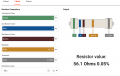
The fifth band is tolerance, probably silver or grey, and just looks white.
So value is 56.1 ohm, 10% or 0.05%
 

WBahn

Joined Mar 31, 2012
32,703
The fifth band is tolerance, probably silver or grey, and just looks white.
So value is 56.1 ohm, 10% or 0.05%
A tolerance of 10% makes no sense on a resistor that is marked at 56.1 Ω, That means the tolerance is ±5.6 Ω.

The final band is likely indicating temperature coefficient, failure rate (MILSPEC) or some other manufacturer-specific parameter.
 

eetech00

Joined Jun 8, 2013
4,704

WBahn

Joined Mar 31, 2012
32,703
I just asked Copilot the following question (using it as a search engine to find links to pages that might go into detail on five-band resistors, not expecting it to actually give me a valid response):

"I have a five band resistor and the colors are green blue brown gold white. What is the value and what does the final white band indicate?"

It did not disappoint, at least in far as meeting my expectations:

"The value of the five-band resistor with the colors green, blue, brown, gold, and white is 152 Ohms with a ±5% tolerance. The final white band indicates the tolerance of the resistor. This means that the actual resistance value can range from 144.4Ω to 159.6Ω (152Ω ± 5%)."

That final band looks pretty white to me, but maybe it's grey. I don't think it's silver. If it's grey, and if that's the tolerance band, then it's a 56.1 Ω resistor with tolerance of ±0.03 Ω. Seems like resistors with that tight a tolerance would be marked with a tighter value.

Plus, 561 is not in the E48 sequence (it goes 536, 562, 590) or in the E98 (where it goes 549, 562, 576).

The other possibility is that it is a four-band resistor with an additional info band. That would make it a 560 Ω ±5% resistor. If the final band is grey and if that indicates the tempco, then it is 1ppm/K
 

panic mode

Joined Oct 10, 2011
4,864
ok so i asked AI the same question:
" what is the resistor value where color bands are green, blue, brown, gold, <space>,white? "

Google AI:
The resistance value for a resistor with color bands green, blue, brown, gold, and white is 560 ohms with a 5% tolerance.
Perplexity:
Those colors describe a 560‑ohm resistor with 5% tolerance; the white is likely a manufacturing mark, not part of the value code.

Here’s how it breaks down for a standard 4‑band code:

  • Green = 5 (first digit)
  • Blue = 6 (second digit)
  • Brown = multiplier of 101101, so 56 × 10 = 560 Ω
  • Gold = ±5% tolerance
Typical 5‑ or 6‑band codes would not place gold before white in that way, so the safest reading is 560 Ω, ±5%, with the extra white marking being non‑standard printing or a temperature/failure-rate mark that most hobby use can ignore.
Grok:
From real circuits:
  • Many BT136-based dimmers/fan controllers use ~330–560 Ω in gate paths (or equivalents) when combined with opto-TRIACs or low-voltage triggers.
  • 560 Ω specifically shows up in some MOC30xx + BT136 setups to drop voltage and limit current from 5–12 V logic sources while still providing enough I_GT (~10–20 mA typical needed for reliable firing).
  • At 560 Ω, from a 5–15 V source: I_gate ≈ (5–15 V) / 560 Ω ≈ 9–27 mA → well within BT136's sensitive-gate spec (I_GT max 35 mA, but often triggers reliably at 5–15 mA), and low enough to not overload weak drivers.
A lower value like 56.1 Ω would allow much higher peak current (~90–270 mA from the same voltages), risking gate damage or unreliable behavior in low-drive scenarios—plus, as you noted earlier, 561 isn't a standard E-series value, while 560 is ubiquitous in E24 (±5%).The white band (isolated at the end) is a classic marker on some fusible/safety/flameproof resistors (common in AC line circuits for fail-open behavior under overload). It doesn't factor into the value/tolerance—it's ignored for the color code, confirming the 4-band reading: green-blue (56) + brown (×10) + gold (±5%) = 560 Ω ±5%.So, yep—560 Ω ±5% is the correct value, and it aligns exactly with its use as a series current-limiting resistor for reliable, safe DIAC → BT136 triggering from typical low-voltage sources. If replacing it, use a 560 Ω (or close like 470–680 Ω) 1/4W–1/2W metal-film or carbon-film resistor (flameproof/fusible if the original was safety-critical).
 

panic mode

Joined Oct 10, 2011
4,864
and even if considering both choices, it is a safer one. in worst case triac does not get triggered. then one can still try lower value. but if it gets blown on the first try, then one need to change both resistor and triac.
 

WBahn

Joined Mar 31, 2012
32,703
Another thing to consider that is in favor of it being 560 Ω, 5%. For this application, is there ANY reason that someone would spec a 0.05% resistor?

I can see why someone might want a low tempco, but 1 ppm/K seems excessively tight. But, I'm not very familiar with these applications.

My best guess is that the white band is actually a manufacturer-specific marking, perhaps indicating a production line or a level of screening. But that's a wild guess. If we knew the manufacturer and the approximate date of manufacture, maybe we could do better, but it's unlikely, either that we can deduce that information or that it would help us if we did.
 

Thread Starter

R!f@@

Joined Apr 2, 2009
10,004
I am trying to find another option.
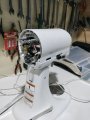
Below is the mixer.
It's 110VAC one.
Speed control is rather tricky way.
2.jpg
1.jpg

3.jpg

4.jpg
Motor is fine. I can operate using a variable tx.
Customer does not need high speed. Only a few set speed is fine.

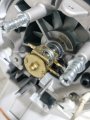
This thing has a centrifugal switch ( Governor ). A speed controller and a plastic mount sorta thing. All broken. The centrifugal thingy broke due to high speed ( 220VAC ). The metal thing touched the boad, blowing the triac and also the plastic speed switch assy.
I can source them but it is rather expensive.

I am choosing another option.
Make a speed controller for the AC motor. Desired speed can be achieved from 25VAC to 50VAC.
My plan is to make a speed controller with 6 steps with a switch. That way voltage will never rise higher than 50VAC. I can always adjust max speed depending on mixer load.

What do you think ?

https://www.youtube.com/shorts/j-_fanEsxio
 
Last edited:
Top