Calculating Resistor Ohms Using Color Band Codes

Thread Starter

RAMBO999

Joined Feb 26, 2018
259
Hi all

I have a bit of a mystery here. I am looking for a second, third or as many opinions as I can muster.
I have this TV power board on which I have replaced a blown fuse and capacitor.
When I powered it up again a 5 band resistor downstream of the capacitor blew with a big flash.
The new capacitor is exactly the same component as the old one so it took me by surprise.
Anyway, I have removed the 5 band resistor so that I can replace it.
When I put a meter across it it reads 0.8 ohms.
Obviously, even a knackered resistor is going to give some reading as long as there is continuity.
But it's not necessarily going to be the rated resistance according to the 5 band colour coding rules.
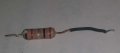
The problem is that the resistor is distorted and all the gaps between the bands appear to be the same length so it's difficult to tell which end to start at when isung the color codes to work out the rated resistance.
so what I would like to do is to throw it out there and have some of you guys work out what the resistance ought to be.
Is that ok?

Here's what I have.

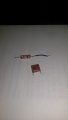
BROWN / BLACK / SILVER / RED / BLACK (See it on the left in the attached picture)

Note that the SILVER is in the middle in position 3 which is strange as it is only used as a multiplier so I would expect it to appear in position 4 (where the RED is) on a 5 band resistor. I would be happy to see SILVER in position 3 on a 4 band not a 5 band resistor.

If this was a 4 bander then ignoring the right most black band the others would give me @ 10 x 0.01 = 1 ohm with a tolerance of +/- 2% which would mean that my actual 0.8 ohm meter reading is in range.

But if I try to calculate it as a 5 band resistor it doesn't actually make sense.

Any thoughts would be appreciated especially regarding the silver band at position 3. like why is it there and not in position 4?

Thanks
 

Attachments

Thread Starter

RAMBO999

Joined Feb 26, 2018
259
Welcome to AAC.
A silver band in the multiplier position multiplies the 2 sigfigs before it by .01
Black is never the first band so brown is the first digit here making it a 10 *.01 ohm resistor 1% with a 250PPM tempco (if I read the chart right)
https://en.wikipedia.org/wiki/Resistor_color_code
Hello JohnInTX. Thanks for the reply. Yes. We agree on the calculation (which is based on a 4 band resistor with TWO significant bands) but this is a 5 band resistor and therefore the first THREE bands are supposed to be significant bands not TWO. Which is why the third band on a 5 band resistor should never be SILVER because SILVER is a multiplier colour. See my point? Any thoughts on that perhaps? Is there a 5 band condition that allows for this condition that I am not aware of for example? It would be nice to know.
 

WBahn

Joined Mar 31, 2012
32,703
JohnInTX addressed the five bands.

The first two are the value bands (brown-black = 10)
The third is the multiplier (silver = 0.01)
The fourth band is the tolerance (red = 2%)
The fifth is the temperature coefficient (black = 250 ppm/K)

So it would be a 0.1 Ω, 2%, 250 ppm/K resistor.

This is, unfortunately, not guaranteed since there are lots of different marking schemes used for resistors. But this is the most likely.

Also, note that 10 Ω x 0.01 is NOT 1 Ω
 

WBahn

Joined Mar 31, 2012
32,703
Could 'silver' possibly be 'grey'? Some manufacturers use less-than-ideal colours.
I don't think it's likely. The end black band is almost certainly a tempco since black is not used for a tolerance band and for it to be a multiplier band that would mean that we have a four value bands on a 20% tolerance resistor.

But it could be a custom marking scheme.
 

Thread Starter

RAMBO999

Joined Feb 26, 2018
259
I don't think it's likely. The end black band is almost certainly a tempco since black is not used for a tolerance band and for it to be a multiplier band that would mean that we have a four value bands on a 20% tolerance resistor.

But it could be a custom marking scheme.
What's a tempco? Do you mean its used to denote "unused"? It's possible, I suppose, but why wouldn't they just leave it off and just have the 4 bands? That would then conform to the known code. Do manufacturers have their own schemes? I can't imagine it would make much business sense working outside of known standards.
 

WBahn

Joined Mar 31, 2012
32,703
Unused????

The tempco is the temperature coefficient. In the case of a black band, it means that the resistance can be expected to change about 250 parts/million for every Kelvin (°C) change in temperature. It's an important parameter for many applications that use precision resistors (tolerance of 2% or less).

There are applications that require different information than the standard provides for. For example, military applications might require failure rate information.

If you think resistor marking is frustrating, wait till you get to capacitors!
 

ebp

Joined Feb 8, 2018
2,332
"tempco" is a contraction of "temperature coefficient" and here implying temperature coefficient of resistance
According to standards, black means ±250 ppm/°C or sometimes expressed as ±250 ppm/K, the former meaning that for each degree Celsius change in temperature the resistance may change by up to 250 parts per million, and the change can be either positive or negative. The second form says the same thing except the temperature is in Kelvins.

Tempco bands are typically only used on better quality resistors. I used to use Philips 1% metal film through-hole resistors a lot. They had six bands - three significant digits, multiplier, tolerance and tempco.

2% tolerance resistors are a bit of an oddity, but with very low values it is difficult to tightly control tolerance without resorting to laser or other trimming, which is expensive. With 2% tolerance, no more than two digits can be significant.

Sometimes the tempco band is wider.

Small inductors are also color coded and can be confused with resistors.

Many surface mount resistors and capacitors have NO markings.
 

ebp

Joined Feb 8, 2018
2,332
Tempco is very important in lots of applications in precision circuitry, and often can be a worse problem than the initial tolerance of a resistor. In much such circuitry, resistor tolerance and drift limit the circuit performance.

Ordinary cheap 1% tolerance SMD resistors typically have a tempco of ±100 ppm/K, which is not good but acceptable for many things.
If you pay considerably more, you can get 0.1% tolerance types with a typical tempco of 25 ppm, which is a remarkably unsatisfactory situation in my opinion - you get reasonable tolerance & crummy tempco.
If you want better tempco, you have to pay a lot more again to get down to the ±10 ppm/K range. You are now in the range of several tens of cents to over a dollar per resistor. The 1% types are a fraction of a cent.
You can spend several dollars for a single resistor to get a combination of tight initial tolerance and very low tempco. They are large and typically numerically marked. Vishay bulk metal foil resistors are in this category. But if you don't use resistors like that the benefits of the voltage reference you paid $300 for go out the window.

Resistor values also change as they age. Aging effects are usually included in the data sheet but I've never seen any resistor with any marking related to aging.

The worst part of tempco & aging is that the sign of the change is unknown - that dreaded "±". It is known for certain types, such as copper wire wound resistors (very rare) where the tempco of the resistor is used to compensate for the tempco of something else.

Tempco also applies to inductors and capacitors. Some ceramic capacitors are made with specific tempcos of known sign and relatively large magnitude to compensate for the opposite-signed tempco of an inductor in a tuned circuit.

An awful lot of successful electronics design is fussing over these bloody annoying little details. Tempco of components is rarely a concern in digital circuitry, but it has its own collection of nasty sharp hooks to snag the unwary.
 

Thread Starter

RAMBO999

Joined Feb 26, 2018
259
That's great guys. Very informative. The thing is that my understanding of a 5 band resistor is that the the banding
always represents sig number, sig number, sig number, multiplier, tolerance so no more bands left for tempco. You
would need to go to 6 bands. Am I wrong in that assumption? Can you have sig number, sig number, multiplier, tolerance, tempco?
And, if you can , how do you know which combination the 5 bands represent? I can see, for example, in my resistor,
that a colour in the middle that can ONLY be a multiplier might legitimately mean that only the 1st and 2nd bands are significant. Are there any such rules?
Am I making sense here?
 

dl324

Joined Mar 30, 2015
18,220
Can you have sig number, sig number, multiplier, tolerance, tempco?
Yes. You can have up to 3 significant digits.
And, if you can , how do you know which combination the 5 bands represent?
Did you bother reading the wiki article I linked to?

Some colors are not valid in some positions. You can use that information to determine the correct orientation of the bands. Then you decode according to the number of bands.

A further complication is that some resistors have silver and gold bands replaced with gray and yellow to avoid any metalic content in the markings.
 

Thread Starter

RAMBO999

Joined Feb 26, 2018
259
Yes. You can have up to 3 significant digits.
Did you bother reading the wiki article I linked to?

Some colors are not valid in some positions. You can use that information to determine the correct orientation of the bands. Then you decode according to the number of bands.

A further complication is that some resistors have silver and gold bands replaced with gray and yellow to avoid any metalic content in the markings.
I did read the wiki. Before I decided to come here and ask around. I read others too which showed 5 band examples with 3 sigs. But I don't think any of them gave one with just 2 sigs. They gave 4 band examples with 2 sigs, obviously. Which led me to think that 5 banders would always have 3. It's the "at least 2" that's significant then. Right? In my case my resistor legitimately has a SILVER 3rd band, a multiplier only colour, and that means there are only 2 sigs. This is what I suggested earlier. I get it now. The first thing I need to do when confronted with a 5 bander is check the middle band. If it's a multiplier colour then it's 2 sigs. If not it's 3 sigs. Does that sound like a reasonable strategy?
 

WBahn

Joined Mar 31, 2012
32,703
That's great guys. Very informative. The thing is that my understanding of a 5 band resistor is that the the banding
always represents sig number, sig number, sig number, multiplier, tolerance so no more bands left for tempco. You
would need to go to 6 bands. Am I wrong in that assumption?
Yes! Several people have given you examples of how to interpret that five-band resistor with tempco information. Some have given you links to sites with more information.

Here's yet another link:

https://www.hobby-hour.com/electronics/resistorcalculator.php
 

ebp

Joined Feb 8, 2018
2,332
The color codes are standard. The exact way in which they are used is a matter of custom, not rules.

Unfortunately, it really is a case of not knowing the players unless you buy the program, and it can be really frustrating. As you say, you happened to luck-out because silver is only used as a multiplier (unless it is identifying the part as an inductor :mad:) and because the first digit is never zero. If you can't identify the manufacturer (which is usually rather difficult based on appearance) and you don't have a schematic (which is why you're baffled in the first place) you may be in position of trying to figure out what the circuit does and making an educated guess about which of the possible values, depending on which way round you read the bands, seems most plausible in the circuit.
Cheap through-hole 1% resistors from Asian sources drive me crazy(er) because the bands are often more or less uniformly spaced and along the whole length of the body, so it really is hard to tell which end is which. Plus the difference between red, orange and brown often isn't much.

You also got lucky because the resistor wasn't burned to a crisp with the markings totally obliterated (and often a hole burned into the board for good measure).

AND there are more complications. Different materials are used to make the resistive element. Carbon film is common for 5% tolerance parts. Metal film is common for 1% tolerance parts. Metal oxide film is used for some power resistors, typically up to about 3 W, but can be used for small resistors because it has better pulse withstanding ability than metal film. There are fusible resistors, designed to go reliably open circuit when grossly overloaded. Sometimes the body color will help, but not always. Tiny axial-leaded resistors are often rated at 1/8W, but I used to use some from Philips that are rated for 1/2 W. "1/4W" size" may be rated for 1/2 W.
 

WBahn

Joined Mar 31, 2012
32,703
I did read the wiki. Before I decided to come here and ask around. I read others too which showed 5 band examples with 3 sigs. But I don't think any of them gave one with just 2 sigs. They gave 4 band examples with 2 sigs, obviously. Which led me to think that 5 banders would always have 3. It's the "at least 2" that's significant then. Right? In my case my resistor legitimately has a SILVER 3rd band, a multiplier only colour, and that means there are only 2 sigs. This is what I suggested earlier. I get it now. The first thing I need to do when confronted with a 5 bander is check the middle band. If it's a multiplier colour then it's 2 sigs. If not it's 3 sigs. Does that sound like a reasonable strategy?
It's one of a list of things to check.

It will be unusual that the multiplier will not be a color than can also be a value band, so while it's helpful, it's not definitive.

In general you need to ask whether the colors are consistent with any of a few different interpretations. Usually you can rule all of them out but one. For instance, tolerance bands are chosen from just a few colors and the same with tempcos. Also, most resistors are value from the appropriate set of preferred resistances, so if the bands yield a preferred value, there's a good chance you are reading it correctly, particularly if other interpretations yield nonpreferred values.
 
Top