5 Band resistor identification

WBahn

Joined Mar 31, 2012
32,703
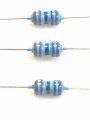
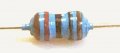
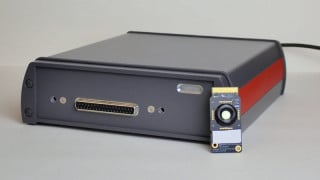
Assuming I'm getting the colors right and that they are, from left-to-right in the photo:

Brown-Red-Black-Black-Brown

Then it is likely a 1% resistor (indicated by the final band, in either direction, being brown).

If read from the left, it's a 120 Ω resistor, if read from the right, it's a 10 kΩ resistor. Both are standard values, which is the usual way to break the tie.

The only way to possibly distinguish the two (without performing some kind of measurement) would be based on the relative spacing or which end of the resistor the bands are closer to. In this case the two differences are small enough as to arguably just be coincidental and not by design.

Make a measurement. If you don't have a meter, get one. But lacking that, if you have an LED (just a typical red or green LED), a 1 kΩ resistor, and a 9 V battery. then connect the two resistors in series across the battery and put the LED in parallel with the unknown resistor (with the anode toward the positive end of the battery, of course). If it is 120 Ω, then the voltage across it without the LED would be about 1 V and not enough to light the LED. If it's 10 kΩ, the LED will get about 7 mA of current, which will be easy to see and yet not risk damaging it (unless it's a very low-current LED, in which case make the adjustment).
 

Thread Starter

ilkaydemirhan

Joined Dec 29, 2022
7
Thank you for your comments.

First I made a mistake, I hesitated between 10K or 120 Ohm.

I have a multimeter, but I know color codes are indicator of resistors. If this five-band resistor causes a wrong reading, I think there is no point in using a color code. If I knew the manufacturer of the resistors I would like to ask them.

It's pretty easy to identify the resistor in four-band resistors. I think there should be an easy method in five bands. By looking at the colors without using a multimeter.

Best regards,

ilkay
 

MrSalts

Joined Apr 2, 2020
2,767
What does the datasheet say? Who is the manufacturer? This type of paint job is common for unbranded resistors sold with no datasheet or technical information from sites like AliExpress, ebay or Amazon. Buy quality resistors and store them in labelled containers and you won't waste your own time or anyone else's. Otherwise, get a meter and measure them.

If they are old or used in warm electronics enclosures or exposed to sunlight/UV light, gray and browns can fade to purple, black can fade to gray, white can turn yellow and reds can fade to pink or white. Blue is fairly stable. Browns can also turn teal/greenish as the red component bleaches.
 

Thread Starter

ilkaydemirhan

Joined Dec 29, 2022
7
What does the datasheet say? Who is the manufacturer? This type of paint job is common for unbranded resistors sold with no datasheet or technical information from sites like AliExpress, ebay or Amazon. Buy quality resistors and store them in labelled containers and you won't waste your own time or anyone else's. Otherwise, get a meter and measure them.

If they are old or used in warm electronics enclosures or exposed to sunlight/UV light, gray and browns can fade to purple, black can fade to gray, white can turn yellow and reds can fade to pink or white. Blue is fairly stable. Browns can also turn teal/greenish as the red component bleaches.
Hi Dear,

You are right. I bought oscilloscope DIY kit on internet. These resistors were in the kit. Resistors have no datasheet or brand.

There is no other way to measure with a multimeter.

Best Regards,

ilkay.
 

Ian0

Joined Aug 7, 2020
13,097
I have some laser-marked 1206 resistors. They are labelled "2001" (2k), but you could turn them the other way round and then they say "1002" (10k) because the "2" is drawn with 180° rotational symmetry - so it's not just colour bands that confuse!
 

dl324

Joined Mar 30, 2015
18,220
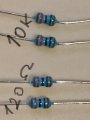
The top two resistors are 10K, the bottom two resistors are 120 Ohms. Colors are the same in both groups. From left to right brown-red-black-black-brown.
I would have read the bottom two as 10k because the brown band wasn't well positioned on the resistor body. There's no excuse for the first band to not be positioned properly.

Let me guess. These are cheap resistors manufactured in China...

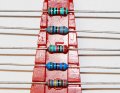
On most of the 5 band resistors I have, there's either a gap between the value bands and tolerance bands, or the tolerance band uses a different line style (thicker).

I'll post some examples later.

EDIT: Examples.
resistorBands.jpg
On the 5 band resistors, there's a gap between the tolerance band. On the 6 band resistors, either the tolerance or tempco band is wider than the rest.

These are 1/4W resistors and the OP's look to be 1/8W. That's still no excuse for making the bands difficult to read.
 
Last edited:

Ian0

Joined Aug 7, 2020
13,097
Connect a red LED to a 3V battery via one of the resistors. If it lights brightly, it's 120Ω.
(The you can turn the resistor round so that it reads 10k, and it should be much dimmer)
 
Top