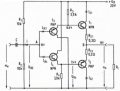
If R3 and R4 get bigger the current and the voltage over R3 and R4 drops right? But what about basic potential of T1? Its still 10,6V? And ua increases?
The effect is very small. The voltage is determined by the base-emitter forward voltage of T3 and T4. Hence the emitter of T3 is about 0.6 V above 10V (½ supply voltage) and the emitter of T4 is about 0.6V below 10V.
Not necessarily. Imagine a resistor connected across a battery. If you increase the resistance, does the voltage across the resistor drop? Now imagine it connected across a current source. If you increase the resistance, does the current through the resistor drop?
What happens depends on the interaction between the increased resistance and the circuit it is connected to.
But what about basic potential of T1? Its still 10,6V? And ua increases?

 Facebook
 Google
 GitHub
 Linkedin