Power Board Not Working After Resistor Change – Need Help

Thread Starter

zamangul442

Joined Jul 18, 2025
2
Hello experts,
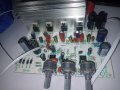
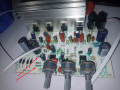
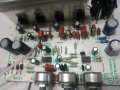
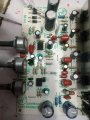
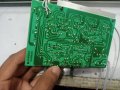
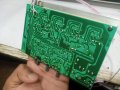
I replaced 2 resistors (560Ω) on a power board. After that, the board doesn’t power on, and there’s no response from the power LED. Please help me figure out what’s wrong. I have attached clear pictures below.
Thank you!
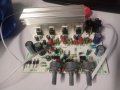
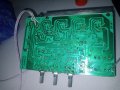
WhatsApp Image 2025-07-19 at 12.07.01 AM.jpeg
WhatsApp Image 2025-07-19 at 12.07.02 AM.jpeg
WhatsApp Image 2025-07-19 at 12.07.01 AM (1).jpeg

Moderators note : removed double pictures
 
Last edited by a moderator:

panic mode

Joined Oct 10, 2011
4,864
if the board was working before, what was the reason to replace some of the parts?
and you did not bother to show where the replaced parts were, or what they look like now. i am guessing it is these two (and you call that good image)
1752869535013.png
 

Thread Starter

zamangul442

Joined Jul 18, 2025
2
and you did not bother to show where the replaced parts were, or what they look like now. i am guessing it is these two (and you call that good image)
I have only one amplifier board, and I replaced only two resistors on one channel.


Both resistors were 560 ohms and were burned (black in color), so I replaced only those two with the same value resistors taken from another working amplifier.


After replacement, the amplifier powers on, but there is no audio output. The woofer and speaker just vibrate slightly but produce no sound or bass.


Note that the amplifier uses four TDA2030 ICs, and none of them are overheating or damaged. There was no blast, spark, or burning smell either.


The board is labeled 12+12V, but I am using a 15+15V 2A transformer. The shopkeeper told me it would work fine — and initially it did give a faint sound for a moment — but now there's only vibration from the speaker, no output.


Also, the resistors you marked were the same ones that had turned black, so I only changed those two.


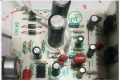
I will upload some HD close-up pictures for your reference — please have a look and guide me about the actual issue.


WhatsApp Image 2025-07-19 at 3.24.15 PM.jpegWhatsApp Image 2025-07-19 at 3.24.15 PM.jpegWhatsApp Image 2025-07-19 at 3.24.15 PM (1).jpegWhatsApp Image 2025-07-19 at 3.24.15 PM.jpegWhatsApp Image 2025-07-19 at 3.24.15 PM (1).jpegWhatsApp Image 2025-07-19 at 3.24.15 PM.jpegWhatsApp Image 2025-07-19 at 3.24.15 PM (1).jpegWhatsApp Image 2025-07-19 at 3.24.16 PM.jpegWhatsApp Image 2025-07-19 at 3.24.16 PM.jpegWhatsApp Image 2025-07-19 at 3.24.16 PM (1).jpegWhatsApp Image 2025-07-19 at 3.24.16 PM (1).jpeg
 

MisterBill2

Joined Jan 23, 2018
27,177
OK, now for some really bad new: Resistors do not burn up for "no reason." So you replaced the burned resistors that had protected some more expensive components by acting like fuses. Very seldom do components, especially resistors, burn up because they are defective. Some other part has failed in some manner causing excess current to flow. So additional checking is required. A very simple check is inspecting the larger capacitors to see if there is a bulge in the top, indicating failure.
Did you investigate to see what part had failed that caused the excess current in those two resistors?? Are you able to follow the circuit on the PCB to see what those two resistors connected to?? THAT would be a valid diagnostic procedure, if you had no circuit schematic to use.
 

Irving

Joined Jan 30, 2016
4,996
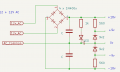
The resistors you changed feed the 9v zener diodes. This suggests the fault wasn't those resistors - they were collateral damage.

What test equipment do you have to hand? Assuming a multimeter, the first thing is to verify the supply voltages are OK. Here is the partial circuit diagram and where to test....
1752927688048.png
1752927206084.png
 
Last edited:

DickCappels

Joined Aug 21, 2008
10,661
The TDA2030 can cease to function without turning into a short, getting hot or otherwise indicating distress. Check the voltages around the TDA2030 including its input signal and output signal. The may well tell the story.
 

MisterBill2

Joined Jan 23, 2018
27,177
It might possibly be that, since the 18 volt supply is not regulated, that the higher load opened up and the voltage increased, burning the resistors. But more likely the 9 volt load drew too much current. Since both resistors burned that is believable. A short to common would cause the resistors to burn about 572 milliwatts, way too much for a quarter watt resistor.
 

Irving

Joined Jan 30, 2016
4,996
It might possibly be that, since the 18 volt supply is not regulated, that the higher load opened up and the voltage increased, burning the resistors. But more likely the 9 volt load drew too much current. Since both resistors burned that is believable. A short to common would cause the resistors to burn about 572 milliwatts, way too much for a quarter watt resistor.
But as yet no obvious reason for a short to ground on either 9v rail, and certainly not on both simultaneously. A 15-0-15v AC transformer would give +/- 20V on the main supply rails, which means the 9v dropper would be seeing around 219mW, enough to get warm but not char a 1/4W device IMHO. The diodes would experience around 180mW (400mW device) and no evidence of any issues. There's surprising little evidence on the PC of charring, I would have expected some discolouration of the screen printing.

More concerning is that 15-0-15 giving +/- 20v DC is the top supply limit for the TDA2040 amps. Recommended operation is <=34v.

Incidentally, the RH two amps are right & left tweeter drives, the LH two amps running as a bridge are the woofer driver.. The first RC4558 dual low-noise opamp is configured as a unity gain voltage follower after the input volume control (RH pot). The second opamp appears to be an active X-over filter.
 

MisterBill2

Joined Jan 23, 2018
27,177
It is also possible that with a different power transformer the supply voltage was too high and all of the amplifier modules are destroyed. That would explain everything. Is there any information on the voltages that are supposed to be present on the various terminals of TDA2030 amplifier ICs?? can the TS do actual voltage measurements?? I am guessing that the shopkeeper did not have any 12 volt transformers to sell, and so of course claimed the 15 volt one was OK to use.
 
Top