Replacing lead acid battery with lithium phosphate battery

Ya’akov

Joined Jan 27, 2019
10,226
Welcome to AAC.

It appears so, but the information on that battery is not very comprehensive. What is available makes it appear to be a drop-in replacement for a PbSO₄ AGM or similar battery of the type used in UPSs. Your best course is to contact the manufacturer and ask directly.
 

MrAl

Joined Jun 17, 2014
13,680
Can I replace my UPS 12V/7 Ah (lead acid) battery with a 12 V/12 ah (lithium phosphate) battery?
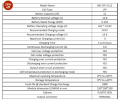
I have attached the battery specifications below..
Hello,

This is not a good idea at all and there are a number of reasons.

First, a lead acid battery has completely a different iv charging profile than a lithium battery of any type.
Second, the loading factors are different also. Lead acid can handle a higher current than most lithium batteries.

Also, some lead acid battery profiles are 4 stage made just for lead acid alone, and one stage could be to desulfate the lead acid battery. Using that kind of charge method could damage the lithium battery maybe worse.
A lead acid battery charger will usually use a constant voltage scheme too while a lithium charger would use constant current followed by constant voltage. That means for one that the lead acid charger could put out more current than the lithium battery is supposed to receive.

What happens depends highly on how they designed the lead acid charging circuit. That's one reason why this type of swap is discouraged.

As far as the loading, it depends how much of a load the UPS puts on the battery when operating at full load. If it's higher than the max rating of the lithium battery it could easily damage it.

If you do decide to try this anyway, you better be very careful. Maybe make some measurements of current into and out of the battery with a clamp on current meter that can do DC as well as AC, and measure the voltage with a lead acid battery and a lithium battery.
But heck, the charging circuit may actually reject the lithium battery and never charge it, or the UPS may detect a fault with the battery and never auto switch into UPS power mode.

As a final note, decent chargers made for both lead acid and lithium LiFePO4 batteries have a 'mode' switch. To charge LA batteries you switch it to the lead acid mode, and to charge LiFePO4 you switch it to the LiFePO4 mode. That's even with just a 2 amp maximum output current from the charger, so it's not just the current that matters.

Also, the lithium battery is not going to like being trickle charged like a lead acid battery either :)
 
Last edited:

Ya’akov

Joined Jan 27, 2019
10,226
Hello,

This is not a good idea at all and there are a number of reasons.

First, a lead acid battery has completely a different iv charging profile than a lithium battery of any type.
Second, the loading factors are different also. Lead acid can handle a higher current than most lithium batteries.

Also, some lead acid battery profiles are 4 stage made just for lead acid alone, and one stage could be to desulfate the lead acid battery. Using that kind of charge method could damage the lithium battery maybe worse.
A lead acid battery charger will usually use a constant voltage scheme too while a lithium charger would use constant current followed by constant voltage. That means for one that the lead acid charger could put out more current than the lithium battery is supposed to receive.

What happens depends highly on how they designed the lead acid charging circuit. That's one reason why this type of swap is discouraged.

As far as the loading, it depends how much of a load the UPS puts on the battery when operating at full load. If it's higher than the max rating of the lithium battery it could easily damage it.

If you do decide to try this anyway, you better be very careful. Maybe make some measurements of current into and out of the battery with a clamp on current meter that can do DC as well as AC, and measure the voltage with a lead acid battery and a lithium battery.
But heck, the charging circuit may actually reject the lithium battery and never charge it, or the UPS may detect a fault with the battery and never auto switch into UPS power mode.

As a final note, decent chargers made for both lead acid and lithium LiFePO4 batteries have a 'mode' switch. To charge LA batteries you switch it to the lead acid mode, and to charge LiFePO4 you switch it to the LiFePO4 mode. That's even with just a 2 amp maximum output current from the charger, so it's not just the current that matters.

Also, the lithium battery is not going to like being trickle charged like a lead acid battery either :)
All indications are this particular battery is one of the many designed as a drop-in replacement for SLA types. That have an internal BMS, with over- and under- voltage and current protection and balancing. They present all the expected parameters of a 12V PbSO₄ battery in order to make them compatible with existing equipment.
 

Ian0

Joined Aug 7, 2020
13,112
Think of the environment. Lead-acid batteries are 99% recyclable. Lithium batteries end up in landfill where they corrode, leach toxic chemicals start fires. Unless weight is a concern, keep to lead acid.
 

Ya’akov

Joined Jan 27, 2019
10,226
Think of the environment. Lead-acid batteries are 99% recyclable. Lithium batteries end up in landfill where they corrode, leach toxic chemicals start fires. Unless weight is a concern, keep to lead acid.
Valic concern, but just picking a nit—the LiFeP0₄ batteries are at least not a fire hazard.
 

MrAl

Joined Jun 17, 2014
13,680
All indications are this particular battery is one of the many designed as a drop-in replacement for SLA types. That have an internal BMS, with over- and under- voltage and current protection and balancing. They present all the expected parameters of a 12V PbSO₄ battery in order to make them compatible with existing equipment.
Hi there and thanks for the reply.

Yes the BMS is good for protection I have to agree fully with that and I am glad you brought that up because I forgot to mention it.

What I suspect could happen though is that the inverter/converter would try to draw too much current from the battery and the BMS would shut the battery down. That would be considered one of the 'fault' detections I mentioned. That would be a big problem because we would be expecting the unit to keep the equipment going while it would actually drop everything out unexpectedly.

Note this is just a suspicion though, I cannot prove this without testing the unit(s) myself.
One thing I did like to hear was that the new battery would be 12AHr as compared to the old 7 or 8AHr battery, which means it may do OK with a little more of a current draw. I hope it does I'd like to see this work too.

There is one more little problem though associated with LA to Li conversions, and that is the issue of the attainable charge level using an LA charger to charge Li chemistries. I have read (not tested, yet) that an LA charger will not charge an Li battery to a full charge. How much difference this is I don't have any numbers on yet though, and I did not test it. I may attempt this test soon as I think it would be interesting. Anyway, the degree of actual charge and how it affects things like impedance and just the general success of the operation of the UPS does come into question and this would have to be answered. If he does decide to try it though it would be interesting to find out how it works out in practice and over a long time period.

If it was me though I would just go with another LA battery because without testing or reading a lot of technical publications we can be reasonably sure it will work again and I would assume for a decent amount of time. I do realize however that if we could get this to work every time it would be almost like a boom to UPS technology because the batteries, for one, are much lighter than LA types. That's very convenient when you have to carry these things around :) Also, the cycle life is much longer if the spec's for charging and discharging are observed.

After reading your reply now I kind of hope he tries it so we can learn from this. I have a UPS that I rely on too and would love to see the weight reduced by something like 3 times (I think that's the right factor).

Oh one thing more I should mention. I read an article made by a battery company that said that using an Li battery in an LA application is frowned upon. Funny though, on the sales page they said they have an "LiFePO4 drop in replacement" for an LA battery. So they don't want to see people using them for LA, but they don't mind selling them for use for replacing LA (ha ha).
Maybe what this tells us is that they could work, just maybe not as well as we would like to see them work.
 
Top