There's nothing wrong with LM741. You just know when/how to use them. Tektronix used them in a lot of their equipment and only used "better" opamps when necessary.
In your case, you're using the LM741 in an inappropriate way. It doesn't work well with a single supply because the input can only be within 2-3 volts of the rails and the output is similarly constrained. And opamps make for slow comparators.
LM393 is a comparator that was designed to allow its input and output include ground. Comparators always make better comparators than opamps. You can use a comparator as an opamp, but it'll be slow and doesn't have built-in frequency compensation.
There's nothing wrong with LM741. You just know when/how to use them. Tektronix used them in a lot of their equipment and only used "better" opamps when necessary.
In your case, you're using the LM741 in an inappropriate way. It doesn't work well with a single supply because the input can only be within 2-3 volts of the rails and the output is similarly constrained. And opamps make for slow comparators.
LM393 is a comparator that was designed to allow its input and output include ground. Comparators always make better comparators than opamps. You can use a comparator as an opamp, but it'll be slow and doesn't have built-in frequency compensation.
I imagine there are members bashing LM741 (I don't read all posts). I have dozens of LM741 and I snatch them up whenever I see them at swap meets and such because I might need them to repair my vintage Tektronix equipment. The last batch I got came from a well-known guy (in Tektronix circles) who used to work at Tektronix.
The 741 was a terrific opamp in its heyday and people would pay several dollars each. I wish I had designed it...
One caution if you use the LM393 comparator. I think it is an open collector device and so it will need a resistor from the output pin to the V+ source. And probably the connections are different from the 741. AND, also, it will need the power connections.
All I'm trying to do is amplify the 1.5 volt signal from the walkie talkie receiver to a 12volt signal in order to activate the automotive relay. Isn't there a basic transistor amplifier schematic I can use for this?
Feel like this is pretty simple. I'm just a nooby looking for guidance.
All I'm trying to do is amplify the 1.5 volt signal from the walkie talkie receiver to a 12volt signal in order to activate the automotive relay. Isn't there a basic transistor amplifier schematic I can use for this?
All I'm trying to do is amplify the 1.5 volt signal from the walkie talkie receiver to a 12volt signal in order to activate the automotive relay. Isn't there a basic transistor amplifier schematic I can use for this?
Yes. This is a 1-transistor project. Let's reboot.
Three things:
1. Relay coil data. Voltage / Current / Wattage / whatever. And a link to a product page, datasheet, etc.
2. Receiver output voltage - where is this coming from? Earphone jack, internal speaker, other? Also, voltage range. If 1.5 V is the "On" condition, what is the voltage in the "Off" condition? And are the voltages DC, AC, pulses, - ?
3. Note that there ae radio control transmitter/receiver sets on ebay for under $10.
Yes. This is a 1-transistor project. Let's reboot.
Three things:
1. Relay coil data. Voltage / Current / Wattage / whatever. And a link to a product page, datasheet, etc.
2. Receiver output voltage - where is this coming from? Earphone jack, internal speaker, other? Also, voltage range. If 1.5 V is the "On" condition, what is the voltage in the "Off" condition? And are the voltages DC, AC, pulses, - ?
3. Note that there ae radio control transmitter/receiver sets on ebay for under $10.
Ok sounds good. So I am taking AC from the two wires that used to be connected to the speaker of the receiver. With the "call" button held down on the transmitter the wires read 1.5 volts AC. When I release the call button on the transmitter, the voltage drops to 0.
Below is a link to the data sheet and attached is a picture of the relay's basic info.
The LM393 dual comparator has a weak output current. Its minimum output current is only 6mA with a 1.5V voltage loss. The selected relay coil needs 133mA at 12V but an ordinary transistor needs an input current of 13.3mA to saturate then some LM393 ICs cannot do it.
It will work with ALL LM393 ICs if the transistor is replaced with an NPN darlington transistor.
other comparators are able to sink 16mA and that would work They are open collector devices and so a bit of adjustment to the circuit will be required Like using a PNP transistor.
Can you measure the resistance of the radio's speaker?
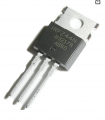
Do you have access to an n-channel MOSFET such as a 2N7000, an IRLZ44, or something in-between?
Here's the fun part: Can you measure the AC voltage out of the radio with the speaker disconnected, and the speaker wires connected to a 10K resistor? The voltage might be significantly larger without the dpeaker attached, possible large enough to drive a logic-level MOSFET through a voltage doubler. 2 diodes, 2 capacitors, no opamp of comparator IC.
Can you measure the resistance of the radio's speaker?
Do you have access to an n-channel MOSFET such as a 2N7000, an IRLZ44, or something in-between?
Here's the fun part: Can you measure the AC voltage out of the radio with the speaker disconnected, and the speaker wires connected to a 10K resistor? The voltage might be significantly larger without the dpeaker attached, possible large enough to drive a logic-level MOSFET through a voltage doubler. 2 diodes, 2 capacitors, no opamp of comparator IC.
Speaker is 7.5 Ohms. Signal from speaker wires when disconnected is 1.5VAC and then with a 10K resistor it is .8 VAC. And I just got a bag of Z44N's. What do you think?
REally, you do not need a comparator in the circuit at all. Use a two transistor direct coupled darlington circuit, or a darlington transistor, like the MPSA1`3. Use the diode rectifier as shown in the post #1 circuit, except with a capacitor in series with the diode. Then change the 100 ohm resostor to a 1000 ohm resistor, and that can feed the base of the transistor directly. Then the collector of the transistor will connect to the bottom of the relay coil, with the +12 volts on the top. AND no need tor that diode across the relay because neither turn on nor turn off will be fast. The added benefit will be no standby current load from the relay interface driver circuit.
That's pretty much where I'm headed, but without knowing the peak signal voltage it is not clear that the a Darlington or FET transistor ever will conduct.
If it's 2N7000, be aware they're very easily damaged by ESD. Even when I thought I was handling them properly, I managed to damage several in the past 5 years or so. Sadly, they didn't fail outright and it took longer than it should have to determine that they were damaged.
I've used an ESD strap more in the past few years than I had in the several decades prior combined.
Even with the speaker removed, the receiver output voltage could be as low as 1.5 Vrms, or 2.1 Vpeak. That's enough to drive a darlington, probably more reliably than driving a FET. Things get worse when you add an input rectifier diode. Things get better if that diode is part of a rectifying charge pump ("voltage doubler"). Because the diode Vf (0.7 V) is such a large percentage of the input Vpeak (2.1 V), the boost is only around 0.7 V, for about 2.8 Vp at the base of gate. Along with a filter capacitor as in posts #1, #2, and #3, this looks like a workable solution. I would go with a 600 mA bipolar or darlington rather than a 200 mA FET like the 2N7000.
But there is another approach. If you drive the transistor base/gate with the input voltage directly, you get a rectified square wave across the relay coil because the transistor acts as an active rectifier. Put a hold-up capacitor across the coil, and you get the desired result.
Absent more information, let's assume the receiver signal is a 400 Hz sinewave. That is a 400 Hz squarewave across the relay coil, and the coil current is 133 mA. Using the quickie approximation for the desired capacitor size:
EC=it
C = it/E
The required capacitor size equals the discharge current times the discharge period, divided by the allowable voltage drop across the coil during discharge. Because the discharge voltage delta is less than 20% of the total voltage, this linear approximation works well because it is in the straightest part of what is overall an exponential curve.
Lets say that the 12 V coil voltage should not drop below 10 V, so E = 2 V. The off time of the squarewave is 1/2 cycle of the input, 1.25 ms, or 0.00125 seconds.
C = (0.133 x 0.00125) / 2 = 83 uF, rounding up to 100 uF. Interestingly, the same size capacitor as in the previous circuits. There is a lot of margin built into this value because the actual minimum operating voltage is 8.4 V, much less than the 10 V value used. The cap should be rated for 25 V to 100 V. As above, no coil suppression diode needed.
Even with the speaker removed, the receiver output voltage could be as low as 1.5 Vrms, or 2.1 Vpeak. That's enough to drive a darlington, probably more reliably than driving a FET. Things get worse when you add an input rectifier diode. Things get better if that diode is part of a rectifying charge pump ("voltage doubler"). Because the diode Vf (0.7 V) is such a large percentage of the input Vpeak (2.1 V), the boost is only around 0.7 V, for about 2.8 Vp at the base of gate. Along with a filter capacitor as in posts #1, #2, and #3, this looks like a workable solution. I would go with a 600 mA bipolar or darlington rather than a 200 mA FET like the 2N7000.
But there is another approach. If you drive the transistor base/gate with the input voltage directly, you get a rectified square wave across the relay coil because the transistor acts as an active rectifier. Put a hold-up capacitor across the coil, and you get the desired result.
Absent more information, let's assume the receiver signal is a 400 Hz sinewave. That is a 400 Hz squarewave across the relay coil, and the coil current is 133 mA. Using the quickie approximation for the desired capacitor size:
EC=it
C = it/E
The required capacitor size equals the discharge current times the discharge period, divided by the allowable voltage drop across the coil during discharge. Because the discharge voltage delta is less than 20% of the total voltage, this linear approximation works well because it is in the straightest part of what is overall an exponential curve.
Lets say that the 12 V coil voltage should not drop below 10 V, so E = 2 V. The off time of the squarewave is 1/2 cycle of the input, 1.25 ms, or 0.00125 seconds.
C = (0.133 x 0.00125) / 2 = 83 uF, rounding up to 100 uF. Interestingly, the same size capacitor as in the previous circuits. There is a lot of margin built into this value because the actual minimum operating voltage is 8.4 V, much less than the 10 V value used. The cap should be rated for 25 V to 100 V. As above, no coil suppression diode needed.
Speaker is 7.5 Ohms. Signal from speaker wires when disconnected is 1.5VAC and then with a 10K resistor it is .8 VAC. And I just got a bag of Z44N's. What do you think?

 Facebook
 Google
 GitHub
 Linkedin